


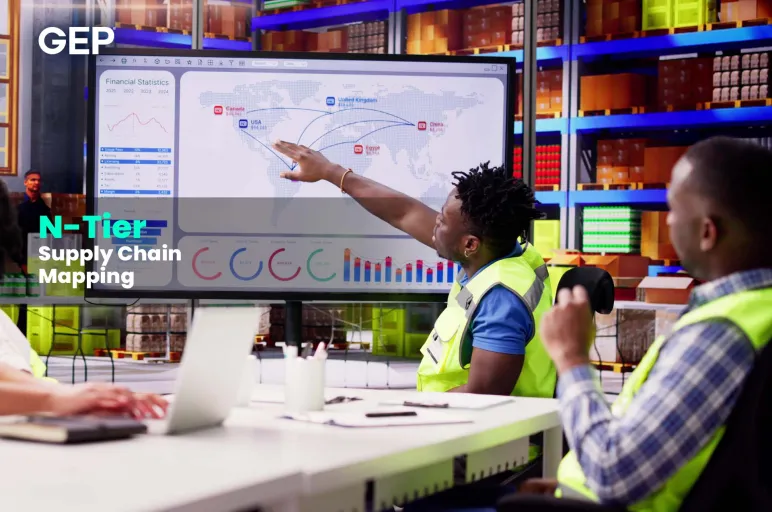
Mapping the N-Tier Supply Base: Intercepting Tier-2 and Tier-3 Risk Before It Reaches You
- The most damaging supply chain disruptions originate at Tier-2 and Tier-3 nodes that buyers have never assessed.
- Dual-sourcing at Tier 1 is an illusion of safety when both suppliers rely on the same hidden upstream source. N-tier mapping exposes these shared chokepoints.
- AI-driven monitoring turns the supply map into an early-warning system, giving procurement weeks of lead time to act before sub-tier events reach production.
July 21, 2026 | Supplier Management Strategy 5 minutes read
Most enterprises know their direct suppliers well. Far fewer can name the suppliers behind those suppliers — the raw material processors, component makers, and logistics intermediaries whose failure can halt production just as surely as a Tier-1 default. N-tier mapping closes that blind spot, turning an opaque upstream network into a visible, monitorable asset.
What is N-Tier Supply Chain Mapping?
N-tier supply chain mapping is the practice of identifying and documenting the full network of suppliers beyond direct (Tier-1) partners — the Tier-2 suppliers who serve them, the Tier-3 suppliers behind those, and so on down to raw materials. The output is a living map of entities, sites, materials, and dependencies that shows how value actually flows into your products. Unlike a static supplier list, an n-tier map captures relationships: which sub-tier facility feeds which Tier-1 line, which components share a common upstream source, and where geographic or ownership concentrations sit hidden below the surface.
Sub-Tier Visibility Is Just the Start
Discover the 4 strategic imperatives every procurement and supply chain leader must act on in 2026
Why the Biggest Supply Chain Disruptions Originate Beyond Tier 1
History keeps proving the point. The 2011 Tōhoku earthquake crippled automakers not through their assemblers but through a single Tier-3 microcontroller and pigment supplier. Pandemic-era semiconductor shortages, the Suez blockage, and regional conflicts all propagated upward from sub-tier nodes buyers had never assessed. The reason is structural: risk concentrates upstream. Dozens of Tier-1 suppliers may quietly depend on one specialty chemical plant, one foundry, or one port. Because these nodes are invisible to the buyer, they carry no mitigation plans, no monitoring, and no contractual protection — which is precisely why disruptions there hit hardest and last longest.
Identifying Hidden Concentration Risks and Single Points of Failure
Dual-sourcing at Tier 1 creates an illusion of resilience if both suppliers buy from the same Tier-2 source — a phenomenon known as hidden concentration or the "diamond structure." Effective mapping surfaces these chokepoints by cross-referencing bills of materials, supplier disclosures, customs and shipment data, and site-level intelligence. The analysis should flag: single qualified sources for critical inputs, geographic clustering of sub-tier sites in one region or seismic/flood zone, common ownership across seemingly independent suppliers, and long requalification lead times that make substitution slow even when alternatives exist.
How to Incentivize Upstream Supplier Transparency
Tier-1 suppliers often resist disclosure, fearing disintermediation or loss of pricing leverage. And overcoming this calls for a mix of contract, trust, and value exchange. Embed mapping obligations in contracts and supplier codes of conduct, but pair them with confidentiality protections. Many platforms let suppliers disclose to a neutral system without revealing commercial identities to the buyer.
Offer reciprocity: share risk alerts, demand forecasts, and financing support with transparent suppliers. Weight transparency in supplier scorecards and award decisions so disclosure becomes commercially advantageous. Regulatory tailwinds (such as CSDDD, an EU-wide directive; LkSG, Germany’s Supply Chain Due Diligence Act) also give buyers legitimate, non-negotiable grounds to require sub-tier data.
The Operational Framework for Mapping Tier-2 and Tier-3 Networks
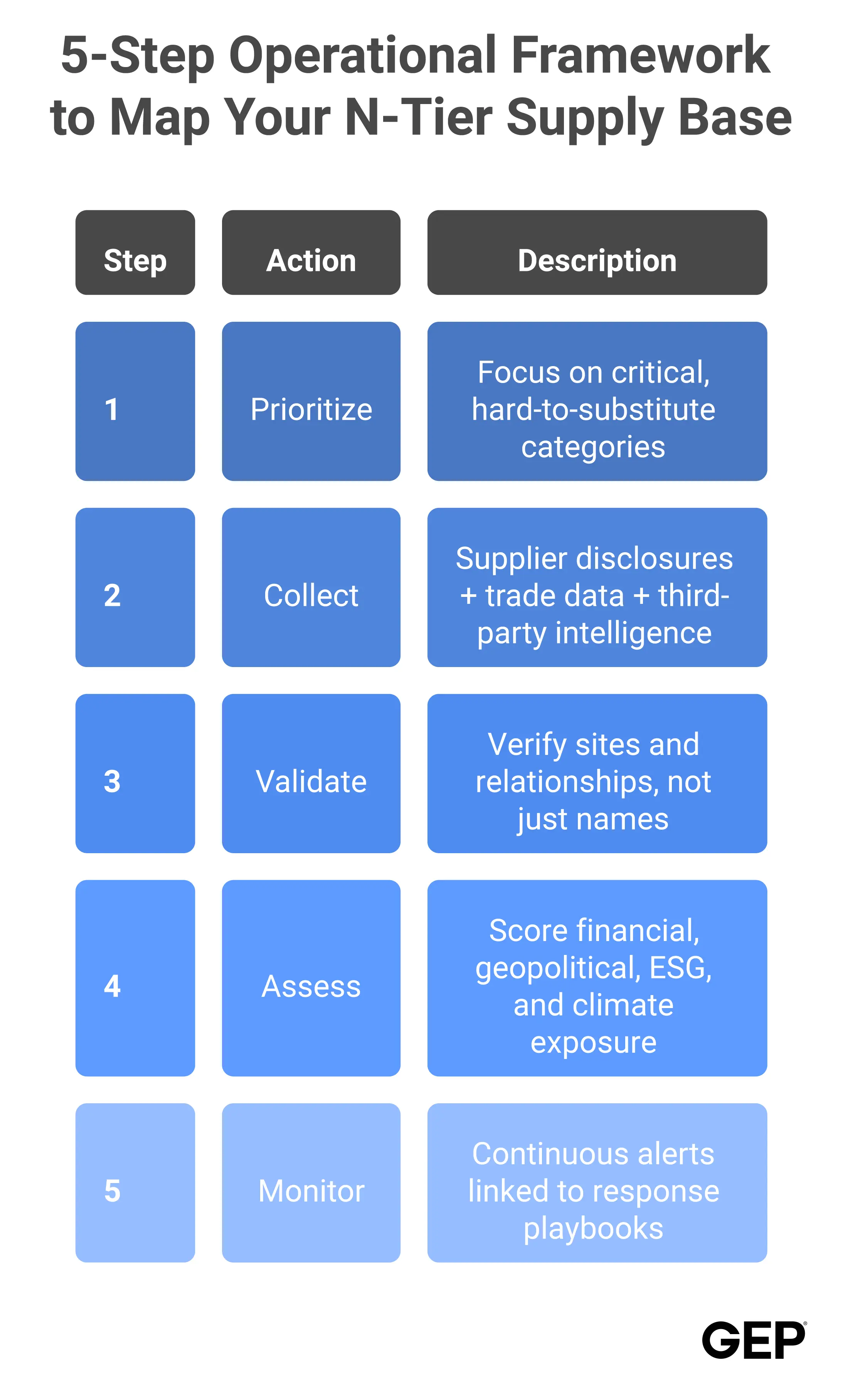
Mapping everything at once fails. A workable framework should include the following:
- Prioritize segment spend and select critical categories by revenue impact and substitutability.
- Collect supplier-declared data, third-party databases, trade records, and AI-driven entity resolution.
- Validate, triangulate sources and verify sites, not just corporate names.
- Do an assessment. Score each node for financial, geopolitical, ESG, cyber, and climate exposure.
- Monitor and act. Connect the map to event monitoring and playbooks, and refresh it continuously as sourcing shifts.
Let's simplify the above-mentioned points with an easy-to-follow infographic for your quick reference.
Leveraging AI and Predictive Intelligence to Detect Sub-Tier Signals in Real Time
AI transforms mapping from a one-time project into a sensing capability. Machine learning infers likely sub-tier relationships from shipping manifests, financial filings, and network patterns. Natural language processing scans news, sanctions lists, and local-language media for early distress signals — layoffs, litigation, factory incidents — at mapped sub-tier sites. Predictive models then estimate propagation: which Tier-1 suppliers, SKUs, and revenue streams a Tier-3 event will touch, and when. The result is lead time measured in weeks instead of discovering impact when a shipment fails to arrive.
Are fragmented systems and blind spots affecting your supplier monitoring?
See how procurement software with embedded AI agents can result in stronger supplier performance
Integrating N-Tier Risk Insights into Procurement Decision-Making
Visibility only matters if it changes decisions. Feed sub-tier risk scores into sourcing events so that awards reflect network resilience, not just unit price. Leverage concentration insights to justify dual-sourcing, buffer inventory, or nearshoring for genuinely exposed inputs. Build risk clauses and disclosure requirements into new contracts, and brief category managers with node-level intelligence before negotiations.
Over time, N-tier insight becomes a standing input to category strategy, shifting procurement from reactive firefighting to designed-in resilience.
Explore GEP’s AI Supply Chain Management Software


FAQs
Tier-1 suppliers sell directly to your company; Tier-2 suppliers supply your Tier-1s; Tier-3 suppliers supply the Tier-2s, typically providing raw materials or basic components further upstream.
Combine contractual disclosure requirements with confidentiality safeguards, cite regulatory mandates like the EU-wide directive Corporate Sustainability Due Diligence Directive (CSDDD), and reward transparency through scorecards, shared risk intelligence, and preferential award consideration.
Hidden concentration occurs when multiple Tier-1 suppliers depend on the same sub-tier source. Both of your "independent" suppliers could fail together if that shared Tier-2 node is disrupted, nullifying dual-sourcing.
AI infers sub-tier relationships from trade and financial data, scans global news for distress signals at mapped sites, and predicts how upstream events will propagate to your products and revenue.
These laws require due diligence across the full value chain, not just direct suppliers. N-tier maps provide auditable evidence of upstream identification, risk assessment, and remediation that regulators demand.