


Make Markets Move in Your Favor: Modernizing CPG Procurement in 2026 with Agentic AI
- No AI investment will deliver value on top of fragmented infrastructure. Build a centralized data foundation that is connected, clean, and well-integrated.
- Agentic AI is emerging as 2026’s best bet for CPG procurement. It’s not just for handling routine tasks but also for self-learning and making autonomous decisions in real time.
May 18, 2026 | Procurement Strategy 8 minutes read
Supply chains never fail due to bad luck. They fail due to poor planning and, even worse, poorly executed last-minute plans. In CPG procurement, leaders need to address market challenges with the strategic intelligence only modern AI-driven platforms can provide.
Consumer Packed Goods (CPG) procurement is the function responsible for sourcing the materials, services, and partnerships that CPG companies depend on to produce and deliver products at scale.
The CPG industry is uniquely exposed to volatility. From raw -ingredient pricing tied to weather and geopolitics to packaging -material shortages and labor disruptions, CPG procurement sits at the center of enterprise risk.
Today, it operates far beyond a transactional cost-control role and is now a strategic function that directly influences margin, supply chain resilience, ESG accountability, and speed to market.
Let’s deep dive into what CPG procurement looks like in 2026, the top challenges you're likely navigating, trends shaping its next chapter, and AI-native to help you lead from the front.
Bring Speed and Stability to CPG Procurement
Build a procurement function that adapts to market shifts quickly
Rethinking CPG Procurement for a High-Risk, High-Opportunity Global Market
In the CPG industry, the margin for error is razor-thin. One shift in consumer sentiment, a viral trend that flips purchase decisions overnight, or a single compliance violation can unravel months of planning, and almost always leaves procurement teams scrambling to absorb the shock.
For organizations operating across global markets, the stakes are high and can compound quickly. CPG procurement leaders are managing multi-tier supplier networks across continents, navigating real-time commodity price swings, and responding to a regulatory environment that grows more complex each quarter.
On the flip side, global consumers are increasingly making purchase decisions based on values like sustainability, transparency, and ethical sourcing. CPG and retail companies are now held accountable for supply chain integrity in ways that weren't five years ago.
Direct vs. Indirect Procurement in CPG & What Actually Separates Them
In the CPG industry, both categories carry strategic weight.
Direct procurement covers everything that goes into the product itself (ingredients, raw materials, packaging). It is tightly coupled with demand planning and production continuity. Get it wrong, and you're dealing with stockouts and margin hits, fast.
Indirect procurement handles the operational infrastructure (marketing services, logistics vendors, IT, facilities, and professional services). Here, the damage is quieter, but it compounds as bloated overhead, vendor sprawl, and unmanaged contracts.
Both matter. The difference is just where the pain shows up. What's changed in 2026 is that cloud-native, AI-powered procurement software now gives you a unified view across both, so category managers aren't making high-stakes calls with half the picture.
Now, let's get into the challenges, the trends, and where AI fits in.
Can Procurement Cut Ratepayers' Electricity Costs?
See how utilities reduce cost pressure through smarter sourcing decisions
Why CPG Procurement Is Harder in 2026 Than It's Ever Been
2026 is when all the pressure CPG procurement has been absorbing for years finally arrives at once. Tariffs are unpredictable, consumers are unforgiving, suppliers are stretched, and the margin for error has never been thinner.
Let’s look at the five market forces challenging CPG procurement in detail.
1. Commodity Price Volatility and Supplier Risk
Agricultural inputs, petroleum-based packaging, currency swings, or geopolitical shocks can reprice your cost base overnight.
Most procurement teams are still responding with periodic category reviews and backward-looking spend data. By the time the analysis is ready, the margin hit has already landed.
What you actually need is an AI-driven risk model that continuously monitors upstream signals and triggers responses before the shock reaches your P&L.
2. Fragmented Data and the Absence of a Single Source of Truth
Data maturity is the first investment that makes everything else work.
Ask any CPG procurement leader what their biggest internal obstacle is, and you'll hear some version of the same answer: the data is everywhere and nowhere at once.
This fragmentation kills decision speed and makes accurate spend analysis, especially purchase price variance management, nearly impossible to trust. Without clean, connected data flowing across functions, your AI capabilities are only as intelligent as the siloed inputs you feed them.
3. Sustainability and Compliance Pressure
Regulatory and reputational pressure around sustainability is and will continue to accelerate. CPG companies face growing scrutiny from investors, retailers, and regulators over the environmental and social footprint of their supply chains.
Scope 3 emissions reporting, supplier diversity standards, and responsible sourcing requirements are moving from voluntary to mandatory in major markets.
Procurement is now the front line of compliance accountability. You must build structured supplier assessment and tracking into their workflows, as they operate with significant blind spots that will eventually surface in audits or in public discourse.
4. Supplier Relationship Management at Scale
Most CPG procurement organizations manage hundreds of supplier relationships across categories, geographies, and contract types. The complexity of maintaining performance visibility, managing renewals, tracking compliance, and negotiating proactively at that scale is humanly impossible without digital support.
Suppliers that aren't properly measuring performance declines miss out on price-creep and consolidation opportunities. AI-enabled supplier management intelligence changes the math entirely, giving category managers a level of oversight that was previously unreachable.
5. The Slow Adoption of Agentic AI Capabilities
In CPG procurement, the organization that waits for a human to read a report before acting is already behind. Most teams are still using AI the way early explorers used maps. It may be useful, but it always describes terrain that's already changed.
The real frontier is agentic AI: systems that don't wait to be asked. They sense anomalies, trigger workflows, update cost models, and escalate decisions autonomously and continuously, at a speed no human team can match.
Five Trends Every CPG Procurement Leader Is Building On in 2026
For CPG procurement leaders, trends aren't just market intelligence. They're a preview of the decisions that will define performance for the next three to five years.
Know what's shifting, why, and how to navigate it in your procurement strategy.
1. The Rise of Agentic AI Across the Procurement Lifecycle
Something is stirring inside the world's most advanced procurement operations. Quietly, persistently, without rest — AI agents are at work. They watch supplier performance the way a seasoned tracker reads a trail: nothing escapes notice.
A pricing anomaly surfaces at 2 am and is flagged before the market opens. A sourcing decision that once took days resolves in minutes. These systems don't need hand-holding or a weekly review meeting. They feed intelligence back into the business in real time, and the organizations that run them operate in an entirely different league.
Leaders who aren’t actively building toward autonomous AI orchestration, with an agentic AI procurement software that unifies your source-to-pay processes for both direct and indirect spend, will miss early opportunities for efficiency and strategic advantage.
2. Procurement-Finance Convergence
For years, procurement and finance operated like two departments speaking different languages. That wall is coming down. Leading CPG brands are now integrating spend forecasts, purchase price variance analysis, and optimization scenarios directly into their operating plans and rolling forecasts.
When a commodity spikes or a supplier fails, the financial impact gets modeled and presented to the board in hours. Not weeks. That speed changes everything.
It's a fundamentally different relationship with data, speed, and accountability, and is rapidly becoming the baseline expectation for enterprise procurement functions that want a seat at the strategic table.
3. Real-Time Scenario Planning and Hedging Intelligence
In the deepest ocean trenches, creatures have evolved to sense pressure changes long before the storm hits the surface. The best CPG procurement teams are artificially building that same instinct.
They're not waiting for a commodity spike to model the damage. They're running scenarios constantly: what happens to margins if a key ingredient jumps 15%? What if a critical packaging supplier goes dark? What if a new tariff regime rewrites the sourcing map overnight?
AI-driven forecasting, woven together with an integrated hedging strategy, makes this kind of anticipatory intelligence possible. And in 2026, it's no longer the exclusive territory of the largest global players.
Any organization willing to connect procurement inputs to financial outcomes can develop the same early-warning instincts. The question is whether you build them before the pressure hits, or after.
4. Sustainability-Led Supplier Qualification
Procurement's role in shaping a company's sustainability narrative is now impossible to overstate.
Sustainability criteria are moving into the core of supplier qualification and selection, not as a separate audit track, but as a primary scorecard dimension.
CPG brands serious about building resilient, responsible supply chains are embedding carbon footprint, water usage, labor standards, and traceability requirements directly into sourcing templates and contract frameworks.
5. Demand-Driven Procurement and Customer Experience Connection
Consumer expectations have never been more specific. The demand for personalized products, regional variants, and rapidly refreshed portfolios puts direct pressure on procurement to operate with shorter lead times and greater supplier flexibility.
Consumer loyalty now lives at the intersection of availability, quality, and speed, and procurement is a direct lever on all three. In 2026, the CPG procurement function shapes what the business can promise its customers.
What Must CPG Leaders Prioritize in 2026? Modernizing Procurement for a Disrupted Global Market
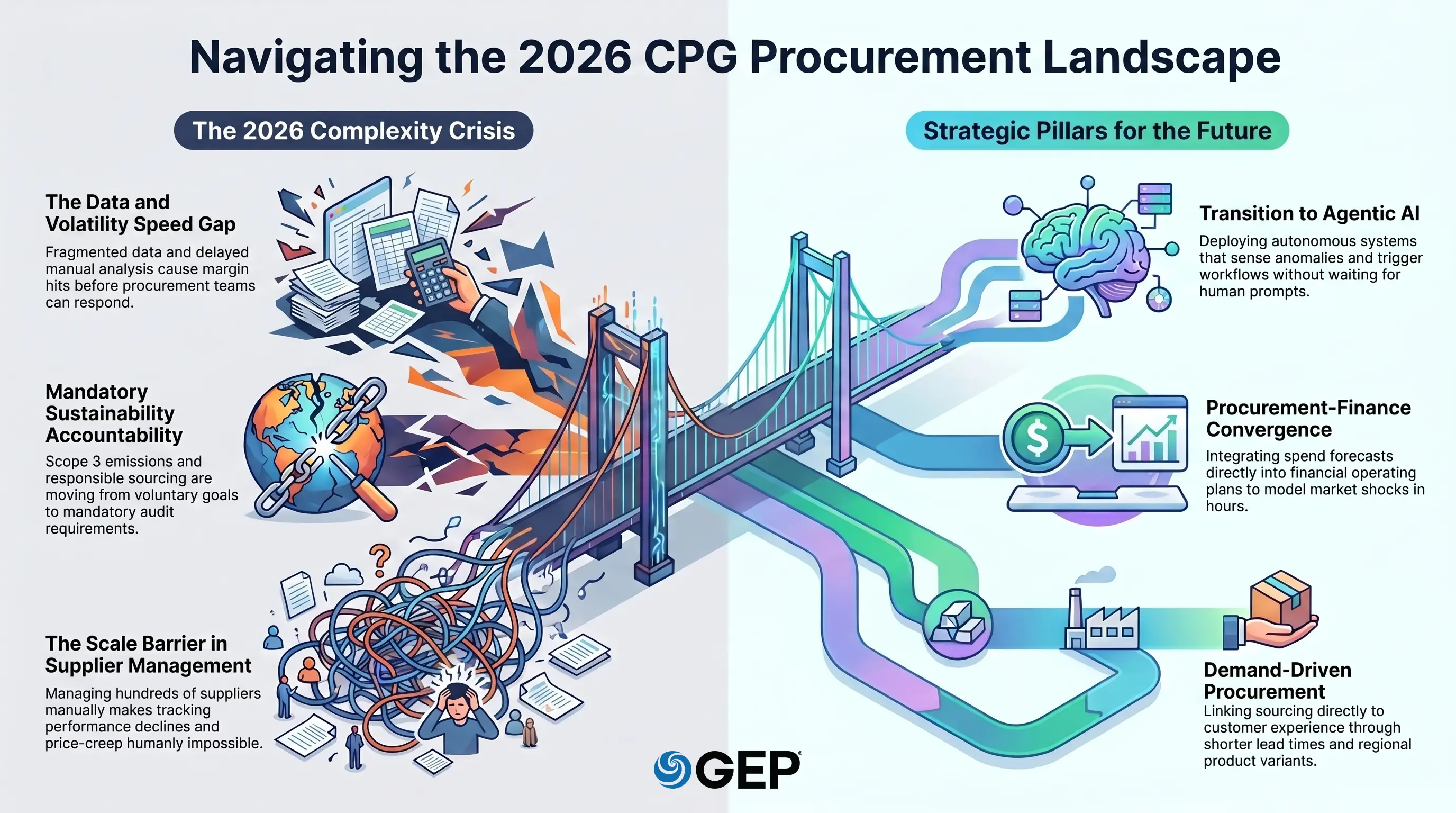
The convergence of AI capabilities, sustainability accountability, commodity volatility, and demand complexity has, for sure, added immense pressure on CPG leaders. But this has also created a window of opportunity for procurement leaders to outsmart their competitors in the complex, changing markets of 2026.
Procurement is undergoing the kind of quiet, irreversible transformation that reshapes entire ecosystems through a slow, compounding shift in how intelligence moves and decisions get made.
The reactive buying function is becoming extinct. In its place, something faster and more capable is emerging. An autonomous, AI-native procurement operation that doesn't wait for instructions, doesn't miss signals, and doesn't sleep.
The CPG procurement firms that adopt agentic AI will become the most adaptable and resilient. They’ll be the ones with the sharpest AI infrastructure, the cleanest data governance, and the ability to move at machine speed when the market demands it.
The window to build that capability is open.
Explore what an agentic AI-orchestrated procurement and supply chain platform can do for your procurement function before competitors beat you to the finish line.
Start building the AI infrastructure that 2026 demands. Consult an expert today.



FAQs
The most pressing challenges include commodity price volatility, fragmented data across procurement and finance functions, growing sustainability and compliance requirements, managing supplier relationships at scale, and the slow adoption of agentic AI capabilities. These challenges compound each other. Poor data makes risk management harder, which in turn makes compliance harder, slowing supplier qualification.
The most effective path is to build a connected planning infrastructure in which procurement data flows directly into financial forecasting, demand planning, and supply chain systems. Establishing a single source of truth for spend, pricing, and supplier performance, and using AI to automate the data connections, will win the long race.
Early procurement involvement in demand planning and portfolio decisions is equally important. Otherwise, as procurement gets pulled into decisions, it becomes more constrained in its ability to manage cost and risk effectively.
Direct procurement covers the raw materials, ingredients, and packaging that flow into finished products. When it fails, the pain is immediate: stalled production, margin erosion, empty shelves. Indirect procurement runs the business around the product, like agencies, logistics, IT, facilities, etc. Indirect procurement fails quietly. Bloated overhead, drifting vendor contracts, inefficiencies that compound before anyone notices. Same function, very different consequences, and both need AI-driven visibility to stay in control.
Good analytics stops surprises before they become crises. It models price variance before budgets lock, spots supplier risk before it disrupts, and benchmarks costs against live market data. The best CPG teams go further. They pair predictive analytics with agentic AI, so insights don't just inform decisions. They trigger them, automatically, before the window closes.