


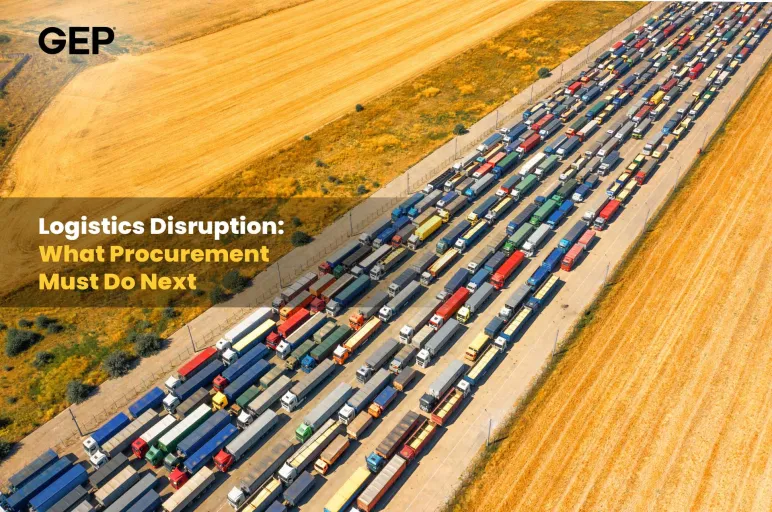
Port Congestion and Logistics Disruption in 2026: What's Breaking Down and What Procurement Must Do Next
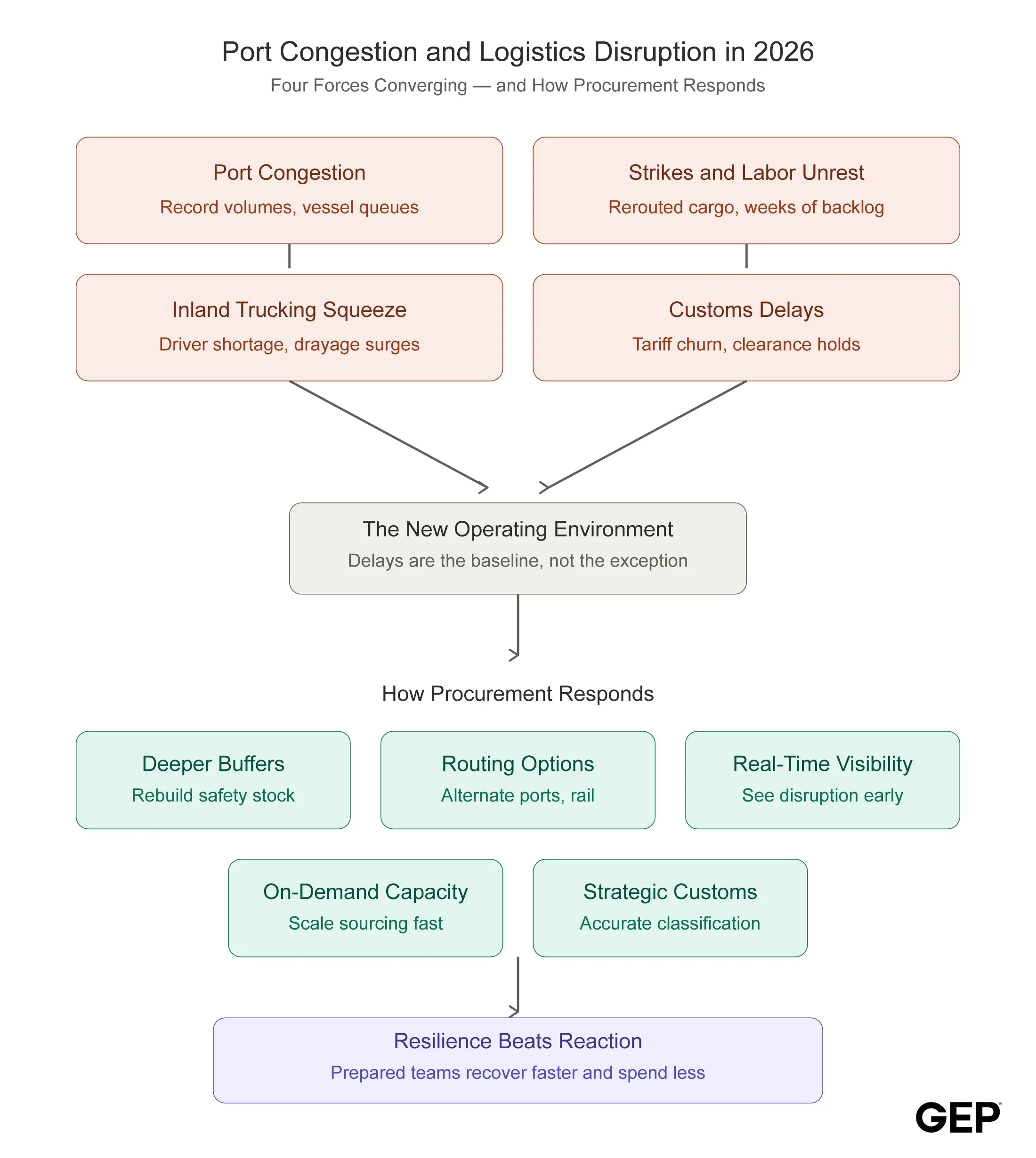
- Coordinated strikes, geopolitical shocks, and record cargo volumes have made delays a constant fixture of global supply chains.
- The actual bottleneck has quietly shifted inland, where trucking shortages and poor port-to-warehouse coordination cause as much damage as ocean freight delays.
- Teams that preemptively build alternative routing, buffer inventory, and invest in tools for better visibility get back on track and at significantly lower cost.
August 13, 2026 | Supply Chain Strategy 5 minutes read
Check the vessel tracking app on any given morning in 2026, and the story is familiar: ships queued outside Rotterdam, containers sitting in Savannah, a trucker somewhere waiting on a chassis that should've been available days ago. For procurement and supply chain teams, this isn't a crisis anymore. It's the operating environment.
Balancing cost, resilience, and agility is no longer a strategic aspiration. It's a week-to-week requirement.
What's Actually Behind Today's Port Congestion?
A lot of things — hitting at once.
Importers front-loaded shipments through late 2025 to beat anticipated tariff changes. Consumer demand recovered faster than terminal capacity could absorb. Rotterdam and Hamburg were each running vessel wait times of 3-7 days in Q1 2026, according to data from Portcast. New York and Savannah weren't far behind.
Then geopolitics piled on. Red Sea diversions rerouted vessels onto longer lanes, compressing berthing schedules and stranding equipment. A February 2026 attack on Ukrainian port infrastructure near Odesa (targeting freight wagons, warehouses, and rail facilities) led to tightened agricultural export capacity while knocking out local utilities, as reported by AFP News. European terminals, already carrying more than a year of compounding disruption, are still absorbing the weight.
The GEP Global Supply Chain Volatility Index
Get the latest intelligence on global supply chain volatility and anticipate risks before they impact your business
Strikes: Predictable, and Still Devastating
The ILA-USMX standoff kept U.S. East and Gulf Coast shippers in contingency mode through much of 2025 and into 2026. When those ports threaten stoppage, cargo reroutes to the West Coast, draining chassis pools, filling yards, and tightening driver availability.
The strike might last days; the recovery takes weeks.
Europe has followed a similar pattern. Belgium's Port of Antwerp was effectively shut during a national strike in late November 2025. Labor actions in Portugal and Greece earlier that year added to Mediterranean queue buildups. In early 2026, a coordinated 24-hour international strike hit multiple major ports simultaneously.
You can see these disruptions coming. Stopping the ripple effects is another matter entirely.
The Inland Leg Nobody's Talking About Enough
Much of 2026's worst disruption isn't happening on the water. It's happening in the few miles between the port gate and the warehouse dock.
When a congested terminal finally clears, the drayage surge runs straight into a trucking market that's already short more than 80,000 drivers, a deficit expected to worsen through the decade, according to the American Trucking Associations (ATA) Driver Shortage Report. A cleared port backlog can generate a secondary trucking bottleneck within 48 hours.
Rail has been a relative bright spot. German port connections into central Europe are outperforming road under current volumes. Cross-border northbound truck crossings from Mexico into the U.S. increased by 18.1% in the first nine months of 2024 compared to 2019, as nearshoring activity continues to accelerate, according to U.S. Bureau of Transportation Statistics (BTS). But as GEP has noted, the port-to-warehouse handoff remains one of the costliest and least coordinated segments of the supply chain, and it's where many procurement teams still have a blind spot.
Explore GEP’s AI-Native Procurement Software
Customs Delays: The Quiet Multiplier
Tariff volatility through 2025 flooded customs authorities with amended filings and reclassification requests they weren't staffed to absorb. Thomson Reuters reported that 82% of companies experienced supply chain impact from new tariffs, with 20–40% of their supply chain activity affected. Misclassified goods sit in secondary inspection. Incomplete documentation triggers holds. A two-day customs delay in an already tight network can be the variable that pauses a production line.
Supply chain management is now the top strategic priority for 68% of trade professionals, which is nearly double last year's figure. Customs complexity is a significant driver of that shift.
Looking for Ways to Protect Your Business from Disruptions
GEP can help you navigate the unpredictability and protect your margins with confidence
What Procurement Needs to Do Differently
Waiting for stability isn't a strategy. Here's what separates teams managing well from those playing catch-up:
Rebuild Your Safety Stock Model
Two to three weeks of buffer is no longer sufficient on congested lanes. Four to six weeks of cover for critical SKUs is the realistic minimum. Compare that cost against emergency air freight and stockouts — the math resolves quickly.
Pre-Qualify Routing Alternatives Now
If Rotterdam is your default, Hamburg and Antwerp should already be approved with your freight partner. Build rail optionality where it outperforms road.
Close the Visibility Gap
Gartner research is stark: only 7% of supply chain leaders can respond to disruptions in real time. Organizations without scenario-based stress testing take up to 30% longer to recover from major shocks.
Pull in On-Demand Procurement Capacity
GEP's disruption guidance makes this case directly. On-demand procurement services let teams expand sourcing capability, renegotiate timelines, and identify alternative suppliers faster than internal headcount alone can manage.
Treat Customs as a Strategic Function
Accurate harmonized system (HS) classification, maintained in real time, and proactive broker relationships aren't back-office tasks anymore. They're risk management.
Explore GEP’s Agentic AI Supply Chain Management Software built for modern supply chains.



FAQs
Port congestion occurs when cargo volume exceeds a terminal's processing capacity. For procurement, that means delayed inbound shipments, higher demurrage fees, and supply gaps that can force production slowdowns or emergency sourcing at premium cost. In 2026, congestion is more episodic than the sustained crises of 2021–22; shorter, but harder to predict and plan around.
Weather events typically resolve within one to two weeks. Labor disputes take longer: vessel queues can take two to four weeks to clear after a strike ends, with trucking and chassis shortages extending the impact further. When disruptions stack, normalization at major hubs has stretched past six weeks.
Direct costs here include demurrage and detention fees, emergency air freight premiums, and expediting charges. Indirect costs, including inventory imbalances, lost sales, and the operational drag of manual disruption management, are often larger and slower to surface.
Platforms combining real-time port data, geopolitical signals, and customs status enable teams to detect disruptions earlier and act before they escalate. Digital twins let organizations stress-test their networks against disruption scenarios in advance. According to Gartner, agentic AI in supply chain management software is projected to grow from under $2 billion in 2025 to $53 billion by 2030, with enterprise adoption rising from just 5% today to 60% within the same period.