


How do Procurement Consulting Services Improve Sourcing Strategies?
- Sourcing breaks down when visibility is poor, supplier reliance is unchecked, and decisions stay reactive instead of planned
- Procurement consulting fixes the foundation through clean data, category strategy, stronger supplier management, and better use of analytics
- The result is faster decisions, better-performing suppliers, and a sourcing strategy that actually holds up under disruption
April 08, 2026 | Procurement Strategy 5 minutes read
You have seen this before. Sourcing starts with good intent, then slowly turns reactive. Too many supplier relationships run on history instead of performance. Decisions get made with partial data. It feels messy, not because the team lacks capability, but because the structure is not built for how sourcing actually works today.
That is where procurement consulting services come in. They help you reset the foundation. Instead of chasing savings in cycles, you start building a sourcing approach that delivers consistently. Data becomes reliable. Decisions become sharper. Strategy starts to feel like strategy again.
With supply chain risk management now sitting firmly on leadership agendas, this is no longer a nice to have. It is a practical way to bring control and clarity back into procurement.
Challenges in Traditional Sourcing Strategies
Limited visibility across spend
You cannot fix what you cannot see clearly. When spend data sits across systems with inconsistent labels, it becomes hard to answer simple questions. Where is the money going? Which suppliers matter most? Where are the real opportunities?
Without that visibility, sourcing turns into educated guessing. Cost reduction opportunities slip through, and supplier consolidation rarely happens in a structured way.
Over reliance on incumbent suppliers
You probably have suppliers who have been around for years. They know your business, and that familiarity makes things easier. But it also reduces pressure to improve.
When the market is not tested regularly, competition drops. Innovation slows down. Negotiations lose their edge because there is no real benchmark to compare against.
Reactive sourcing instead of strategic planning
Sourcing often gets triggered by deadlines. A contract is about to expire, or a problem forces action. The response is quick, but not always thoughtful.
You end up solving for the moment rather than building something sustainable. A strong sourcing strategy should feel planned, not rushed.
Weak supplier management practices
Supplier management often becomes an afterthought once contracts are signed. Reviews are irregular, performance is not tracked consistently, and collaboration stays limited.
That means you are not really managing suppliers. You are just working with them. There is a big difference.
Difficulty managing supply chain risk
Recent disruptions have made one thing clear. Sourcing strategies are only as strong as their weakest link.
If risk is not tracked continuously, issues surface late. You end up reacting instead of responding with control. That is where many teams still struggle.
Role of Procurement Consulting Services in Improving Sourcing Strategies
Bringing clarity through spend analysis
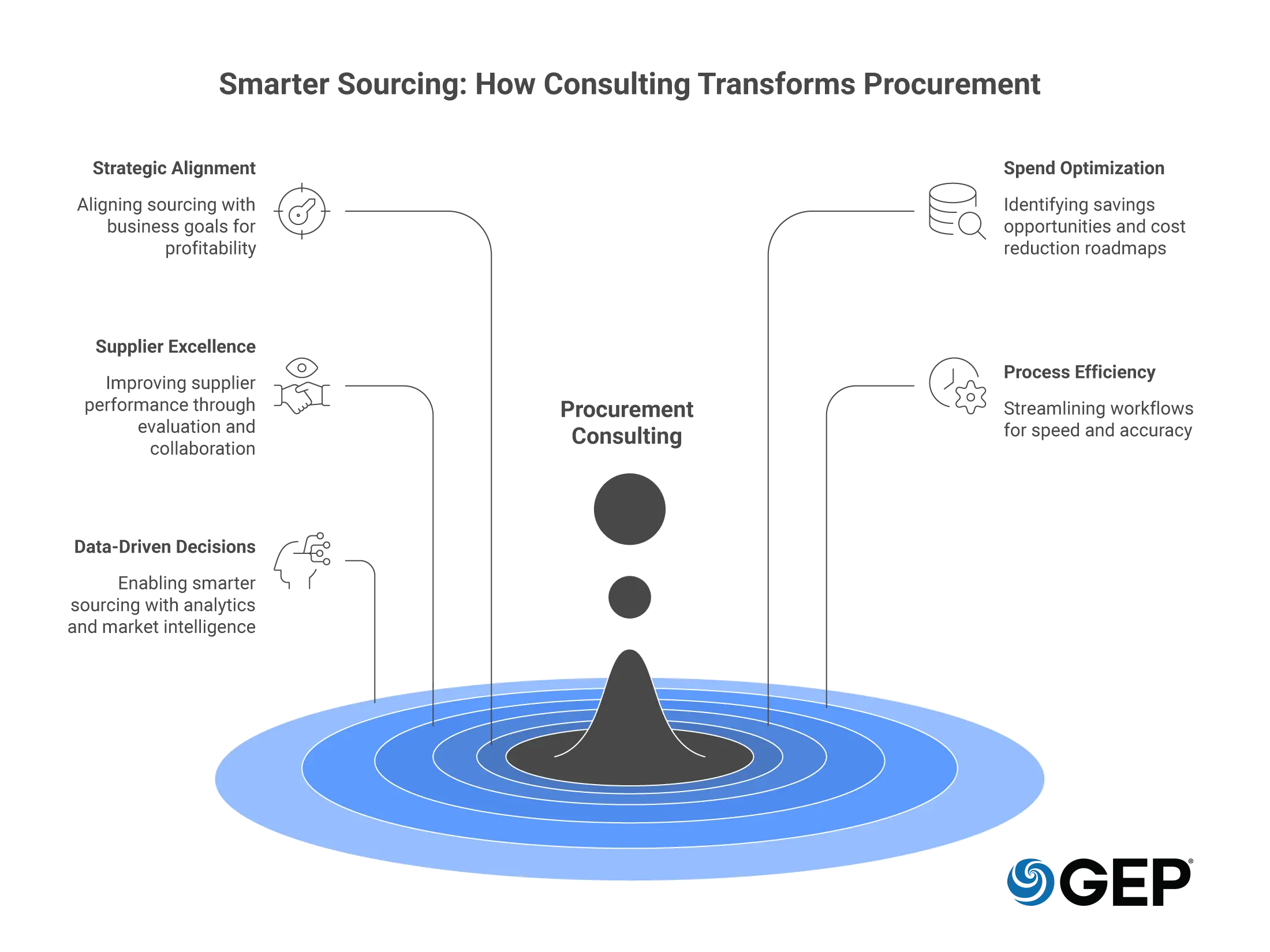
Consultants start by fixing the basics. Spend data is cleaned, structured, and organized so you can actually trust it.
Once that happens, patterns start to show up. You see where consolidation makes sense, where demand can be managed better, and where cost reduction is realistic rather than assumed.
Redesigning sourcing strategies by category
Category segmentation
Not every category needs the same approach. Some need tight supplier partnerships, others need competitive pressure.
Consultants help you segment categories properly, so each one gets a sourcing strategy that fits how it behaves in the market.
Market intelligence integration
You get an outside view of the market. Supplier benchmarks, pricing trends, and risk signals start feeding into your decisions.
This grounds your sourcing strategy in reality instead of internal assumptions.
Strengthening supplier management
Supplier performance frameworks
Supplier management becomes structured. Clear KPIs, regular reviews, and transparent scorecards give you a consistent way to evaluate performance.
You move from informal feedback to measurable outcomes.
Supplier collaboration and innovation
The relationship with key suppliers starts to evolve. Instead of focusing only on cost, you begin to look at value.
That could mean innovation, process improvements, or better resilience. The conversation changes, and so do the results.
Embedding digital tools and analytics
E sourcing and automation tools
Sourcing events become more organized and transparent. You can compare supplier bids properly and run processes that are consistent across categories.
This reduces manual effort and improves confidence in decisions.
Advanced analytics for decision-making
You start using data not just to report, but to decide. Demand patterns, risk indicators, and supplier performance all feed into better choices.
Decisions feel faster because they are backed by clarity.
Building internal capability
A good consulting engagement does not leave you dependent. It leaves you stronger.
Your team understands the processes, uses the tools confidently, and continues improving sourcing strategies over time.
Stay ahead of shifting spend dynamics across key categories.
Explore the GEP Spend Category Outlook to inform data driven decisions
Download Now
The Benefits of Using Procurement Consulting Services in Sourcing
You stop losing savings you cannot see
You already negotiate hard. That is not the problem. The real issue is how much value quietly slips through because demand is unmanaged, specs are inconsistent, or suppliers are not benchmarked regularly.
Consultants help you plug those gaps. Not by pushing harder negotiations, but by fixing how demand, pricing, and supplier performance are structured. That is where the real cost reduction shows up.
Your sourcing strategy actually works when things go wrong
A lot of sourcing strategies look fine on paper. Then a disruption hits and everything falls apart.
With the right consulting support, your sourcing approach is built with alternatives, risk visibility, and supplier depth already in place. So, when something breaks, you are not scrambling. You already know your next move.
Your suppliers start performing better
You probably have a mix of high-performing suppliers and ones you tolerate because replacing them feels painful.
Consultants reset that. Clear performance tracking, competitive pressure where needed, and proper segmentation mean suppliers know where they stand. That changes behavior fast. Service improves. Innovation shows up more often.
You make faster decisions with better data
One of the biggest hidden costs in procurement is slow decision-making. Not because people are slow, but because the data is messy or incomplete.
Once your spend is clean and analytics are in place, decisions stop dragging. You can see tradeoffs clearly and move faster without second guessing.
Unlocking the Full Potential of Your Sourcing Strategy
You know when sourcing is working well. It feels controlled, informed, and forward looking.
Procurement consulting services help you get there by fixing the structure behind the work. They bring clarity, discipline, and a more strategic approach to sourcing.
If the goal is to strengthen supplier management, drive cost reduction, and build sourcing strategies that can handle uncertainty, this is one of the most practical ways to move forward.
Explore how procurement consulting services can reshape sourcing outcomes here https://www.gep.com/strategy/procurement-consulting




FAQs
Procurement consultants bring structure to vendor selection, so decisions are not based on gut feel. You get clear criteria, competitive bidding, and side by side supplier comparisons. They assess cost, capability, risk, and fit, helping you choose suppliers who perform consistently and align with your long-term sourcing strategy.
You typically see a mix of e-sourcing platforms, spend analytics tools, supplier management systems, and contract management tools. These help you clean your data, run structured sourcing events, track supplier performance, and manage contracts better. The result is faster decisions, better visibility, and more consistent sourcing outcomes.