



Procurement Orchestration: The Smarter Way to Manage Suppliers at Enterprise Scale
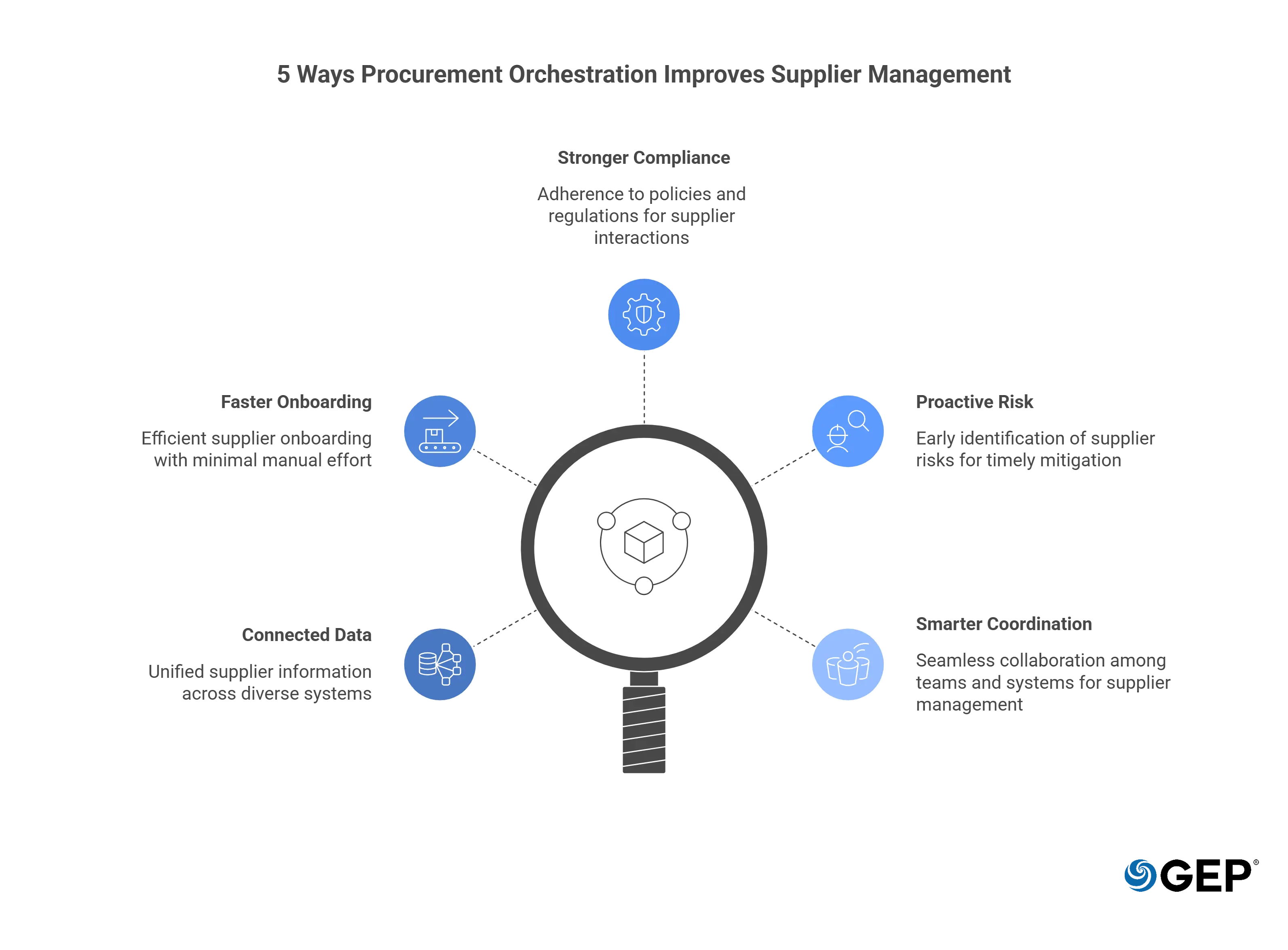
- Procurement orchestration brings supplier data, workflows, and stakeholders together to enable faster decisions, stronger compliance, and better risk management
- Siloed systems and fragmented workflows create strategic risk in volatile supply chains.
- Orchestrated supplier relationships drive faster onboarding, stronger compliance, and better supplier experiences.
September 17, 2026 | Procurement Strategy 5 minutes read
We know that most supplier management problems are not technology problems. The tools exist. The data exists. The people are smart. And yet; somehow; a new supplier that should take two weeks to onboard takes three months. A risk flag that should surface in week one shows up in week twelve. A business user bypasses procurement entirely because your process is simply too painful to bother with.
That is a coordination problem. And procurement orchestration is the answer to it.
What Procurement Orchestration Actually Means
Let's clear something up first, because there is genuine confusion in the market right now. Orchestration and intake management are not the same thing. Intake is one use case within orchestration; an important one, but far from the whole picture. Orchestration is broader: it is the strategic capability that aligns people, processes, and data across the enterprise so that procurement can function as a genuinely unified operation rather than a loose collection of disconnected systems and handoffs.
Pierre Mitchell of Spend Matters framed this well in a recent industry webinar when he described the modern CPO's role as that of a "Chief Externalization Officer": someone whose job is to orchestrate the relationship between the enterprise and its external supplier ecosystem. That is a meaningfully different ambition from running a cost centre. It requires coordination at a scale no procurement team can achieve through manual effort alone.
Ready to Eliminate Supplier Management Silos?
See how procurement orchestration creates a connected and compliant ecosystem
The Real Cost of Fragmentation
Here is what fragmentation looks like in practice. Your ERP holds one version of supplier master data. Your risk team is monitoring a separate platform. Your legal team is routing approvals through email. Your finance team is working from yet another system. No single person has a complete, real-time view of any given supplier relationship; and every time a request moves between systems or teams, something gets delayed, duplicated, or lost.
The downstream effects are significant: maverick buying increases as business users find it easier to go around procurement than through it; supplier onboarding slows to a crawl; compliance gaps widen; and risk events that should have been caught early land as surprises.
In a stable, predictable environment, this is expensive but survivable. However, in today's complex landscape, it is genuinely dangerous. Supply continuity pressures, regulatory requirements, and ESG obligations are all intensifying. Fragmented supplier management compounds every one of these challenges.
What Orchestration Changes
Procurement orchestration introduces a coordination layer that sits across your existing systems and pulls everything into coherent, connected workflows. It does not replace your ERP or your source-to-pay platform. It works alongside them, creating a single experience for business users, procurement teams, and suppliers, so that everyone is operating from the same information and moving through the same process.
Two use cases stand out as particularly powerful. The first is supplier onboarding and maintenance: orchestration centralizes supplier data, automates onboarding workflows, manages updates and extensions, and creates a far better experience for both the supplier and the internal business user requesting them. The second is risk management: orchestration makes source-to-pay processes genuinely risk-aware, surfacing potential disruptions in real time and enabling proactive responses rather than reactive ones.
The result is a procurement function that moves faster, sees more, and works with the business rather than against it.
The Business Case Is Already Being Made
The proof is not theoretical. Leading enterprises are already realizing measurable returns from orchestrated supplier management.
Consider the scale of what some organizations are dealing with: tens of thousands of internal users; hundreds of thousands of supplier management requests per year; a supplier base spread across dozens of geographies and regulatory environments. At that volume, manual processes do not just slow things down; they create structural risk.
The organizations getting this right are the ones that have invested in making the system intuitive for the business user; not just functional for the procurement specialist. When a business user can search, engage, and transact with a supplier through a single, clean interface without needing to understand the underlying plumbing, adoption goes up. Compliance goes up. Data quality goes up. And the procurement team spends less time managing exceptions and more time on the strategic work that actually creates value.
Where AI Fits In
Procurement orchestration and AI are natural partners. AI-native orchestration tools can now embed predictive analytics and real-time recommendations directly into procurement workflows; guiding users to the right supplier, flagging contract risks before they materialize, and automating the routine decisions that have historically consumed disproportionate amounts of procurement bandwidth.
AI is moving beyond automating individual tasks and starting to manage entire workflows. From guiding supplier decisions to coordinating complex approval processes, it is helping procurement teams operate with greater speed and less manual effort. Procurement orchestration provides the connected foundation that makes this possible.
Stay ahead of shifting spend dynamics across key categories.
Explore the GEP Spend Category Outlook to inform data-driven decisions.
Orchestration Is Not a Feature. It Is a Strategy.
If supplier management still feels like a relay race where the baton drops at every handoff, the root cause is almost certainly coordination failure, not capability failure. The people are capable. The technology exists. What is missing is the connective tissue that makes it all work together.
Procurement orchestration provides exactly that. It transforms supplier management from a series of fragmented transactions into a coherent, end-to-end capability; one that is faster, more compliant, more risk-aware, and genuinely better for every stakeholder involved.
The GEP Quantum Intelligence platform brings orchestration, supplier management, risk, and source-to-pay into a single AI-native architecture; so procurement can stop managing complexity and start creating advantage.
Discover how orchestration accelerates supplier onboarding, compliance, and risk management.
Explore GEP's Procurement & Supply Chain Orchestration Platform and Supplier Management Software.



FAQs
Procurement orchestration connects people, processes, data, and systems across the enterprise to create coordinated procurement workflows. It helps organizations streamline supplier management, improve compliance, manage risk proactively, and make faster, better-informed decisions.
It centralizes supplier data and connects onboarding, maintenance, approvals, risk management, and other workflows. This reduces delays and duplication, improves data quality and compliance, and creates a smoother experience for suppliers, business users, and procurement teams.
AI can embed predictive insights and recommendations directly into procurement workflows. It can identify supplier risks, recommend appropriate suppliers, automate routine decisions, and coordinate complex approvals, helping procurement teams operate faster while reducing manual effort.