


How Procurement Orchestration Unifies Intake-to-Pay in 2026
- Procurement orchestration connects fragmented intake-to-pay workflows into one unified operational process.
- AI-driven routing, compliance, and supplier intelligence reduce manual effort while improving speed and visibility.
- Organizations using orchestration eliminate silos between procurement, finance, legal, and accounts payable teams.
September 16, 2026 | Procurement Strategy 8 minutes read
Let's be honest: your problem is not that you lack technology. If anything, you probably have too much of it. The real issue is something far more maddening: your systems do not talk to each other.
Think about what your typical purchasing process actually looks like. A request gets raised in one platform. Approvals happen somewhere else. Contracts sit in yet another system. Your finance team is working off completely separate data. And your accounts payable team? They are processing invoices downstream with no real visibility into anything that happened before it landed on their desk.
Everyone is technically part of the same process. Nobody sees the whole picture. Sound familiar?
That is exactly the problem procurement orchestration was built to solve. And in 2026, it has become the most important conversation in enterprise purchasing.
Here is the idea: intake-to-pay covers the full lifecycle of everything your organisation buys — from the moment an employee raises a request to the moment a supplier gets paid. Procurement orchestration is the coordination layer that connects every single step of that journey. It ties together your workflows, approvals, supplier data, compliance checks, and financial controls into one governed process.
Think of it less as another platform you need to manage and more as the operating system sitting across your entire procurement function: the thing that finally makes everything else work together.
Turn Intake-to-Pay Into One Connected Process
Eliminate silos across procurement with AI-driven procurement orchestration
Why Your Intake-to-pay Process Needs Orchestration
If your procurement environment feels fragmented, that is because it almost certainly is.
You are probably running some combination of an ERP system, sourcing tools, a supplier management platform, a contract lifecycle management system, various approval workflows, a handful of spreadsheets, and legacy processes that have been layered on top of each other for years. Each one might work perfectly well on its own. Together, they create friction at every single handoff.
Here is what that friction looks like in practice: your employees submit requests without knowing where they go next. Your procurement team spends half its time manually chasing approvals. Your finance colleagues are struggling to build accurate spend visibility from disconnected data. Your legal team gets pulled in at the last possible moment via a frantic email. Your suppliers are following up on invoices nobody can locate. And when your leadership asks for end-to-end reporting, everyone quietly dreads the question.
In 2026, that model simply does not hold up anymore. Here is what your organization now expects from procurement: your CFO wants tighter spend control and more reliable forecasting. Your operations leaders want purchasing cycles to move faster. Your employees want a buying experience that does not feel like navigating a bureaucratic obstacle course. And your procurement team is being asked to balance efficiency, compliance, supplier resilience, ESG obligations, and cost optimization — simultaneously.
Procurement orchestration addresses all of that by giving you one unified workflow layer across your entire intake-to-pay process. Instead of your teams managing disconnected activities, they manage one coordinated operational flow. It sounds like a subtle shift. In practice, it changes how your entire procurement function operates.
The Five Components Your Orchestration Model Needs
If you are building or evaluating a procurement orchestration model, there are five foundational components you need working together:
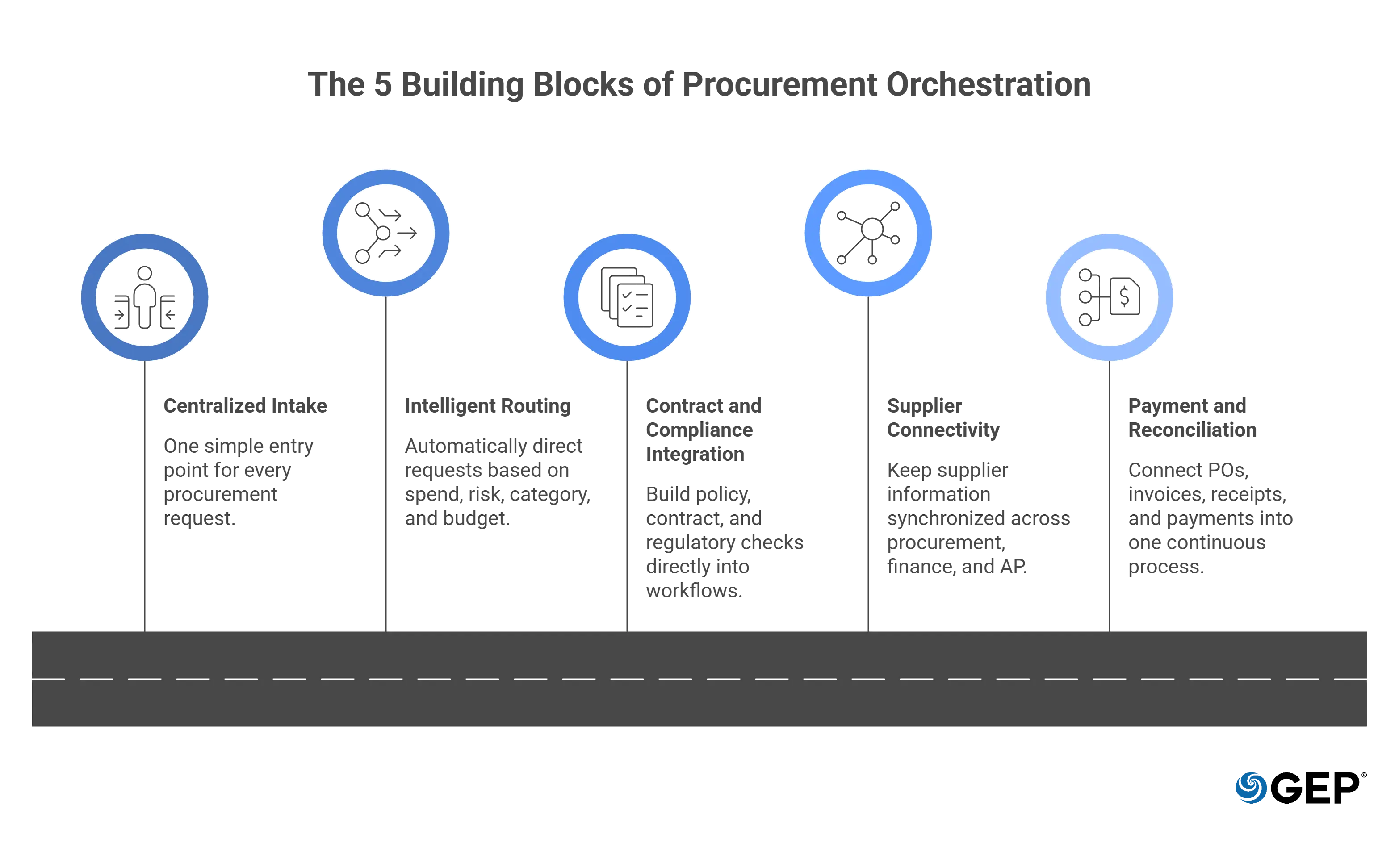
1. Centralized Intake:
Your employees need one place to submit procurement requests — regardless of what they are buying, where they are based, or which business unit they sit in. When you give them a simple, guided intake experience, something important happens: they stop bypassing your procurement process just to move faster. You get visibility earlier. Everyone wins.
2. Intelligent Routing:
Not every request your organization raises should follow the same approval path. A modern orchestration platform uses rules and AI-driven logic to route requests automatically based on factors like your spend thresholds, supplier risk profiles, category type, and budget ownership. The result: your approvals move faster and your team spends less time playing coordinator.
3. Contract and Compliance Integration:
Here is a gap that costs organizations more than they realize — the disconnect between sourcing and compliance. With orchestration, compliance gets embedded directly into your workflow. Before purchases move forward, the system validates contract terms, policy requirements, and regulatory obligations automatically. You stop treating compliance like a last-minute checkpoint and start treating it like part of the process.
4. Supplier Connectivity:
Your supplier data is not static. Banking details change. Certifications expire. Risk profiles shift. Without orchestration, that information drifts across your systems and creates payment risks and operational headaches. With it, your procurement, finance, and AP teams all work from the same verified supplier information, automatically synchronized.
5. Payment and Reconciliation:
Your process does not end when a request gets approved — and your orchestration model should not either. When you connect purchase orders, invoices, receipts, and payment workflows into one continuous flow, you reduce manual matching work, speed up reconciliation, and get your suppliers paid accurately and on time. In a competitive supply market, that experience matters more than most organizations acknowledge.
How Orchestration Removes the Silos You Are Dealing With
The inefficiencies in your procurement process are probably not caused by bad strategy or poor technology. They are caused by isolation: your teams, systems, and workflows operating in separate bubbles with no shared visibility. Here is how orchestration removes those bubbles:
It brings your employees into the process earlier:
In most organizations, procurement only gets involved after the purchasing decision has already been made. By that point, your options are limited, your leverage is reduced, and compliance risks have already crept in. When you give employees a simple intake experience from the beginning, they engage with your procurement process early — not because they have to, but because it actually feels easy. That early visibility lets your procurement team guide sourcing decisions proactively rather than cleaning up problems later.
It aligns your procurement and finance teams in real time:
This is one of the most common and costly silos in any enterprise. Your procurement team is focused on speed and supplier engagement. Your finance team is focused on budgets, approvals, and spend control. Without orchestration, those priorities clash constantly. With it, your approval hierarchies, budget thresholds, and funding availability are synchronized in real time — so your purchasing decisions happen with accurate financial context, not last week's spreadsheet.
It keeps your sourcing and contracting connected:
You might negotiate excellent commercial terms in a sourcing event, but that value evaporates quickly if your contracting workflow then stalls or loses context. Orchestration creates continuity between those two stages by keeping your workflows, stakeholders, and negotiated terms connected throughout. Instead of restarting conversations between departments, your information flows directly from sourcing into legal and contract execution.
It embeds your legal and compliance reviews automatically:
If your legal and compliance teams are currently being pulled into procurement via last-minute escalations and panicked emails, that is a symptom of a process without orchestration. When compliance rules are embedded directly into your workflow, reviews get triggered automatically based on supplier risk, contract value, category type, or regulatory requirements. Governance becomes part of your process — not an additional administrative burden you bolt on at the end.
It stops your AP team inheriting problems they did not create:
Your accounts payable team regularly deals with the downstream fallout of decisions made far upstream: missing purchase orders, inaccurate supplier records, undocumented approvals. When your AP function is connected to your upstream intake-to-pay workflow, invoice data, supplier information, and purchasing records stay synchronized throughout. Your reconciliation errors drop. Your payments move faster. And your suppliers stop chasing you.
Is Your Procurement Organization Ready for What's Coming?
Download the 2026 Procurement Executive Insight Report and find out where you stand
Where AI is Taking Your Procurement Orchestration
If you want to understand where your procurement orchestration model is heading, artificial intelligence is the answer — and the changes are already happening.
The most immediate shift is at intake. AI-powered orchestration tools can now interpret requests written in plain language, classify them automatically, validate them against your policies, and trigger your workflows instantly. What used to require multiple emails and manual coordination can now happen in minutes.
Your supplier risk management is also becoming genuinely proactive. Modern orchestration platforms pull in live intelligence from financial databases, ESG platforms, and regulatory feeds to surface supplier risks before they become disruptions to your operations — not after.
Contract intelligence is another area where you will see significant change. AI can now extract clauses, identify obligations, flag renewal risks, and surface compliance issues automatically across your entire contract portfolio. At scale, that capability transforms how your legal and procurement teams operate.
But here is the development with the most long-term significance for your organization: predictive procurement intelligence. AI models trained on your historical purchasing data can forecast demand, identify consolidation opportunities, recommend preferred suppliers, and optimize purchasing decisions before requests are even submitted.
That moves your procurement function from reactive process management — responding to what people need — toward something far more strategic: anticipating what your business needs and positioning procurement to enable it.
Conclusion
Procurement orchestration is becoming the foundation of how modern intake-to-pay actually works — not because your organization needs more software, but because fragmented procurement processes cannot survive in an environment where speed, visibility, compliance, and supplier resilience all have to coexist.
The organizations getting the most value from procurement in 2026 are not necessarily the ones with the most sophisticated technology. They are the ones who have connected everything: their workflows, their systems, their supplier data, their approvals, and their financial controls — into one coordinated process that everyone can actually use.
That is what procurement orchestration delivers for your organization: a procurement function that finally operates as one connected experience, rather than a collection of disconnected steps held together by goodwill, manual effort, and spreadsheets.



FAQs
It embeds compliance directly into your workflow rather than treating it as a separate review stage you trigger at the end. Rules are configured based on your spend thresholds, supplier categories, regulatory requirements, and internal policies. As your requests move through the process, the orchestration layer validates approvals, triggers compliance reviews, and flags exceptions automatically — without your team having to manually oversee each step.
Fragmented and frustrating. Your requests bounce across disconnected systems. Your approvals slow down. Your supplier data becomes inconsistent across platforms. Your teams lose visibility into where transactions actually stand. And when something goes wrong — a missed payment, a compliance gap, an invoice dispute — nobody has a clear picture of where it originated.
No — and the distinction matters for how you think about your procurement technology. Intake management is the front door: it captures, organizes, and routes your requests at the beginning of the process. Procurement orchestration is everything behind that door: sourcing, contracting, compliance, supplier management, approvals, invoicing, and payments — your entire lifecycle, coordinated as one connected flow.