



How to Write a Procurement Statement of Work That Prevents Scope Creep
- A Statement of Work turns broad contract terms into specific, measurable supplier obligations.
- Clear acceptance criteria, explicit exclusions, and a defined change process separate a strong SOW from a future dispute.
- An effective SOW is collaborative, where the business defines the need, procurement adds rigor, and legal validates the risk.
August 26, 2026 | Procurement Strategy 5 minutes read
Ask any procurement manager about their worst supplier dispute, and odds are it started the same way: nobody wrote down what "done" meant. The supplier thought they'd delivered. The business disagreed. Invoices got held, lawyers got involved — over something one well-drafted document could have settled in minutes.
That document is the Statement of Work. Here's how to get it right.
What Is a Procurement Statement of Work (SOW) and Why Is It Critical?
A Statement of Work spells out, in plain and specific terms, what a supplier will deliver, including the scope, the deadlines, the quality bar, and what you'll pay for it. It usually sits beneath a master agreement. The contract handles the legal relationship; the SOW handles the actual work.
Why does it matter so much? Because vague expectations are expensive. When scope lives in email threads and meeting notes, suppliers fill the gaps in their own favor, buyers assume things that were never promised, and renegotiating mid-project means negotiating from weakness.
A tight SOW gives you a single source of truth. It makes supplier quotes comparable during sourcing, ties payments to verified deliverables rather than good intentions. And just in case the relationship sours, and SOW becomes the evidence that decides who's right.
AI-Native or Bolt-On Procurement Platform?
Find out what separates AI-powered tools from AI-native procurement platforms
What Are the Key Components of a Procurement SOW?
While formats vary by industry and category, an effective SOW almost always includes these elements:
Background and objectives: why this work exists and what success looks like
Scope: what's included, and just as critically, what isn't
Deliverables: described precisely enough that anyone could verify them
Timeline and milestones: dates, phases, dependencies
Acceptance criteria: the objective test each deliverable must pass
Roles and responsibilities: named owners on both sides
Pricing and payment terms: the model, the rates, the invoicing schedule
SLAs and performance standards: with real consequences for missing them
Change management: how scope changes get requested, priced, and approved
Assumptions and governance: dependencies, compliance needs, reporting cadence, escalation paths
Skip any of these and you've left a door open. Suppliers, like water, find gaps.
Also Read: Invoice Cycle Time: What is it, Importance & How to Improve it
Common Mistakes to Avoid When Creating a Statement of Work in Procurement
The same errors show up again and again, and even seasoned teams can fall into predictable traps:
Fuzzy Language
"Assist with," "support as needed". Phrases like these mean whatever the reader wants them to mean. If an obligation can't be measured, it can't be enforced.
No Exclusions
Teams write pages on what's in scope and nothing on what's out. Then the supplier bills for something you assumed was included; and technically, they're not wrong.
Recycled Templates
Copying last year's SOW imports terms that don't apply and drops ones that do. Templates are starting points, not shortcuts.
Missing Change Control
Every project shifts. Without an agreed process for handling changes, each shift becomes a fresh negotiation, usually on the supplier's terms.
Mismatched Pricing Models
Fixed price with loose scope invites padded quotes. Time and materials with no cap invites runaway costs.
Drafting in a Silo
Procurement alone misses operational detail; the business alone misses commercial protection. You need both.
How to Write a Statement of Work (SOW) for Procurement: Step-by-Step Process
1. Start with the problem, not the tasks
Talk to the business owner, technical leads, finance, and legal. Understand what the engagement is actually meant to achieve.
2. Draw the boundaries
Write what's in scope, then force yourself to write what's out. The exclusions list is where disputes end before they even begin.
3. Convert goals into deliverables
Each one should be a concrete output with a due date — something you can point to and verify, not an activity that just happens.
4. Define "done" for every deliverable
Specifications, test results, review sign-offs — whatever fits. If acceptance depends on someone's opinion, rewrite it.
5. Match the pricing model to the scope
Well-defined work suits fixed price; evolving requirements suit capped time and materials; phased projects suit milestone payments.
6. Name names
Who approves deliverables? Who handles escalations? Roles without owners are roles nobody plays.
7. Build in change control
Agree now on how changes get documented, priced, and signed off. You'll be glad by month two.
8. Review with fresh eyes
Have stakeholders, legal, and ideally the supplier read the draft. Every ambiguity caught now is a dispute avoided later.
Procurement SOW Template: A Practical Structure for Creating Your Own
Think of the template in four layers. The foundation comes first: project title, parties, a reference to the master agreement, and a short background on why the work exists. From there, define the work itself — scope with explicit exclusions, deliverables with due dates, a milestone timeline, and acceptance criteria for each output. This front half does the heavy lifting; get it precise and the rest almost writes itself.
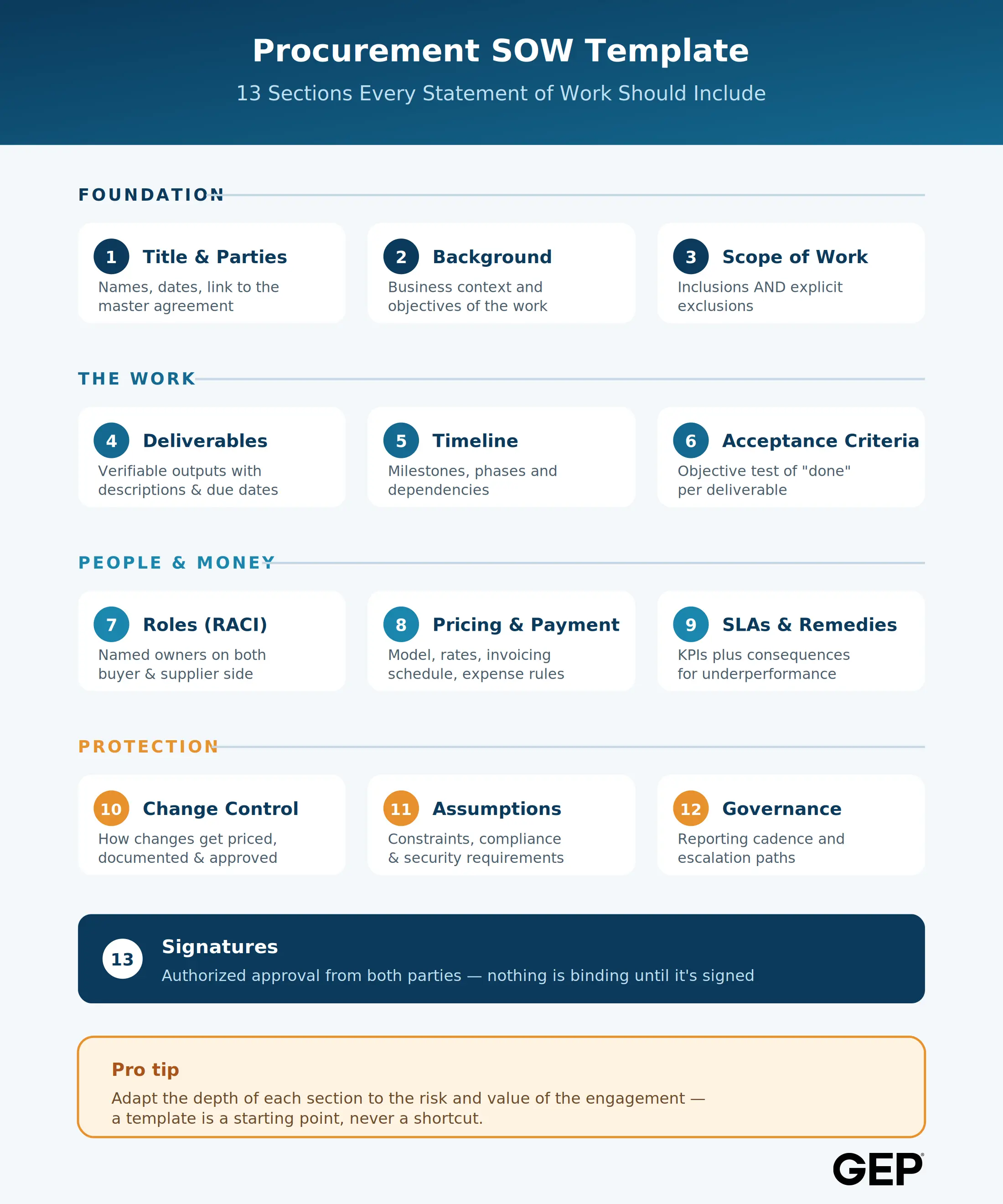
The back half covers people, money, and protection. Spell out roles on both sides (a simple RACI works fine), the pricing model and invoicing schedule, and SLAs with real remedies attached. Then close the loopholes: change management, documented assumptions and compliance needs, governance and escalation paths, and signatures from both parties. Adjust each section's depth to the value and risk involved — a template is a starting point, never a shortcut.
Step Into the Future of Procurement
Empower your CPO strategy with agentic AI–orchestrated source-to-pay transformation
Conclusion
A Statement of Work is far more than administrative paperwork — it is the operational backbone of every supplier engagement. That said, nobody enjoys writing an SOW. It's slow, detail-heavy work, and the temptation to rush it is real. However, the hours spent pinning down scope, acceptance criteria, and change control are the cheapest insurance procurement can buy. Get the SOW right, and everything downstream, including delivery, payments, and supplier relationships, gets easier.
Explore GEP’s AI-Native Procurement Software




Frequently Asked Questions
The contract sets the legal framework: liability, IP, termination. The SOW sits under it and defines one specific engagement — scope, deliverables, dates, and price. One master agreement often governs many SOWs.
It's shared work. The business owner supplies requirements, procurement adds commercial structure, legal checks risk language, and the supplier often sanity-checks feasibility. Procurement usually owns the final version.
Measurability. When deliverables have objective acceptance criteria, SLAs carry real remedies, and every obligation has a named owner, performance conversations stay factual instead of becoming arguments.
Yes, through the formal change process the SOW itself should define. Changes get documented, assessed for cost and schedule impact, and approved in writing by both sides. Verbal changes are how disputes are born.