Commute-Worthy Workplaces: Using Data to Curate “Peak Day” Experiences
- Many organizations approach real estate and facilities management as two parallel, disconnected workstreams.
- Real estate decisions are made on headcount projections, while facilities management decisions are made on operational feedback.
- Here is a procurement perspective on making the office worth the commute - and every facility service and real estate spend accountable to that outcome.
June 22, 2026 | Procurement Strategy 5 minutes read
The Strategic Shift: The Commute is now a Procurement Problem
In the hybrid workplace era, employees decide each morning whether coming in is worth the journey. That decision, once an obligation, is now voluntary, and it places every procurement decision in the real estate and facilities management category under a new test: does this investment make the office worth attending?
The facilities management cleaning contract, the cafeteria outsourcing arrangement, the desk-booking software license, and the square-footage lease are no longer back-office overhead decisions. They are, collectively, experienced investments and they must be evaluated accordingly.
This is the essence of "Peak Day" strategy: rather than provisioning uniformly across every day, leading organizations engineer select high-value days that concentrate service excellence, premium amenities, and curated environments creating a gravitational pull that justifies the commute and validates the real estate investment.
What Traditional Procurement Gets Wrong
Most organizations approach real estate and facilities management as two parallel, disconnected workstreams, one managing leases, the other managing services. This separation produces three endemic failures in a hybrid world:
Fixed-assumption contracts: Facilities management agreements are scoped against a hypothetical 'normal' occupancy. In reality, occupancy swings from 18% on quiet Fridays to 74% on peak Wednesdays, making these contracts simultaneously overspend at low utilization and an under-delivery when it matters most.
Siloed intelligence: Real estate decisions are made on headcount projections; facilities management decisions on operational feedback. These data streams rarely meet, resulting in leased space that cannot be staffed optimally and facilities management investment in services that real estate has flagged for decommission.
Vanity amenities spend: Post-pandemic investment in high-visibility amenities like barista bars, wellness pods, event studios, etc. proceeded without any data-driven framework to measure whether those investments influenced voluntary attendance. Capital was committed with no ROI mechanism.
The Real Estate and Facilities Management Convergence Model
Peak Day strategy does not belong to real estate or to facilities management alone - it lives at their intersection. The diagram below maps how the two disciplines converge around a shared procurement goal, with the procurement intelligence layer governing both.
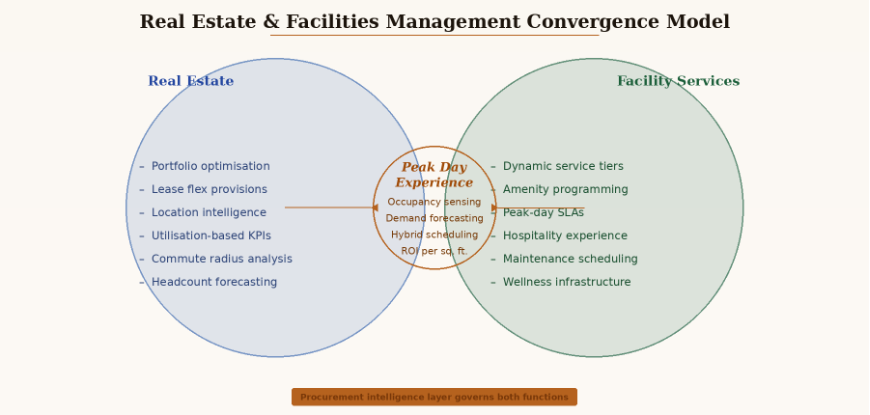
The overlap is the Peak Day experience zone, where procurement decisions carry the highest leverage. A desk-booking system informs cafeteria staffing; commute data shapes lease renewals; employee sentiment directly becomes a facilities management SLA failure. Neither function can optimize this zone alone, and neither can procurement working exclusively within one silo.
The Four Data Pillars That Power Peak Day Decisions
A Peak Day strategy is only as intelligent as the data informing it. Four signal categories constitute a mature real estate and facilities management intelligence framework each with direct procurement implications:
Occupancy and flow data: Badge access, IoT sensors, desk booking, and Wi-Fi heatmaps reveal true space consumption versus leased area. This is the foundation for lease right-sizing and facilities management staffing tier design.
Commute intelligence: Transit APIs, parking fill rates, and employee residential geocoding identify the attendance barriers that no amenity investment can overcome, reshaping transportation procurement and site selection decisions.
Amenity demand signals: Cafeteria throughput, AV booking patterns, fitness utilization, and event registrations reveal which facilities management investments drive in-office gravity, enabling a rigorous amenity ROI scorecard for procurement.
Sentiment and preference data: Pulse surveys and workplace NPS scores map the experiential gap between what employees expect when they commute and what the environment delivers. Each gap identified is a facilities management SLA failure or a procurement specification deficiency.
Procurement Principle
The architecture that enables Peak Day intelligence is a unified data layer, a workplace experience platform or facilities analytics dashboard that aggregates all four signal types. Specifying, procuring, and governing that platform is one of the highest-value category decisions in the real estate and facilities management portfolio.
Rewriting the Contract: From Static Scope to Dynamic Intelligence
Understanding the data must be translated into contract architectures that reflect it. Across the real estate and facilities management category, Peak Day procurement requires structural changes in how scopes of work are written, service levels defined, and commercial arrangements structured:
Facilities management service agreements move from fixed-headcount, uniform-daily-scope to occupancy-tiered service bands with distinct peak-day SLAs and pre-agreed supplier mobilization windows tied to desk-booking forecasts.
Real estate leases evolve from fixed-term, fixed-square-footage arrangements to include flex provisions triggered by peak-day utilization thresholds, surge capacity clauses for collaboration-dense periods, and portfolio right-sizing reviews tied to quarterly occupancy data.
Workplace technology contracts mandate data interoperability as a core requirement ensuring that occupancy sensing, desk booking, and facilities management platforms feed a shared analytics layer accessible to both real estate and facilities management procurement teams.
Food and beverage and hospitality contracts introduce peak-day premium service tiers with elevated quality commitments and volume guarantees restructured around peak-day concentrations rather than daily averages.
The Five-Stage Procurement Playbook
Translating Peak Day strategy into an operational procurement reality follows a disciplined sequence:
01. Data readiness assessment
Audit existing technology contracts for data export capabilities and interoperability gaps. This is the first deliverable: a real estate and facilities management data readiness assessment that maps what intelligence is available and what procurement actions are needed to close the gap.
02. Identify and validate peak patterns
Allow three to six months of data collection to determine which days, spaces, and time bands generate the highest voluntary occupancy, strongest amenity utilization, and best sentiment scores. This is the foundation of all subsequent sourcing decisions.
03. Redesign contract architecture
Introduce occupancy-tiered service bands, peak-day SLAs, and output-oriented performance metrics into facilities management contracts. Engage landlords on flex provisions and utilization-triggered lease clauses backed by verified occupancy data.
04. Activate and curate peak days
Establish facilities management supplier mobilization protocols for peak days. Build pre-peak readiness certification into contract KPIs. Govern vendors to ensure the peak-day service tier specified in the contract is the experience employees actually encounter.
05. Measure, iterate, and govern
Track financial outcomes (facilities management cost efficiency, real estate cost per utilized seat), experiential outcomes (employee satisfaction, amenity utilization), and strategic outcomes (retention correlation). Review quarterly. Peak Day procurement is an operating model, not a project.
The Bottom Line: Own the Data Layers
The organizations that will define the workplace standard of the next decade are already running this model, renegotiating facilities management contracts with occupancy-tiered service bands, presenting lease renewals backed by six months of utilization data, and running quarterly cross-functional intelligence reviews that bring real estate and facilities management procurement into a single strategic conversation.
For procurement leaders in the real estate and facilities management category advisory group, the mandate is clear: own the data layer, design the convergence, and build contracts that reward excellence when it matters most. Every sourcing decision in the real estate and facilities management category is either reinforcing or eroding the single most important thing an organization can offer its people a reason to show up.
Author: Akshat Jakhar