


When Tariffs Change Overnight: Rethinking Supply Chain Contracts for Cost Protection
- Most supply contracts stay silent on who absorbs a tariff increase, leaving buyers exposed the moment a duty rate shifts.
- Force majeure and commercial impracticability rarely hold up against tariff-driven cost spikes, since courts require true impossibility, not just added expense.
- Pass-through clauses and rate-linked pricing formulas protect margin automatically, cutting out the renegotiation cycle tariffs usually trigger.
August 03, 2026 | Supply Chain Risk Management 5 minutes read
A tariff rate can hold for years, then move in a single quarter. The contract signed before that move usually says nothing about who eats the difference. Procurement teams keep running into this, and the real fix isn't with customs. It sits in the contract itself.
This blog breaks down where agreements tend to go quiet on cost responsibility, and which protections hold up once a supplier starts pushing back on price.
The Financial Footprint: Evaluating Duty Exposure Across Supply Networks
Duty exposure rarely sits in one tidy place. A finished product might pull components from four or five countries, each on its own tariff schedule, and a rate change on just one of those inputs can quietly reshape landed cost. Nobody notices until the invoice looks wrong.
Tracing this properly means going back to the full bill of materials, country by country, not stopping at final assembly. Teams doing this audit for the first time in a while often find two surprises: classification codes that never got updated, and a supplier who rerouted part of their sourcing months ago without saying much about it.
There's also the cost nobody puts in the spreadsheet at first. Freight surcharges. Brokerage fees. The cash tied up paying duties before goods even clear customs. A review that stops at unit price is only telling half the story, maybe less.
Know Your Exposure Before the Next Tariff Hits
A step-by-step framework to assess duty exposure, verify supplier cost claims, and quantify landed cost impact
Operational Audit: Establishing Contractual Responsibility for Customs Duties
So, who's responsible once the tariff hits? A lot of teams assume Incoterms answer this. They don't, not really. Incoterms handle delivery and risk transfer. They were never built to assign tariff cost specifically, and treating the two as the same thing is where a lot of contracts fall apart under pressure.
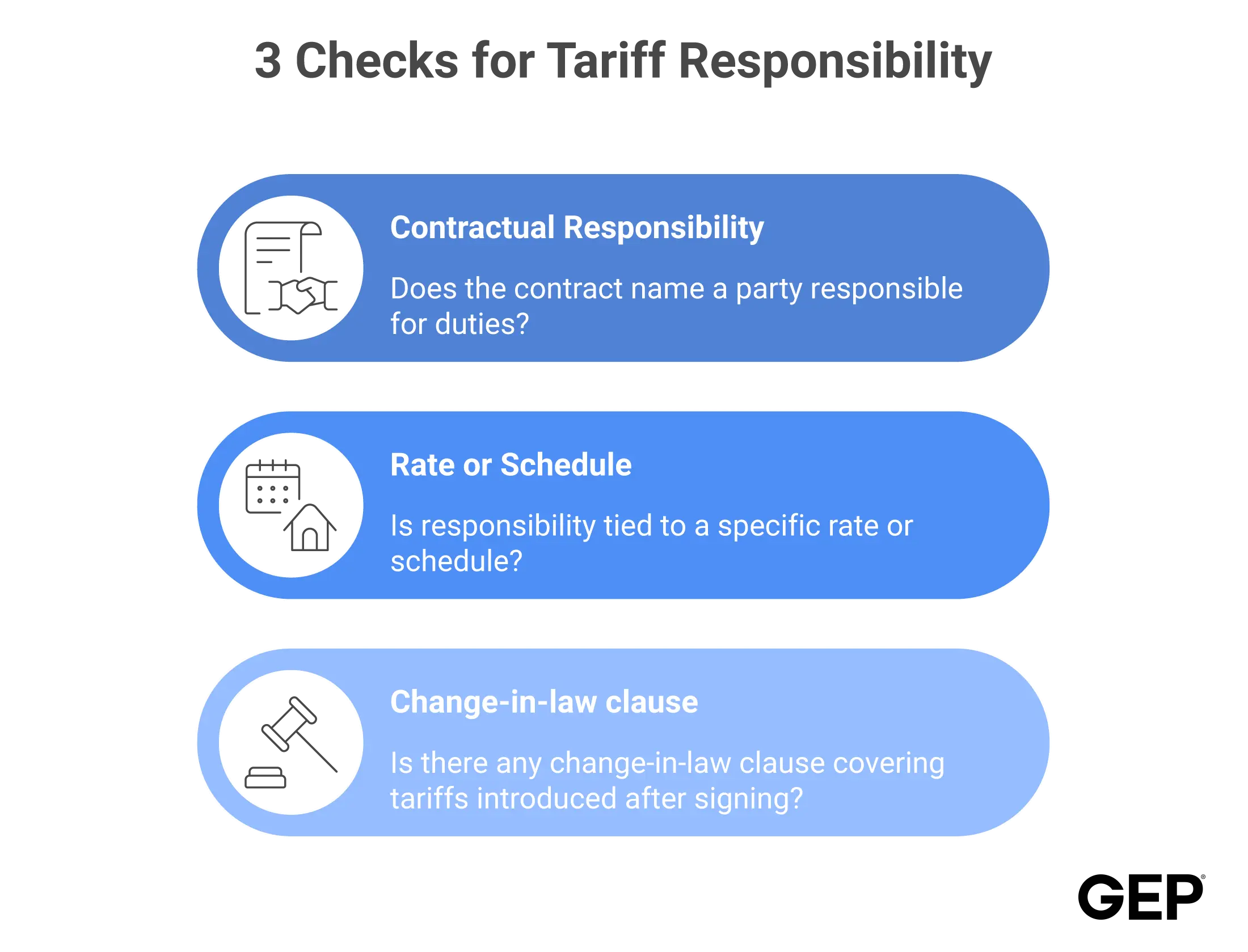
A real audit checks three things separately: does the contract name a party responsible for duties, is that tied to a specific rate or schedule, and is there any change-in-law clause covering tariffs introduced after signing? Pull an older contract and run this check. Odds are it fails at least one, often all three, because nobody was thinking about tariff swings when the language got drafted five years ago.
Silence has a default. And the default isn't always the buyer's friend.
Legal Defense Limits: Why Cost Spikes Rarely Cancel Supply Agreements
Once tariffs eat their margin, some suppliers reach for force majeure. Or they'll cite commercial impracticability under the UCC. Both get raised more often than they hold up.
Force majeure generally needs something closer to true impossibility, not just added expense. A tariff makes shipping more costly. It doesn't make shipping impossible. Commercial impracticability sets a similarly high bar, asking whether the core assumptions behind the deal have essentially collapsed. Margin pain, even severe margin pain, rarely clears that bar on its own.
Worth remembering in a tense renegotiation: a supplier asking to adjust pricing is reasonable and worth hearing out. A supplier claiming they can walk away from delivery entirely because of a tariff is standing on much weaker legal ground. Most buyers have more leverage in that conversation than they realize.
Commercial Risk-Sharing Mechanisms for Volatile Import Environments
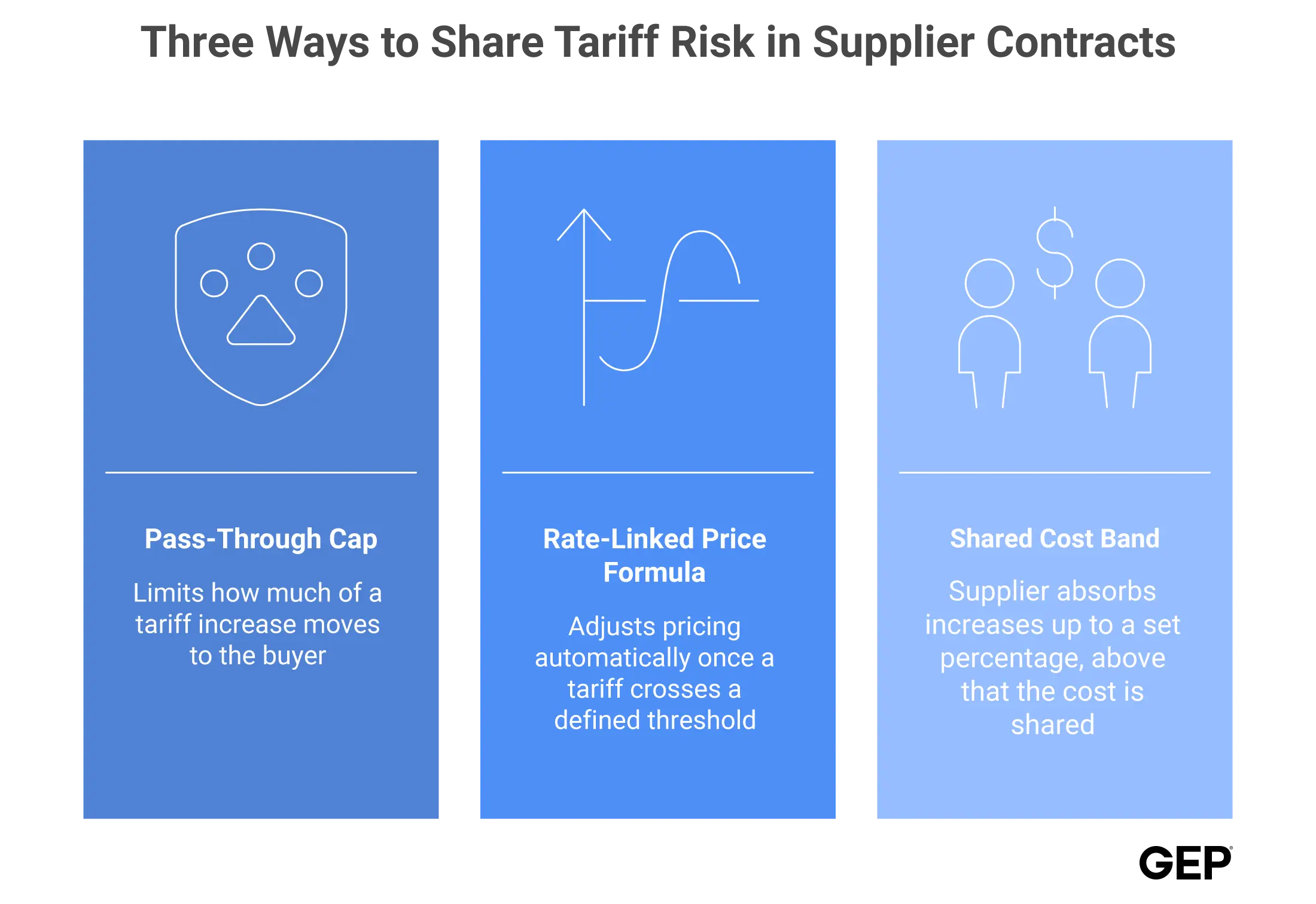
Since the legal path is narrow, the practical fix is commercial. Tariff pass-through clauses cap how much of the increase is passed on to the buyer, splitting the hit rather than dumping it on one side.
Price formulas tied to published tariff schedules cut out a lot of back-and-forth. Instead of renegotiating every time a rate shifts, the contract already specifies the math. Once the rate crosses a defined threshold, pricing adjusts on its own. No meeting is required.
Shared cost bands split the difference further. Supplier absorbs increases up to a set percentage; anything above that gets shared or passed through. It's not a perfect solution for either side, but it keeps both parties out of the adversarial renegotiation loop that tariffs tend to trigger.
Commercial Negotiation Playbook: Balancing Buyer and Seller Protection
The best time to negotiate tariff protection is before the volatility shows up, not during it. Push for change-in-law language that opens a renegotiation window rather than triggering an automatic price hike. That gives both sides a process instead of a demand.
Sourcing flexibility matters just as much, maybe more. A clause letting the buyer qualify an alternate supplier, or shift volume, without penalty when tariffs make one origin uncompetitive preserves room to move that long fixed-term deals tend to remove entirely.
Contract length is worth reconsidering too. Shorter terms with renewal options cost some volume discount, sure, but they also stop you from being stuck with pricing that trade policy has since made irrelevant.
Build Contracts That Hold Up Under Trade Volatility
Talk to a GEP expert about structuring tariff protections into your supply agreements
Building Contracts That Absorb the Next Trade Shock
Tariff volatility isn't a phase to wait out. It's a standing variable now, and contracts built for a calmer trade environment will keep generating the same fights until someone rewrites them for the one we're actually in.
The teams handling this well aren't the ones with the thickest contracts. They're the ones who audited their exposure, closed the silent gaps sitting in older agreements, and built pricing that reacts on its own instead of waiting for a phone call. That's the difference between managing tariffs as a recurring headache and managing them as a feature the contract already handles.
Explore GEP’s Tariff Management Resource Center for expert guidance and practical actions to mitigate the volatility.




FAQs
Usually not. Both doctrines require performance to be genuinely impossible or fundamentally unworkable, not just less profitable. Tariffs raise cost without blocking shipment, so courts tend to reject these claims when margin pressure is the only argument on the table.
A capped pass-through clause, or a shared cost band where increases past a set threshold are split between both parties, tends to be the easiest to draft and the easiest to enforce later.
Anchor the clause to a specific tariff rate or schedule, build in a renegotiation window tied to a percentage change, and skip vague language that leaves the actual response undefined.
Shorter terms limit how long you're stuck with pricing that a policy shift might already have made outdated. Sourcing flexibility clauses let volume move toward a lower-tariff origin without breaching the deal.