
Quantifying the Business Value of Sustainable Procurement: KPIs That CPOs Care About
- Sustainable procurement KPIs are no longer just ESG compliance tools, they’re direct indicators of supply chain resilience and enterprise value.
- Chief procurement officers who track the right metrics gain a real edge in risk management and cost control.
- Turning sustainability goals into board-ready numbers requires clean data, clear ownership and a direct link to shareholder value.
May 04, 2026 | Procurement Strategy 5 minutes read
Sustainability pledges are cheap. Numbers are not.
For years, procurement leaders faced pressure to make supply chains greener and more ethical. Most organizations responded with policies, reporting frameworks and supplier codes of conduct. What they struggled to produce was the one thing CFOs and boards actually want: measurable, tangible sustainability results tied to business outcomes.
That gap is closing. Sustainable procurement KPIs have grown from aspirational targets into hard financial metrics. For chief procurement officers managing ESG compliance, geopolitical risk and investor expectations, knowing which KPIs drive results has become essential.
Why CPOs Must Quantify Sustainable Procurement ROI
The business case for sustainable procurement used to rest on reputation and risk avoidance. That framing no longer holds. Mandatory Scope 3 disclosure requirements are expanding across the EU and beyond. Investors want quantified performance, not narrative commitments.
Supply chain disruptions have also made resilience and sustainability inseparable. A supplier with poor environmental practices is also a supplier with regulatory exposure and operational risk. Procurement leaders who translate these realities into financial metrics earn a seat at the strategy table; those who rely on qualitative arguments alone do not.
The KPIs below are the ones procurement leaders are using to show business value and hold suppliers accountable.
The Key KPIs for Sustainable Procurement Value
Sustainable Spend
Sustainable spend tracks the share of total procurement spend going to suppliers who meet defined ESG criteria. It is one of the most direct levers CPOs have for improving corporate sustainability performance.
Beyond compliance, this metric signals intent. Companies with high sustainable spend ratios show investors that their sourcing decisions match their stated values. For CPOs, pushing this percentage up also strengthens supplier negotiations. Vendors who want preferred status know exactly what standards they need to hit.
Scope 3 Reduction
For most companies, purchased goods and services make up the largest share of their carbon footprint. Scope 3 Category 1 emissions fall squarely in procurement’s domain. That puts CPOs on the hook for a metric that can make or break net-zero commitments.
Getting reliable supplier emissions data is still a challenge, but companies that invest in collecting and verifying it gain visibility into supplier operations, energy use and cost structures across the supply chain.
Supplier Sustainability Score
A supplier sustainability score rolls environmental, social and governance data into a single rating. Procurement teams use it to segment their supply base and track compliance without manual reviews. It also creates a clear audit trail for regulators and investors.
The strategic value goes further. High-scoring suppliers tend to have more stable operations, stronger labor practices and better governance. Over time, that pattern becomes a data-driven case for developing suppliers rather than replacing them.
Circular Economy Rate
The circular economy rate measures how much of your sourced material comes from recycled, reused or remanufactured inputs. As raw material costs rise and regulations tighten around product lifecycles, this metric is becoming a practical cost management tool, not just a sustainability signal.
Raising this rate does more than cut waste. It diversifies the supply base and reduces exposure to commodity price swings, which matters when markets are volatile.
Risk Management and Supply Chain Resilience
This is where sustainable procurement KPIs connect most directly to CFO priorities. Putting a dollar figure on exposure from high-risk suppliers, whether due to ESG gaps, geographic concentration or governance failures, turns sustainability risk into treasury language.
Teams that track spend concentrated in risky supplier segments can model the cost of disruption against the cost of diversifying. That reframes sustainable sourcing as an investment in supply chain resilience rather than a sunk cost.
Key Considerations for Implementing Sustainable Procurement KPIs
Choosing the right KPIs is only half the work. Making them stick requires solid data, aligned stakeholders and governance that most organizations are still building.
Data quality is the first hurdle. Supplier-reported sustainability data varies widely, and KPIs built on unreliable inputs will not survive audit. Invest in supplier engagement programs that make data submission easy, and bake verification into the process from day one.
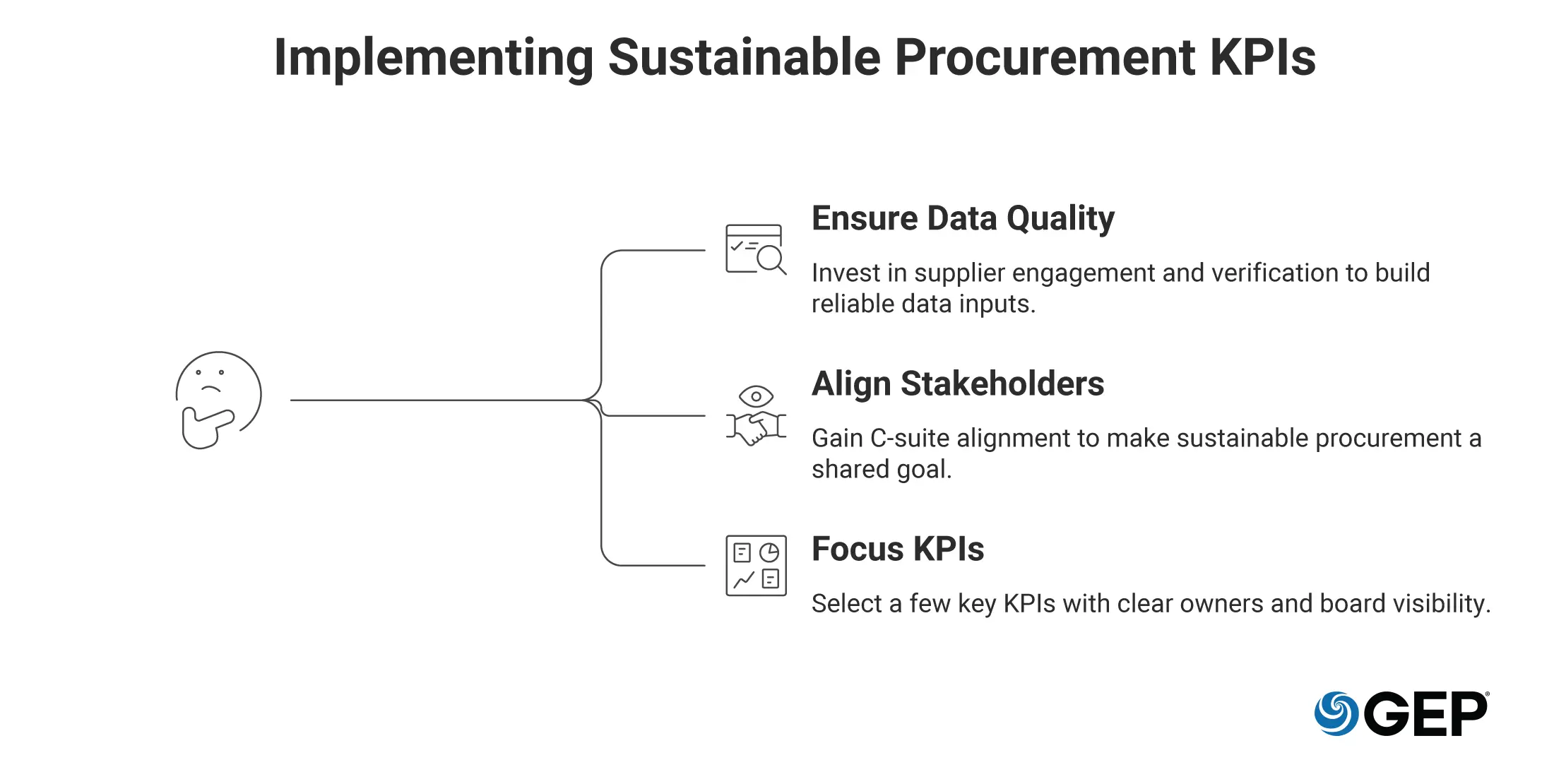
C-suite alignment is just as important. Sustainable procurement KPIs work best when the CFO, COO and chief sustainability officer are all using the same scorecard. When Scope 3 reduction becomes a shared goal across functions rather than a procurement-only task, the commitment behind it is much harder to ignore.
Resist the urge to track everything. A focused set of four or five KPIs with clear owners and board-level visibility beats a crowded dashboard that no one acts on. Start with the metrics tied to your organization’s biggest sustainability commitments and build from there.
Conclusion
Sustainable procurement has shifted from a compliance function to a value creation engine. The organizations seeing the strongest returns are the ones treating sustainability KPIs with the same discipline they apply to cost savings: clear targets, consistent tracking and real accountability.
For chief procurement officers, the opportunity is plain. Quantifying the business value of sustainable procurement gives you a language that boards understand and investors reward. These metrics are not just about ESG credentials. They are about building a supply chain that is more resilient and better prepared for the next disruption.
Want to see how leading organizations put these principles into practice? Explore our guidance on sustainable procurement to learn how high-performing procurement teams are building measurable ESG value.
FAQs
Q. Can sustainable procurement improve supplier risk scores?
A. Yes. Suppliers who meet sustainability criteria tend to have fewer operational disruptions, regulatory penalties and reputational incidents, all of which improve their risk profiles. ESG scoring gives procurement teams an early warning system for supply chain vulnerabilities.
Q. How does Sustainable Spend directly impact CPO and shareholder value?
A. Routing spend to verified sustainable suppliers reduces exposure to ESG-linked disruptions and regulatory fines, which protects margins. Investors increasingly factor this risk discipline into valuations, making sustainable spend a direct contributor to shareholder value.