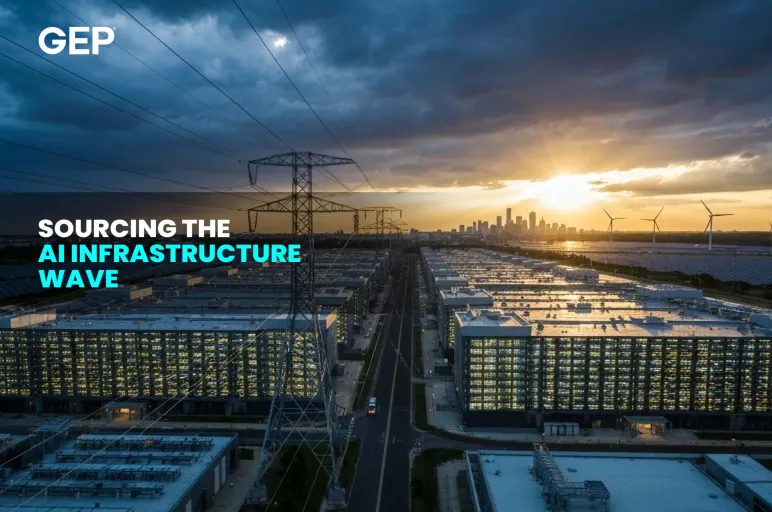
Sourcing and Procurement Strategies for the Trillion-Dollar AI Infrastructure Wave
- Bank of America's new $250 billion infrastructure initiative and Morgan Stanley's $1.5 trillion pledge confirm the funding question is settled — the delivery question isn't.
- BloombergNEF finds that 52 of the 100 largest announced U.S. data center projects come from developers who have never built one, and the grid has never connected more than about 10 GW of new data center demand in a year.
- When money is abundant and transformers, grid slots, chips and skilled labor are not, sourcing execution — not financing — decides what actually gets built.
September 17, 2026 | Sourcing Strategy 4 minutes read
Something unusual is happening in AI infrastructure: the money has stopped being the hard part. For two years, the debate centered on whether anyone could fund compute buildouts at the scale AI demands. That question now looks settled. Wall Street's largest banks are competing to finance data centers, chips and power, and hyperscalers are spending at rates that would have seemed absurd not long ago. The harder question has quietly taken its place — who can actually build what all this capital is chasing?
Bank of America's $250 billion Critical Infrastructure Finance Initiative, announced August 12 to finance U.S. data centers, semiconductors, energy and core infrastructure, landed days after Morgan Stanley pledged to facilitate roughly $1.5 trillion for similar projects over a decade. J.P. Morgan estimates hyperscaler capex alone will reach $697 billion in 2026, up $173 billion since January. The money, clearly, has arrived.
What's scarce is everything the money is supposed to buy.
The GEP Global Supply Chain Volatility Index
Get the latest intelligence on global supply chain volatility and anticipate risks before they impact your business
Capital Is Solved. Execution Isn't.
The gating factors are not financing anymore, but rather power availability, supply chain constraints and timelines. Grid connection queues now run multiple years in key markets. Semiconductors, electrical gear and skilled labor are all under pressure, and memory prices are inflating project economics further.
BloombergNEF's July outlook quantifies the squeeze. BNEF revised its 2030 U.S. data center forecast up 52% to 118 GW after the announced pipeline grew by 101 GW in just seven months. Yet its AI chip scenario implies 63 GW more capacity should be built by 2033 than energy constraints will allow. The chips exist on order books; the electrons to run them do not. The U.S. grid, BNEF notes, has never connected more than roughly 10 GW of new data center demand in a single year; and closing the gap would require about 48 GW of on-site gas generation by 2035.
Read those two reports together and the message to procurement leaders is blunt. Banks will find you the capital. Nobody will find you a transformer, a turbine slot or a grid interconnection date. That's your job now.
The New Sourcing Risk Map
The risk profile of this buildout is also shifting in ways that standard supplier playbooks don't cover. BNEF found that 52 of the 100 largest announced U.S. projects come from companies that have never built a data center, with 87 GW of capacity riding on first-time developers. Even experienced builders are stretching: the median project is now 8.7 times larger than the biggest thing its developer has previously delivered, up from 2.1 times a decade ago.
For anyone sourcing colocation capacity, signing a build-to-suit lease or supplying into these projects, that's counterparty risk hiding in plain sight. Development timelines already diverge sharply — hyperscalers average 5.3 years from planning to power-on, while other developers take 8.4 years — and inexperience widens that spread. A committed megawatt is not a delivered megawatt.
The exposure runs both directions, too. Suppliers of electrical equipment, cooling and construction services now face a customer base where nearly half the largest buyers have no delivery history. This scenario should change how payment terms, cancellation clauses and capacity reservations get negotiated on their side of the table.
Procurement Strategies for a Supply-Constrained Buildout
If execution is the new battleground, procurement holds most of the levers. Here's where to apply them first.
Buy Positions in Queues, Not Just Products
Grid interconnection slots, turbine manufacturing windows and advanced chip allocations are the real scarce assets. Contract for them the way traders contract for capacity, early, multi-year, with committed volumes and step-in rights.
Underwrite Suppliers and Partners Like a Lender Would
J.P. Morgan notes investors are doing rigorous credit work despite the capital flood. Procurement should match that discipline: probe delivery track record, scaling history and financing structure before betting a program on a first-time builder.
Phase Commitments to Match Demand Visibility
Operators are structuring buildouts in phases with contracted demand precisely because monetization lags capex. Mirror that in sourcing, where staged volumes with options beat monolithic commitments when technology cycles move faster than construction.
Treat Power as a Procurement Category
Onsite generation, storage and energy contracts now determine schedules more than concrete does. Energy sourcing belongs inside the infrastructure program, with one owner.
Executing at Scale with GEP Quantum Intelligence
A category this large, moving this fast, across this many interdependent suppliers, outgrows spreadsheets quickly. GEP Quantum Intelligence, GEP's AI-native procurement and supply chain orchestration platform, runs the full source-to-pay (S2P) cycle through a network of autonomous agents, thus executing sourcing events, monitoring supplier risk and enforcing contracted terms at the point of purchase.
The platform’s unified data layer connects bills of materials, suppliers and contracts in one place, and real-time dashboards surface spend concentration and risk exposure. This is exactly what a CPO needs when a handful of equipment makers and grid operators control the critical path.
Looking for Ways to Protect Your Business from Disruptions
GEP can help you navigate the unpredictability and protect your margins with confidence
Summing It Up
The trillion-dollar announcements will keep coming; that part of the machine works. The organizations that turn announced capital into energized capacity will be the ones whose procurement teams secured the physical inputs while competitors were still celebrating the term sheet.