



Spot Buying: The Fast Fix That Can Quietly Cost Procurement More
- Spot buying lets procurement teams respond to urgent or unplanned needs without waiting for a formal sourcing cycle.
- Used without discipline, it can quietly raise costs and weaken supplier relationships built through strategic sourcing.
- The right approach treats spot buying as one controlled option within a broader sourcing strategy.
September 15, 2026 | Sourcing Strategy 4 minutes read
Procurement rarely runs on schedule. A supplier misses a delivery. A project team needs something nobody sourced before. Demand spikes overnight, and the contract on file doesn't cover it. When that happens, teams reach for spot buying to close the gap fast.
Most organizations use it reactively. Nobody sits down and decides, "we'll spot buy this quarter." It happens purchase by purchase, until finance asks why costs crept up. Left unchecked, spot purchases erode negotiated pricing, sidestep preferred suppliers, and leave a thinner paper trail than anyone would like.
This blog breaks down what spot buying actually is, why it happens, and how to tell when it's the right call rather than a workaround for bad planning.
What Is Spot Buying in Procurement?
Spot buying is a one-time or short-term purchase made outside a formal, pre-negotiated contract. You go to the market, pay the current price, and get what you need without the runway a strategic sourcing event requires. That's the whole trade: speed for commitment.
Strategic sourcing, by contrast, runs on planned, competitive processes and multi-year supplier relationships.
Stop Chasing Unmanaged Spend
Get GEP's insights on eliminating unmanaged and maverick spend before it erodes your bottom line
How Does Spot Buying Work?
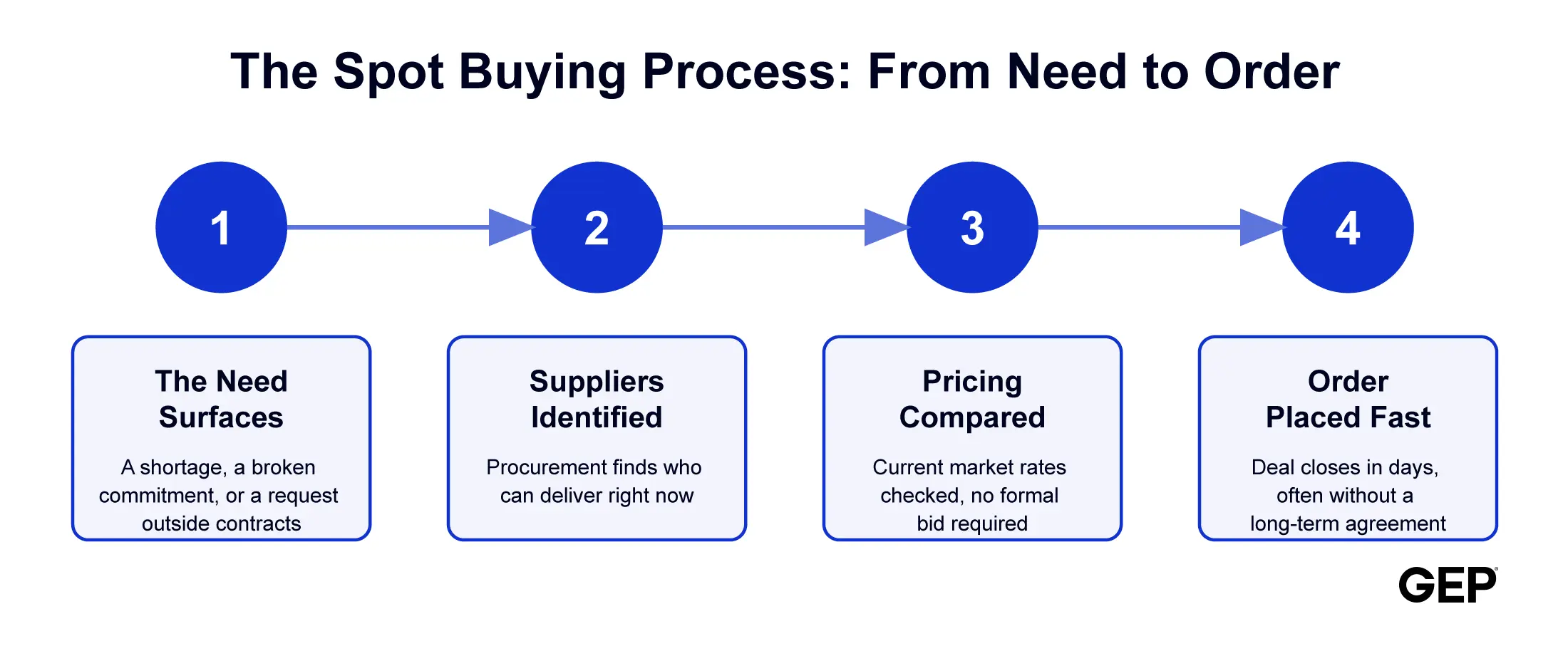
It usually starts with something breaking. A shortage. A supplier who doesn't deliver. A request for an item procurement that has never been touched before. From there, someone identifies available suppliers, checks current pricing, and places the order without any formal bid or long-term agreement. Days, not weeks. None of the negotiation depth you'd get from a proper sourcing event.
Why Does Spot Buying Occur in Procurement?
A few situations show up again and again: a sudden spike in demand, a supplier that fails to deliver, a seasonal or project need nobody planned for, a request for something procurement has never sourced. Different causes, same response. Buy now. Figure out the process later.
The Procurement Dilemma Behind Spot Buying
Here's the tension nobody resolves cleanly. Move fast, and you skip the checks that keep spend visible and suppliers accountable. Move slow, and the business unit waiting on the purchase starts working around procurement entirely. Teams end up weighing the cost of delay against the cost of an unmanaged buy, usually with less information than they'd like.
Strategic Sourcing vs. Spot Buying: Understanding the Trade-Off
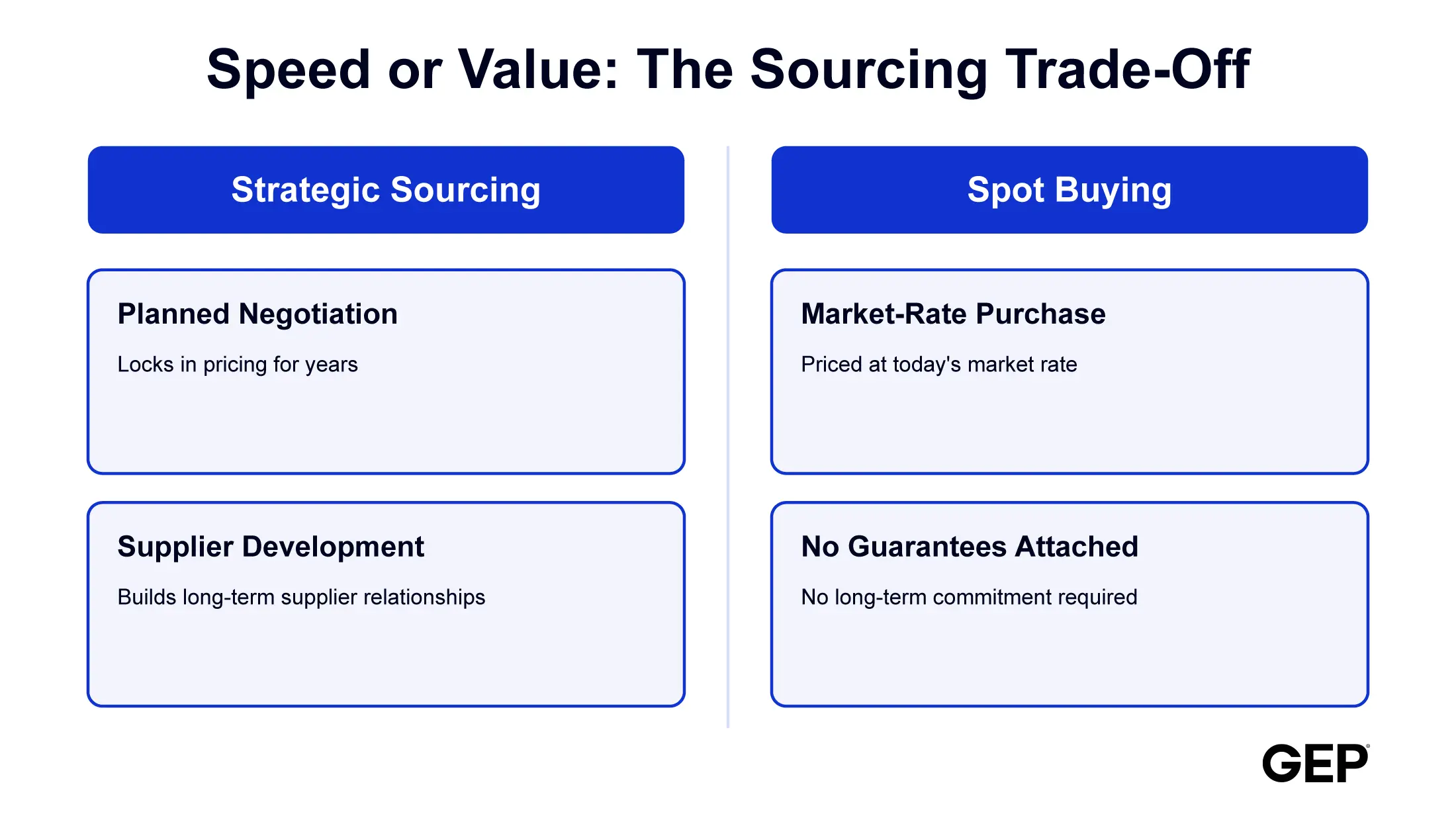
Strategic sourcing plays the long game: negotiated pricing, supplier development, volume commitments that pay off over years. Spot buying gives up all of that for speed. A strategic contract might lock in better terms and service guarantees for the next three years. A spot purchase solves today's problem at today's price and nothing more. Both have a role. The trouble starts when spot buying quietly becomes a default instead of the exception.
Common Challenges Associated With Spot Buying in Procurement
The friction adds up in predictable ways. Costs run above contracted rates. Supplier quality gets harder to track once you're buying outside the relationships you've built. Compliance and audit trails thin out, since spot purchases sit outside standard approval steps. And negotiating leverage disappears fast when suppliers know you need the order regardless of price.
When Is Spot Buying the Right Procurement Strategy? Set a threshold before you need one. Pick a dollar value or a volume cutoff, below which a spot purchase doesn't need a business case, and above which it goes through sourcing regardless of how urgent it feels. That single rule does more to keep spot buying honest than any judgment call made in the moment. Review it twice a year against actual spend and supplier performance, because what counted as low-volume last year might not this year.
Build a Smarter Spot Buying Process
Combine spend visibility with sourcing strategy to keep urgent purchases under control
Turning Spot Buying Into a Deliberate Strategy
Spot buying isn't going away. Supply chains don't run predictably enough for any sourcing calendar to cover every scenario. The teams that handle it well treat spot buying as one tool among several, chosen on purpose and tracked closely, not a fallback for whatever planning misses.
That discipline starts with visibility. Know where the spend is going. Know which suppliers actually deliver. Know which "one-off" purchases keep showing up every quarter. Get that right, and spot buying stops draining the budget quietly and starts working as part of a strategy built to hold up under pressure.
Explore GEP’s AI-Native Procurement Software




FAQs
It gives procurement a fast way to meet urgent or unplanned needs, take advantage of current market pricing, and avoid locking into a long-term commitment for a one-off purchase.
Because the need falls outside an existing contract, because speed matters more than negotiated terms at that moment, or because the purchase probably won't happen again.
Spot purchases tend to cost more than contracted rates, since they skip volume discounts and negotiated terms. Do it occasionally and the cost is manageable. Do it often and it adds up fast.
Not much. Procurement teams generally use the two terms interchangeably, both referring to a one-time purchase made outside a formal contract to meet an immediate need.