



15 Non-Negotiables for a Successful Procurement Transformation
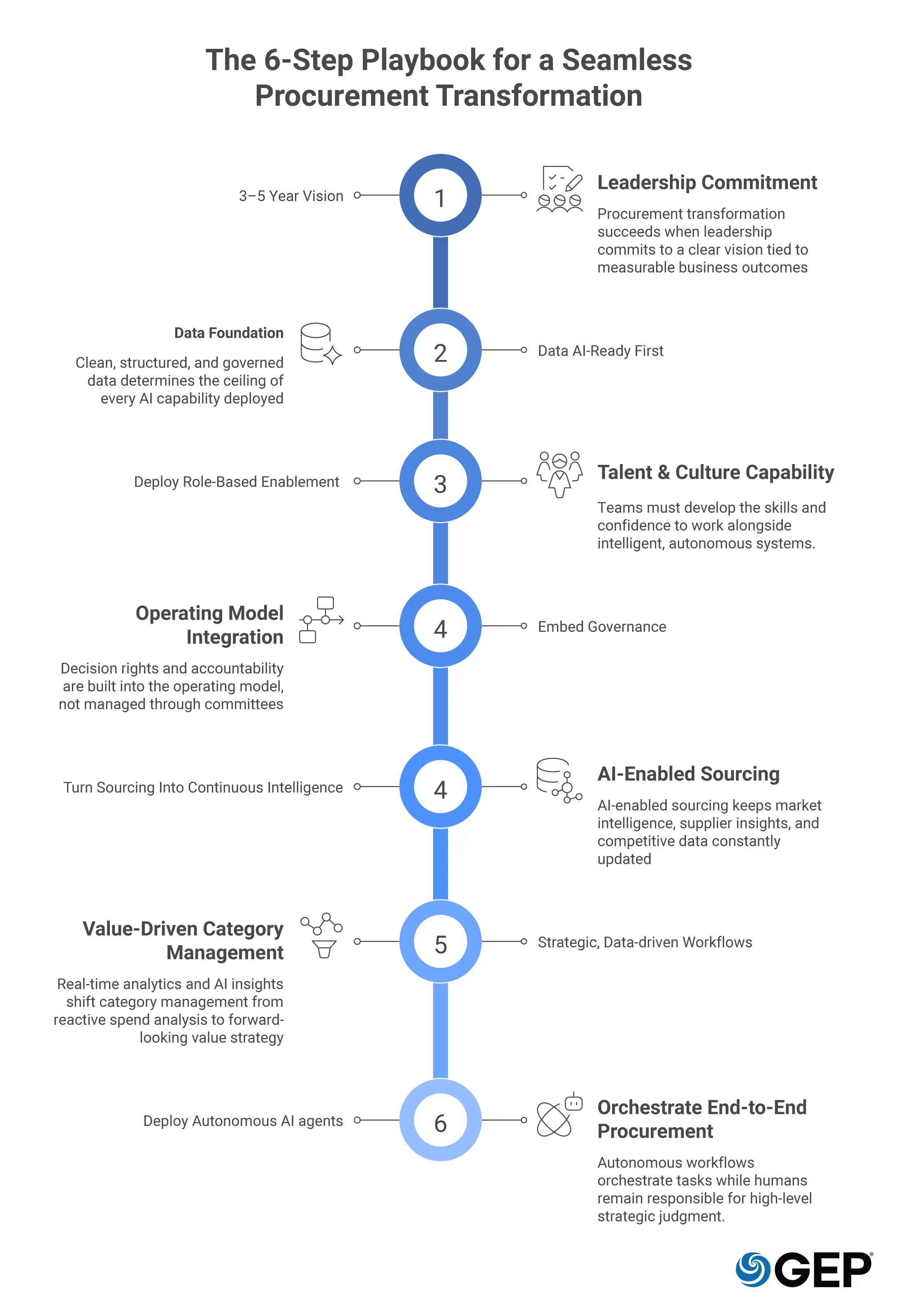
- Transformation without direction is just disruption. Every initiative needs to trace back to a measurable business outcome.
- AI performs at the ceiling your data allows. Get the foundation wrong, and every capability you build on top of it will underperform.
- Agentic AI plans, executes, and resolves exceptions across entire procurement workflows autonomously.
April 13, 2026 | Procurement Software 7 minutes read
Not long ago, procurement transformation meant process standardization, supplier consolidation, and ERP implementation; and for the time, that was enough.
Then came digital procurement transformation: e-sourcing platforms, spend analytics dashboards, supplier portals, and contract repositories that made the function more measurable and more connected to enterprise strategy. But the intelligence behind those systems remained largely human.
Platforms surfaced information, and people made the calls.
Soon, generative AI began shifting that calculus. Drafting RFPs, summarizing contracts, running should-cost models, and generating risk assessments became tasks measured in minutes.
Procurement strategy started evolving from "how do we process faster" to "how do we decide smarter."
Now, AI in procurement has entered its most consequential phase: agentic AI. Unlike traditional automation or generative AI, AI agents plan, reason, and autonomously execute multi-step workflows without waiting for human instruction at each step.
The volume and complexity of decisions required to operate a modern enterprise have outpaced human-only execution, and agentic AI is increasingly the only operating model that scales to meet that demand.
Ready to Make Orchestration Your Backbone?
Enterprise coordination turns procurement into strategic infrastructure
15 Critical Factors for Successful Procurement Transformation
Procurement transformation usually fails due to misaligned priorities, weak foundations, and the assumption that technology alone can close the gap. Success demands deliberate focus across every layer of the function: strategy, data, process, technology, and people.
Here are the 15 factors that separate transformations that compound value from those that stall after the first wave.
1. Build a Vision That Leadership Actually Owns
A transformation roadmap without executive conviction behind it is a slide deck, not a strategy. Your leadership team needs a documented, sponsored vision for what procurement should look like over the next three to five years. One where every initiative traces directly back to a measurable business outcome. When that connection is missing, transformation fragments into a collection of disconnected projects, each individually justifiable, collectively incoherent.
2. Make Your Data AI-Ready Before You Deploy AI
Every AI capability you deploy will perform at the ceiling your data allows. That means data cleansing, spend classification, taxonomy normalization, and master data governance aren't implementation tasks to schedule after go-live. They are the work that makes everything else possible. Get this wrong early, and you spend years managing workarounds instead of capturing value.
3. Strongly Govern Transformation
Procurement transformation intersects finance, legal, IT, and operations, and each function has its own timelines and tolerance for disruption. Without clearly defined ownership, decision rights, and escalation protocols established upfront, cross-functional friction will slow even well-resourced initiatives. Governance built into the operating model accelerates execution backed by compliant operations.
4. Turn Sourcing into a Continuous Intelligence Capability
AI-assisted sourcing compresses market analysis cycles, sharpens supplier selection, and keeps competitive intelligence current, turning sourcing into an ongoing function. The goal isn't to replace human judgment but to ensure that judgment is exercised after being informed by the best available data, rather than assumptions.
5. Lead Categories Strategically, Not Reactively
Category management that relies on historical spend data and annual reviews will always be one step behind market conditions. Powered by real-time analytics and AI-generated insights, mature category management shifts the conversation from cost containment to forward-looking value strategy.
Clear category ownership and enterprise-wide respect for category mandates aren't organizational niceties; they're what allow strategy to actually land.
6. Stop Leaving Value Buried in Contracts
Contracts should function as living business assets, not static documents filed and forgotten. But across most large enterprises, a substantial amount of contracted value leaks through poor obligation tracking, missed renewals, and important terms that were never enforced.
AI-powered contract lifecycle management spanning authoring, negotiation, compliance monitoring, and renewal management that systematically closes that gap.
7. Build Risk Monitoring That Never Sleeps
A supplier's financial distress, a geopolitical disruption, or a regulatory violation rarely arrives with advance notice. Reactive risk management built around periodic reviews and manual escalation is already a delayed response plan. Your transformation must embed continuous, AI-driven monitoring across the full supplier base so that risk signals surface immediately, not after the damage is done.
8. Use Procurement Cycles as a Feedback Engine, Not Just a Process
Be it invoice processing, three-way matching, exception handling, or the whole procure-to-pay cycle, must deliver real efficiency gains. The more consequential opportunity is treating P2P as a continuous feedback loop. The operational data flowing through this process should be actively improving your sourcing strategy, your supplier decisions, and your spend forecasts upstream.
9. Invest in Supplier Relationships Where It Actually Compounds
Not all supplier relationships deserve the same investment, and spreading SRM effort uniformly is one of the more reliable ways to dilute its impact. AI-driven segmentation lets you identify where deeper collaboration will generate the most durable value, and redirect resources accordingly.
10. Negotiate From Data, Not Instinct
Should-cost modeling gives procurement teams a defensible, data-grounded position before they enter a negotiation that’s built from actual cost drivers rather than benchmarks and intuition. In complex or high-value categories, the difference between teams that use this capability and those that don't will show up directly in margins.
11. Embed ESG Where It Can't Be Ignored
ESG must be a sourcing criterion, a supplier qualification threshold, and an ongoing compliance responsibility. AI-enabled screening and monitoring enable you to apply ESG standards consistently across your entire supply base.
12. Operate at Agentic Speed with Human Judgment
Agentic procurement platforms deploy autonomous AI agents capable of orchestrating end-to-end workflows. You don’t have a system that breaks when running sourcing events, managing negotiations within defined guardrails, processing contracts, and resolving exceptions at each handoff.
This moves workflows from incremental automation to a unified operating model that sustains performance at speed and consistency, even amid volatility and scale.
13. Measure What Maturity Actually Looks Like
Cost savings remain important, but a procurement transformation metrics framework built around cost savings alone will consistently underreport what a high-performing function is actually delivering.
- Track AI suggestion quality and adoption rates.
- Monitor autonomous resolution rates and exception frequency.
- Measure cycle times, supplier performance trends, and the degree to which procurement outcomes are influencing broader business results.
What you measure in year one should look substantially different by year three — and that evolution is itself a signal of maturity.
14. Design the Function to Keep Getting Smarter
Treat procurement transformation as a continuous capability-building discipline rather than a fixed-scope implementation. Structured feedback loops, rigorous post-implementation reviews, and systematic capability upgrades ensure that performance compounds over time instead of plateauing after the initial wave.
15. The Platform Is Only as Good as the People Behind It
Technology alone has never transformed a procurement function. The most capable AI platform will consistently underperform when deployed in an organization where people lack the skills to act on its outputs or the confidence to trust them.
Role-specific enablement, credible change management, and a culture where AI is treated as a collaborator rather than a threat. The talent profile of a high-performing procurement team is shifting, and closing that gap is a leadership responsibility, full stop.
Organizations that execute across all 15 of these factors don't just transform their procurement function but build a durable competitive advantage that compounds as their AI capabilities mature.
The Path to Autonomous Procurement
Unified source-to-pay designed for agentic AI adoption
The Procurement Function of Tomorrow Is Being Built Right Now
The trajectory is clear: greater intelligence, greater autonomy, greater strategic influence. AI agents will take on increasingly complex decision-making, not just within structured workflows, but across dynamic scenarios that once required senior judgment.
The procurement leaders who will shape this future are making the right foundational decisions today in their data, governance, platform architecture, and culture.
Design your transformation roadmap with agentic orchestration, not as an optional upgrade, but as core functionality.
Every platform decision, data initiative, and organizational design choice should be evaluated against one question: Does this move you closer to autonomous, intelligent procurement, or does it create technical debt that slows you down?
If you're ready to move beyond incremental improvement and build a procurement function that operates at the speed and intelligence that modern enterprise demands, explore what an autonomous procurement orchestration platform can do for your organization.




FAQs
AI contributes to procurement transformation by automating routine processes and augmenting human decision-making with real-time analysis. At its most advanced state, it can autonomously orchestrate complex workflows that plan, execute, and adapt without constant human intervention.
An effective AI strategy in procurement stands on four pillars: clean, well-governed data; use cases tied directly to business outcomes; a governance framework that ensures AI decisions are auditable and accountable; and a change management program that builds genuine human capability, not just awareness. Miss any one of them and the technology will disappoint, regardless of how sophisticated it is.
Yes, when deployed within a well-designed governance framework. Agentic AI systems operate within configurable guardrails, escalation thresholds, and full audit trails that give enterprises the control and transparency required for high-stakes decisions. For most large enterprises, the cost of not adopting agentic AI is the more relevant risk. This could translate to falling behind in efficiency, supplier responsiveness, and compliance management, to say the least.