


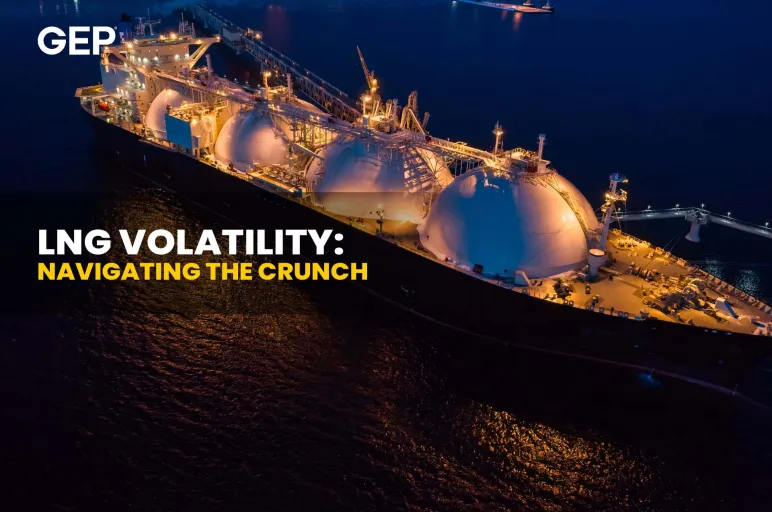
The Global LNG Crunch: Mitigating Energy Volatility in Industrial Supply Chains
- A single chokepoint disruption can remove close to a tenth of global LNG supply, which is what the current crunch has done.
- Chemicals, automotive and other energy-intensive sectors absorb the shock as higher input costs, surcharges and longer lead times.
- The answer is a layered hedging approach and diversified sourcing, not a large long-term commitment signed at crisis prices.
October 12, 2026 | Supply Chain News 5 minutes read
Liquefied natural gas was supposed to be the flexible, seaborne answer to pipeline dependence. In practice, it carries its own concentration risk. A large share of the world's LNG moves through a handful of maritime chokepoints, and when one of them closes, the shortfall shows up in every importing market at once.
The closure of the Strait of Hormuz took cargoes off the water, buyers across continents started bidding against each other for what remains. And that’s just one choke point. The Economist puts the shortfall at roughly 39 million metric tonnes, close to 9% of the previous year's global supply, with Asian LNG near $25 per million British thermal units and European storage at its lowest recorded level for that point in the year.
Those figures will move. The lesson behind them holds: energy-intensive manufacturers carry exposure to events they cannot influence, and that exposure sits in contracts signed long before the disruption.
The GEP Global Supply Chain Volatility Index
Get the latest intelligence on global supply chain volatility and anticipate risks before they impact your business
How Energy Volatility Ripples Through Manufacturing and Chemicals
Gas does two jobs in industry. It fires furnaces, boilers and dryers, and in chemicals it is also a feedstock. Fitch Ratings has pointed to that dual role as the reason chemical producers feel gas price swings so quickly in their margins (Petra).
From there, the cost works its way down the chain. A chemical plant that trims output or reprices its book passes the change to converters within weeks. Metals, glass and castings suppliers run heat-heavy processes of their own, so they follow with surcharges. By the time the pressure reaches the buying desk, it looks like a price increase notice, stretched lead times, or in worst cases, an allocation notice.
Exposure is also uneven. Plants on long-dated contracts ride out a spike that hits spot-reliant sites hard, and two facilities in the same company can end up in very different cost positions. That variation is worth mapping before the next disruption, not during it.
Hedging and Long-Term Contracting in Volatile Energy Markets
In a tight market, the familiar questions get harder: when to hedge, how much volume to cover and for how long. GEP's energy sourcing practice treats these as the core of portfolio and risk management. Three principles hold up across cycles.
Layer your Cover
Buying in tranches over several months beats committing a large volume on one day, because it averages your position instead of betting on a single price.
Match Contract Length to the Outlook
The Economist notes that American liquefaction capacity is expected to nearly double by 2030, so today's shortage could invert later in the decade. A long fixed-price deal struck at the top can look expensive for years. Shorter terms, index-linked pricing with caps or collars, and reopener clauses preserve room to move.
Keep Volume Flexible
Swing rights let you adjust as production plans change, which matters when demand softens and you would otherwise be paying for gas you cannot use.
How GEP Strategy and Consulting Supports Energy Procurement and Resilience
GEP Strategy works with procurement and supply chain leaders on strategic cost management and supply risk management. On energy, GEP manages over $5 billion in spend across electricity, natural gas and related categories, with category specialists tracking the daily price movements and regulatory developments that feed hedging decisions.
For chemical producers, GEP applies supply risk models and diversified sourcing, supported by GEP Quantum Intelligence, its AI-native platform for procurement and supply chains. The objective holds across sectors: a clear picture of where energy exposure sits, a sourcing plan that does not depend on one route or supplier, and contract terms that survive a turn in the market.
Energy Strategies for the Chemicals and Automotive Sectors
Chemicals
Because gas is both fuel and feedstock, feedstock coverage comes first. Qualify alternate suppliers while you still have time to run trials, and review customer contracts for pass-through language so cost increases can be recovered rather than absorbed.
Automotive
Gas rarely appears as a line item here, yet it is embedded in steel, aluminum, glass, castings and paint. Ask tier 1 and tier 2 suppliers direct questions about their energy exposure, and map sub-tier sources for parts made through gas-intensive processes. For critical components, energy-cost indexation written into the agreement is easier to manage than surcharge requests arriving one at a time.
Build Energy Resilience Into Your Supply Chain
See how GEP helps energy-intensive manufacturers hedge price volatility, diversify sourcing and lock in contract terms that hold through the cycle
From Crunch to Glut: Preparing for What Comes Next
Tight markets rarely stay tight indefinitely. The Economist's analysis suggests the sharper the squeeze now, the larger the oversupply once delayed projects land, which points to volatility in both directions rather than a return to calm. Buyers who build flexibility during the shortage are the ones positioned to capture lower prices when the balance shifts.
Treat energy as a strategic category with its own risk model, not as a utility bill, and you will be better placed on both sides of the cycle.




BLOG CATEGORIES
FAQs
The closure of the Strait of Hormuz, a chokepoint that carries roughly a fifth of global LNG, led Qatar to halt shipments. Europe and Asia have since been competing for the remaining cargoes, with Europe entering the season at unusually low storage levels.
Plants face higher fuel and feedstock costs, supplier surcharges and longer lead times. Chemicals sit at the front of the impact because gas is both an energy source and a raw material, and the cost pressure then moves downstream into metals, glass, automotive parts and other heat-intensive chains.
It reduces the impact without removing it. Spreading volume across suppliers, regions and contract structures lowers dependence on any single route, but prices still track a global market, so diversification works best alongside a disciplined hedging approach.