


Solving the Data Latency Trap in Global Procure-to-Pay Workflows Using Agentic AI
- Data latency distorts every downstream decision in your procure-to-pay cycle.
- Agentic AI replaces batch processing with continuous, autonomous action across your P2P workflow.
- Real-time data processing cuts cycle times, strengthens compliance, and scales without adding headcount
June 15, 2026 | Procurement Strategy 6 minutes read
You already know the feeling: you are making a decision based on data that is hours, sometimes days, old. By the time a purchase order clears one system and surfaces in another, the world has already moved. Prices have shifted. Supplier lead times have changed. A payment that should have gone out yesterday is sitting in a queue somewhere.This is the data latency trap. It is not dramatic or sudden. It creeps in quietly, and before long, it is costing you in missed savings, compliance gaps, and relationships with suppliers that slowly erode because payments are unpredictable. In a global procure-to-pay environment, where every timezone adds friction and every system integration adds a delay, latency is not a minor inconvenience. It is a structural problem. And it needs a structural fix.
Procurement deserves real-time intelligence
GEP helps close data gap and run P2P full-speed.
How Data Latency Affects Procure-to-Pay Efficiency and Decision-Making
Here is the real issue with latency: it does not just slow things down. It distorts your picture of reality. When your procurement data is stale, every decision downstream is built on a shaky foundation. Your finance team is forecasting cash flow based on payment timelines that have already slipped.
Your category managers are negotiating contracts without knowing what the actual spend looks like today, right now, this week.
In a global operation, this gets compounded fast. You have ERPs that sync overnight. You have regional teams working with local tools that talk to the central system on a schedule nobody remembers setting. You have suppliers sending invoices in formats that take time to process. The result: a procure-to-pay cycle that is technically running, but always slightly behind the truth. And in procurement, being slightly behind is often enough to miss the window entirely.
The Role of Agentic AI in Mitigating Data Latency in Procure-to-Pay
Agentic AI is not just a smarter chatbot. It is an AI system that can take initiative, monitor streams of data, make decisions within defined rules, trigger actions, and keep learning as it goes. That is exactly what a latency problem needs. Here is how it plays out across the procure-to-pay cycle:
Continuous Data Monitoring Across Systems
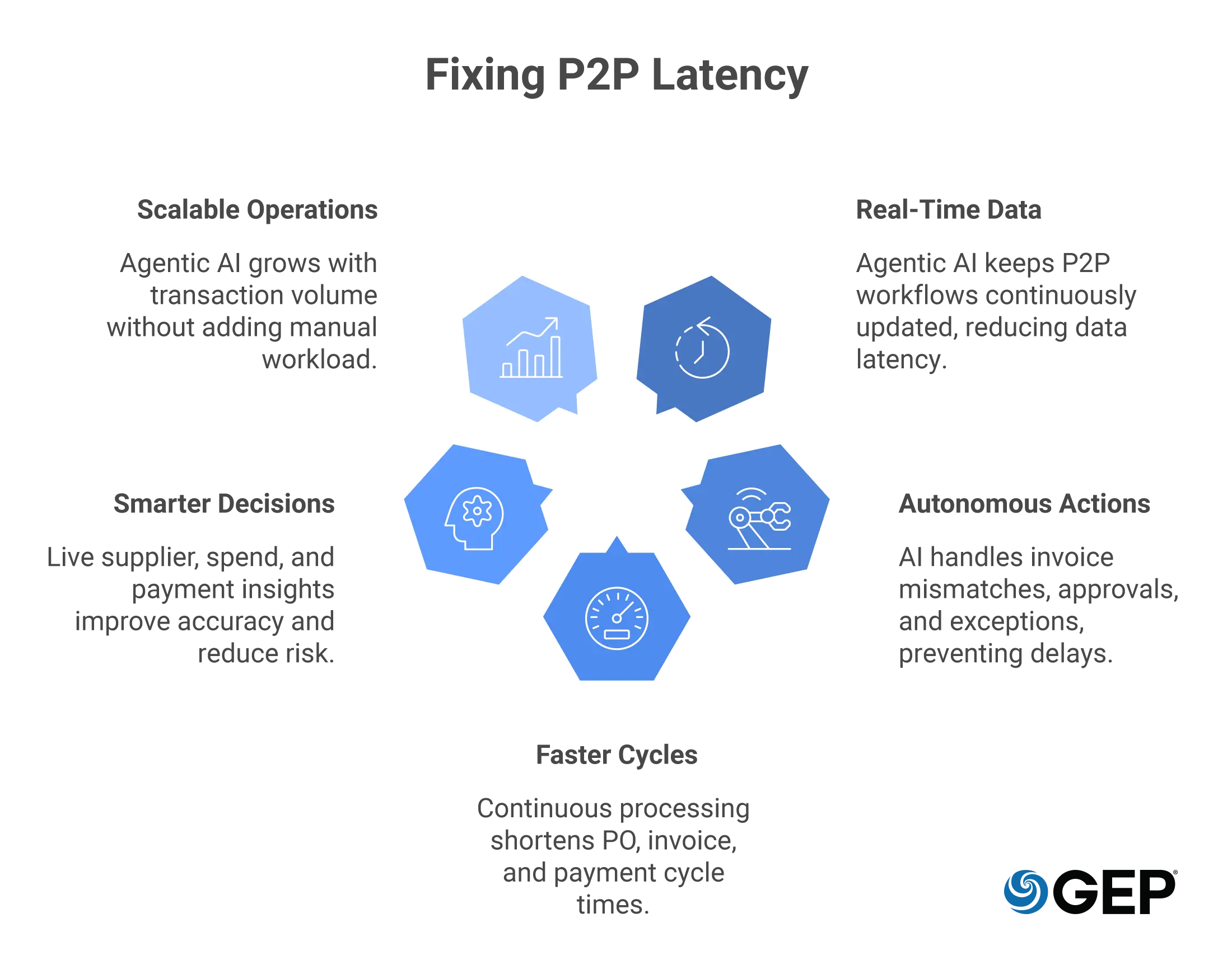
Traditional integrations run on schedules. Agentic AI monitors continuously. It watches supplier portals, ERP feeds, payment systems, and logistics data in real time and flags discrepancies the moment they appear, not after the next scheduled sync.
Autonomous Exception Handling
A huge portion of the latency in P2P comes from exceptions that sit waiting for a human to review them. Agentic AI can be configured to handle routine exceptions autonomously: mismatched invoice lines, duplicate entries, missing PO references. It resolves what it can and escalates only what genuinely needs a human call.
Dynamic Purchase Order Management
When conditions change, like a supplier update or a pricing revision, agentic AI can update purchase orders in real time rather than waiting for a manual review cycle. That alone can shave days off the average cycle time in complex, multi-entity procurement environments.
Real-time Supplier Communication and Status Tracking
Instead of waiting on email updates or supplier portal logins, agentic AI can pull status information from across the supply chain network continuously. If a delivery is at risk or an invoice has been stuck for more than 48 hours, it knows before you have to ask.
Predictive Cash Flow and Payment Intelligence
With real-time data feeding a model that understands your payment patterns and supplier terms, agentic AI can give your finance team a genuinely current view of upcoming cash requirements, not a spreadsheet built on last week's data.
Key Advantages of Using Agentic AI for Real-Time Data Processing
The latency fix is the headline, but the advantages compound well beyond that:
Faster Cycle Times Across The Board
When data moves in real time and routine decisions are handled automatically, the end-to-end P2P cycle gets measurably shorter. Companies using agentic AI in their procurement workflows have seen significant reductions in invoice processing time and payment cycle length.
Better Compliance And Audit Readiness
Real-time processing means every action is logged as it happens. For teams dealing with multi-jurisdiction compliance requirements, that live audit trail is genuinely valuable. No more reconstructing timelines after the fact.
Reduced Manual Workload on Team
Your procurement and AP teams are talented people. They should not be spending their day chasing PO confirmations or resolving three-way match failures that a system could handle. Agentic AI takes the high-volume, low-judgment tasks off their plate.
Improved Supplier Relationships
Suppliers notice when payments are consistent and communication is clear. Real-time data processing makes it possible to honor early payment terms reliably, respond to supplier queries faster, and build the kind of predictability that strengthens long-term partnerships.
Scalability Without A Linear Headcount Increase
As your procurement operation grows, agentic AI scales with it. The system handles increased transaction volumes without requiring a proportional increase in staff, which is the kind of operational leverage that makes CFOs pay attention.
Stay ahead of shifting spend dynamics across key categories
Explore the GEP Spend Category Outlook to inform data driven decisions
The Evolution of Procurement Workflows with Agentic AI
Not long ago, digitizing procurement meant moving from paper to email to ERP. That felt like a big leap at the time. What we are seeing now is the next evolution: from digitized to genuinely intelligent. Procurement workflows are beginning to sense, adapt, and act on their own within the boundaries you set. The role of the procurement professional is shifting from transaction manager to orchestrator. The tools handle the data velocity. You handle the strategy. That is a much better use of your time, and honestly, it makes the work more interesting too.
Procurement at The Speed of Now
Data latency in procure-to-pay is a solvable problem. Agentic AI gives procurement teams real-time intelligence and autonomous processing capability to close the gap between when data is created and when it actually drives a decision. The result: faster cycles, stronger compliance, and a procurement function that finally operates at the speed of the business.
Explore GEP’s Agentic AI Procure to Pay Orchestration Software




Frequently asked questions
Data latency is the gap between when information is generated and when it is actually available to you in a usable form. In global procurement, that gap exists everywhere: between your ERP and your supplier portal, between your regional finance systems and your central reporting, between an invoice being submitted and it appearing in your AP queue. It is a problem because every decision you make during that gap is based on incomplete or outdated information, and in procurement, that directly affects cost, compliance, and supplier trust.
Agentic AI improves accuracy in two ways. First, it processes data continuously rather than in batches, which means the information you are working with reflects what is actually happening right now. Second, it applies consistent rules to every transaction: no human fatigue, no oversight on the 500th invoice of the day. The combination of real-time processing and rule-based consistency dramatically reduces the errors and discrepancies that accumulate in manual or semi-automated P2P environments.
It depends on the complexity of your existing landscape, but a phased integration into a mid-to-large enterprise P2P environment typically runs anywhere from three to nine months for the initial deployment. Smart platforms are built to integrate with major ERPs and source-to-pay systems, which significantly reduces the technical lift. Most organizations start with a specific high-volume process like invoice matching or payment reconciliation, demonstrate value there, and then expand. You do not need to overhaul everything at once.