


What Does AI Really Change in Manufacturing Supply Chains?
- AI and automation improve supply chain performance when embedded into everyday decisions, not layered on as separate tools.
- Start small with one high-impact use case, connect your data, and scale what delivers measurable business value
- The real advantage comes from faster, smarter decision-making across planning, sourcing, and execution.
August 26, 2026 | Supply Chain 5 minutes read
If you’ve been in procurement and supply chain long enough, you’ve seen plenty of transformation waves. Most improved efficiency. Almost none changed how decisions actually get made.
This one is different. Artificial intelligence and automation are not just speeding things up. They are changing how your supply chain senses demand, evaluates risk, and executes decisions in real time.
But the real value is not in understanding that AI is transforming supply chains. It is in knowing how to actually make it work inside your organization without getting stuck in endless pilots.
Let’s make this practical.
Ready to Make AI Work in Your Supply Chain?
Turn AI and automation into measurable outcomes across the supply chain
Understanding AI-Native Automation in Manufacturing Supply Chains
At a practical level, AI-native automation means intelligence built into everyday workflows. Not separate analytics dashboards. Not reports that sit unused.
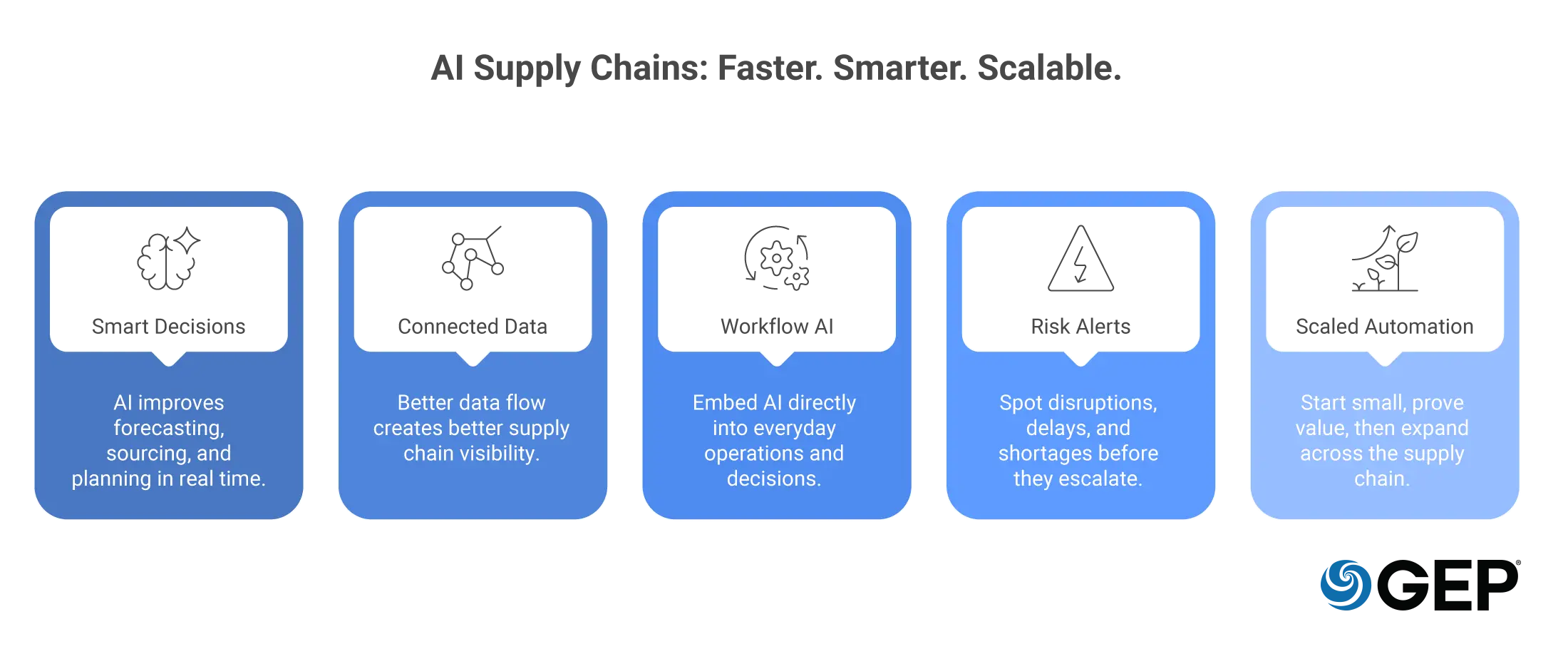
Think of it this way. Your supply chain already runs on decisions. Forecasting, sourcing, planning, logistics. AI simply improves how those decisions are made and executed.
For example:
- Instead of static forecasts, AI continuously recalibrates demand based on signals like orders, market trends, and seasonality
- Instead of manual supplier evaluation, AI scores suppliers dynamically on risk, cost, and performance
- Instead of reactive logistics planning, AI adjusts routes and modes based on real-time disruptions
The shift is from manual coordination to intelligent orchestration.
But to get there, you need a structured approach.
Also Read: Five Examples of AI in Supply Chains
Key Challenges in Automating Manufacturing Supply Chains
Before jumping into execution, it helps to be clear about where things typically break.
Most manufacturing supply chains struggle with three realities.
First, data is fragmented. ERP systems, planning tools, spreadsheets, supplier portals. AI in supply chain cannot deliver value if your data is disconnected.
Second, processes are inconsistent. The same sourcing event handled differently across regions. Different planning assumptions across plants. Automation needs standardization to scale.
Third, teams are overloaded. People are already managing exceptions all day. If AI is positioned as extra work, adoption will fail.
So, the goal is not just to introduce AI and automation. It is to simplify, standardize, and then scale.
How AI is Transforming Manufacturing Supply Chains: Core Strategies
Start With One Decision, Not the Whole Supply Chain
Do not try to transform everything at once.
Pick one high impact decision area. Demand forecasting, supplier risk, or inventory optimization are usually good starting points.
Ask a simple question. Where are we consistently making suboptimal decisions due to lack of visibility or speed?
For example, if forecast accuracy is low, start there. If supplier disruptions are frequent, focus on risk intelligence.
This keeps the scope tight and measurable.
Build a Usable Data Foundation, Not a Perfect One
You do not need perfect data to start. You need connected data.
Bring together the minimum viable datasets required for your use case:
- Historical demand and order data
- Inventory levels across locations
- Supplier performance and lead times
- Production constraints
The key is accessibility, not perfection. AI models improve over time, but only if they have something to learn from.
A common mistake is waiting for a full data transformation before starting. That delays value unnecessarily.
Embed AI Into Existing Workflows
This is critical. If your AI outputs sit in a separate dashboard, adoption will be low.
Instead, integrate intelligence directly into workflows your teams already use.
For example:
- Show AI-native forecast recommendations inside your planning tool
- Embed supplier risk scores into sourcing workflows
- Provide inventory optimization suggestions within replenishment systems
The goal is simple. Make the better decision the easiest decision.
Create a Human in the Loop Model
AI should not replace your team’s judgment. It should augment it.
Set clear rules on where AI makes decisions automatically and where human validation is required.
For example:
- Low risk purchase orders can be auto approved
- High-value sourcing decisions still require human review
- Exception scenarios are escalated with AI recommendations
This builds trust while maintaining control.
Focus on Exception Management
Your team does not need help with routine decisions. They need help with exceptions.
Use AI to identify and prioritize exceptions:
- Demand spikes or drops
- Supplier delays or risks
- Inventory shortages or excess
Then guide users with recommended actions.
This is where AI in supply chain creates real productivity gains. Your team spends less time firefighting and more time solving meaningful problems.
Measure What Actually Matters
Do not just track model accuracy. Track business outcomes.
For each use case, define clear metrics:
- Forecast accuracy improvement
- Inventory reduction
- Service level improvement
- Supplier risk mitigation
Tie these metrics to financial impact. This helps justify scaling efforts.
Scale Through Platforms, Not Point Solutions
Once you see results, the next challenge is scaling.
Avoid building isolated solutions for each use case. Instead, move toward integrated platforms that connect planning, sourcing, and execution.
This is where solutions like AI-native Supply Chain Management Software come into play. They allow you to extend AI and automation across the supply chain without rebuilding everything from scratch.
Scaling is less about technology and more about consistency in how decisions are made.
Build Internal Capability Alongside Technology
One thing often overlooked is capability building.
Your team does not need to become data scientists. But they do need to understand:
- How AI recommendations are generated
- When to trust the system and when to override
- How to interpret insights and take action
Invest in this early. Adoption depends more on people than technology.
Stay ahead of shifting spend dynamics across key categories.
Explore the GEP Spend Category Outlook to inform data driven decisions.
The Future of Manufacturing Supply Chains with AI and Automation
As you implement these steps, you will start to see a shift.
Your supply chain becomes more proactive. Instead of reacting to disruptions, you anticipate them.
Planning becomes continuous. Decisions are updated in real time, not in monthly cycles.
Collaboration improves. Procurement, planning, and operations work from the same data and insights.
And most importantly, your team moves up the value chain. Less time on manual tasks. More time on strategic decisions.
This is what transforming supply chain management actually looks like in practice.
Conclusion
AI and automation are not a silver bullet. But when applied correctly, they fundamentally improve how your supply chain operates.
Start small. Focus on one decision area. Build a connected data foundation. Embed intelligence into workflows. Scale what works.
Because at the end of the day, competitive advantage in manufacturing supply chains comes down to one thing.
How fast and how well you make decisions.
AI simply makes that better.




BLOG CATEGORIES
FAQs
AI analyzes historical data, market signals, and external factors to continuously refine forecasts, making them more accurate and responsive to change.
Yes, AI identifies risks early and recommends alternative actions, helping organizations respond proactively and maintain continuity.
Industries with complex supply chains such as automotive, electronics, pharmaceuticals, and consumer goods benefit significantly.
Technologies include machine learning, predictive analytics, natural language processing, and integrated data platforms that enable real time decision-making.