  • contact
  • language
    • English
    • Français
    • Deutsch
  • search
X
    GEP Logo GEP Logo
    • Company  
        • About Us 
        • Culture 
        • Careers 
        • Contact Us 
        • AI-First at GEP
        • Sustainability at GEP
        • UPDATE FOR EXISTING CLIENTS

        About Us

        • Leadership
        • Customers
        • Partners
        • News
        • GEP in the News
        • Events
        • Mission & Vision
        • Awards & Recognition
        • Contact Us
        GEP leads Gartner 2025 Magic Quadrant for Source-to-Pay Suites

        GEP Is a Leader in the 2026 Gartner® Magic Quadrant™ for Source-to-Pay Suites

        Read More
        GEP Webinar - Put Agentic AI to work in procurement
        Register Now

        Culture

        • Diversity
        • GEP Cares
        • GEP Core Values
        • Women at GEP
        A Procurement Software Platforms Leader — 4 Years Running

        GEP & Xylem Unite to Bring Clean Water to 1,800 in Maharashtra

        Mapping & Reducing Scope 3 Emissions: A Quickstart Guide for Procurement Pros

        GEP & Akshaya Patra: Partnering to Deliver 4 Billion Meals and Fight Hunger Worldwide

        Careers

        • Explore Global Careers Opportunities
        • North American
        • Europe
        • India
        • Latin America
        • Asia-Pacific
        • Life at GEP
        • Join Us
        • Campus Connect
        TOP EMPLOYER 2025 - USA
        TOP EMPLOYER 2025 - UK
        TOP EMPLOYER 2025 - INDIA
        TOP EMPLOYER 2025 - Costa Rica

        Contact Us

        • Ask Us
        • Request for Proposal
        • Schedule a Demo
        • Share Feedback
        GEP - AMERICA

        GEP in the Americas

        GEP - EUROPE

        GEP in Europe

        GEP - ASIA

        GEP in Asia

        GEP - AFRICA

        GEP in Africa 

        GEP - Middle East

        GEP in the Middle East

        AI-First at GEP

        Sustainability at GEP

        UPDATE FOR EXISTING CLIENTS

    • Solutions  
        • GEP Quantum Intelligence 
          • Intake & Orchestration
        • GEP E-Invoicing 
          • E-Invoice Receiving
        • Strategy 
          • Procurement Consulting  
          • Supply Chain Consulting  
        • Managed Services 
          • Procurement Outsourcing  
          • Supply Chain Outsourcing  

        GEP Quantum Intelligence

        GEP Quantum Intelligence (Qi)

        Solutions

        • Intake & Orchestration
        • Sourcing Management
        • Contract Management
        • Supplier Management
        • Intelligent Category and Spend Management
        • Procure to Pay
        • Third-Party Risk Management
        • ESG Tracking & Reporting
        • Supply Chain Management

        Experience Agentic Intake & Orchestration

        PLATFORM

        • AI-Native Architecture
        • Agentic Integration
        • GEP Quantum Intelligence Studio

        UPDATE FOR EXISTING CLIENTS

        • Important note for existing GEP Software Clients 

        GEP E-Invoicing

        Intelligent e-invoicing for seamless global compliance

        • Invoice Sending
        • Invoice Receiving
        • E-Invoice Compliance
        • E-Invoice Network
        • Compliance Navigator
        • Digital Supply Chain
        A Procurement Software Platforms Leader — 4 Years Running

        Tariff Resource Center: Strategies, Insights and Action Plans

        Read More

        Strategy

        Unrivaled supply chain and procurement expertise + the transformative power of AI

        Procurement Consulting

        • Procurement Transformation
        • Digital Procurement Transformation
        • Opportunity Assessment
        • M&A Services

        Supply Chain Consulting

        • Supply Chain Strategy
        • AI Readiness
        • Inventory Optimization
        • Network Strategy & Optimization
        • Warehousing & Transportation Management
        • Supply Chain Risk & Resilience
        • ESG & Sustainable Supply Chains
        GEP Webinar - Put Agentic AI to work in procurement
        Register Now

        Procurement Consulting

        • Procurement Transformation
        • Digital Procurement Transformation
        • Opportunity Assessment
        • M&A Services
        6 Strategies for CPG Companies To Supercharge Sales and Operations Planning

        6 Strategies for CPG Companies To Supercharge Sales and Operations Planning

        Read More

        Supply Chain Consulting

        • Supply Chain Strategy
        • AI Readiness
        • Integrated Planning
        • Inventory Optimization
        • Network Strategy & Optimization
        • Operations & Manufacturing Excellence
        • Warehousing & Transportation Management
        • Supply Chain Risk & Resilience
        • ESG & Sustainable Supply Chains
        Mapping & Reducing Scope 3 Emissions: A Quickstart Guide for Procurement Pros

        10 Practical Steps To Reduce Scope 3 Emissions

        Read More

        Managed Services

        World-class skills, experience and know-how — amplified by the power of AI

        Procurement Outsourcing

        • Source-to-Contract
        • Spend Analysis 
        • Procure-to-Pay
        • Cost Recovery & Invoice Auditing

        Supply Chain Outsourcing

        • Planning & Forecasting
        • Inventory Management
        • Logistics Management
        • Supply Chain Data Management
        GEP Webinar - Put Agentic AI to work in procurement
        Register Now

        Procurement Outsourcing

        • Source-to-Contract
        • Spend Analysis
        • Strategic Sourcing
        • Category Management
        • Tail-Spend Management
        • Procurement Support Services
        • Procure-to-Pay
        • Cost Recovery & Invoice Auditing
        • Accounts Payable
        GEP Named a Leader in Procurement Outsourcing Services

        GEP Named a Leader in Procurement Outsourcing Services

        Read More

        Supply Chain Outsourcing

        • Planning & Forecasting
        • Inventory Management
        • Logistics Management
        • Supply Chain Data Management
        • Supply Chain Risk Management
        GEP Named a Leader in Procurement Outsourcing Services

        Expanding the Possibilities for Procurement and Supply Chain Management by Using AI

        Read More
    • Industries  
        • Explore by Industry 

        Explore by Industry

        • Automotive
        • Chemicals
        • Consumer Packaged Goods
        • Energy & Utilities
        • Financial Services
        • Government & Nonprofit
        • Industrial Manufacturing
        • Life Sciences
        • Oil & Gas
        • Private Equity
        • Retail
        • Telecommunications, Media & Technology
        • High-Tech
        • Media & Entertainment
        • Software, Social & Platforms
        • Telecom
        • Travel & Hospitality
    • Knowledge Bank  
        • Explore by Topic 
        • Explore by Type 
        • Global Supply Chain Volatility Index

        Explore by Topic

        • Artificial Intelligence
        • Digital Transformation
        • Software & Technology
        • Strategy & Planning
        • Operations
        • Procurement
        • Sustainability
        • Inflation Strategies
        GEP Webinar - Put Agentic AI to work in procurement
        Register Now

        Explore by Type

        • White Papers
        • Research Reports
        • Bulletins
        • Case Studies
        • Webcasts
        • Blogs
        • Podcasts
        • Insights From the Top
        • Info Guide
        Resilience: Delivering Value Amid Volatility

        Resilience: Delivering Value Amid Volatility

        Read More

        Global Supply Chain Volatility Index

    • Careers
      • Join Us
      • Life at GEP
      • Campus Connect
    • Partners

    Contact Us GET DEMO

       
    • GEP Quantum Intelligence ›
      • GEP Quantum Intelligence
      • ‹ Back
        • AI-Native Architecture
        • Sourcing Management
        • Contract Management
        • Supplier Management
        • Intelligent Category Management
        • Procure to Pay
        • Third Party Risk Management
        • ESG Tracking & Reporting
        • Intake & Orchestration
        • Agentic Integration
        • GEP Quantum Intelligence Studio
        • Supply Chain Management
    • GEP Strategy ›
      • GEP Strategy
      • ‹ Back
        • Procurement Consulting ›
          • Procurement Consulting
          • ‹ Back
            • Procurement Transformation ›
              • Procurement Transformation
              • ‹ Back
                • Procurement Strategy
                • Org. Design & Implementation
                • Capability Building
                • Change Management
                • Governance & Performance
                • Processes & Policies
                • S2P Operations
                • Sourcing & Category Management
                • Technology
            • Digital Procurement Transformation
            • Opportunity Assessment
            • M&A Services ›
              • M&A Services
              • ‹ Back
                • M&A Clean Room
        • Supply Chain Consulting ›
          • Supply Chain Consulting
          • ‹ Back
            • Supply Chain Strategy
            • AI Readiness
            • Integrated Planning
            • Inventory Optimization
            • Network Strategy & Optimization
            • Operations & Manufacturing Excellence
            • Warehousing & Transportation Management
            • Supply Chain Risk & Resilience
            • ESG & Sustainable Supply Chains
    • GEP Managed Services ›
      • GEP Managed Services
      • ‹ Back
        • Procurement Outsourcing ›
          • Procurement Outsourcing
          • ‹ Back
            • Source-to-Contract
            • Spend Analysis
            • Strategic Sourcing ›
              • Strategic Sourcing
              • ‹ Back
                • MRO
                • CAPEX
                • Logistics
                • Packaging
                • IT & Telecom
                • Energy
                • Direct Materials
            • Category Management ›
              • Category Management
              • ‹ Back
                • Contract Management
                • Supplier Performance Management
                • Savings & Compliance Tracking
            • Supply Market Intelligence  
            • Tail-Spend Management Services
            • Procurement Support Services ›
              • Procurement Support Services
              • ‹ Back
                • eSourcing
                • Supplier Performance Management
                • Savings & Compliance Tracking
                • Sourcing Support
            • Procure-to-Pay
            • Cost Recovery & Invoice Auditing
            • Accounts Payable
        • Supply Chain Outsourcing ›
          • Supply Chain Outsourcing
          • ‹ Back
            • Planning & Forecasting
            • Inventory Management
            • Logistics Management
            • Supply Chain Data Management
            • Supply Risk Management
    • GEP E-Invoicing ›
      • GEP E-Invoicing
      • ‹ Back
        • E-Invoice Sending
        • E-Invoice Receiving
        • E-Invoicing Compliance
        • E-Invoice Network
        • Digital Supply Chain
        • Compliance Navigator
    • Industries ›
      • Industries
      • ‹ Back
        • Automotive
        • Chemicals
        • Consumer Packaged Goods
        • Energy & Utilities
        • Financial Services
        • Government & Nonprofit
        • Industrial Manufacturing
        • Life Sciences
        • Oil & Gas
        • Private Equity
        • Retail
        • Telecommunications, Media & Technology
        • High-Tech
        • Media & Entertainment
        • Software, Social & Platforms
        • Telecom
        • Travel & Hospitality
    • Knowledge Bank ›
      • Knowledge Bank
      • ‹ Back
        • Explore by Topic ›
          • Explore by Topic
          • ‹ Back
            • Artificial Intelligence
            • Digital Transformation
            • Operations
            • Procurement
            • Software & Technology
            • Strategy & Planning
            • Sustainability
            • Inflation Strategies
        • Explore by Type ›
          • Explore by Type
          • ‹ Back
            • Insights From the Top
            • White Papers
            • Research Reports
            • Bulletins
            • Case Studies
            • Webcasts
            • Blogs
            • Podcasts
            • Info Guide
        • Global Supply Chain Volatility Index
    • Company ›
      • Company
      • ‹ Back
        • About Us
        • Leadership
        • Customers
        • Partners
        • AI-First at GEP
        • Sustainability at GEP
        • News
        • Events
        • Culture ›
          • Culture
          • ‹ Back
            • GEP Core Values
            • Women@GEP
            • Diversity
            • GEP Cares
        • Mission & Vision
        • Awards & Recognition
        • Contact Us
    • Global Presence ›
      • Global Presence
      • ‹ Back
        • Americas ›
          • Americas
          • ‹ Back
            • English
            • Español
            • Portugués
        • Europe ›
          • Europe
          • ‹ Back
            • English
            • Deutsch
        • Asia-Pacific ›
          • Asia-Pacific
          • ‹ Back
            • English
            • 中文
        • Middle East ›
          • Middle East
          • ‹ Back
            • English
            • العربية
    • Contact Us
    • Careers ›
      • Careers
      • ‹ Back
        • GEP Per Se
        • Campus Connect
    • Language ›
      • Language
      • ‹ Back
        • English
        • Français
        • Deutsch
    • UPDATE FOR EXISTING CLIENTS
    • BLOGS
    • Strategy
    • Technology
    • MIND
     
    •  
    •  
    •  
    •  
    Blog Image

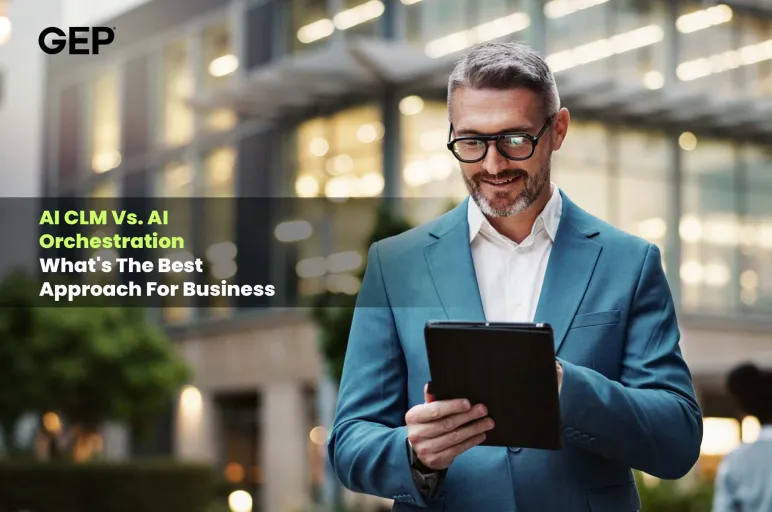
    AI CLM vs. AI Contract Orchestration: What's the Difference and Which Is the Right Approach?

    • CLM centralizes and manages contracts, while orchestration connects contracts to real business actions and workflows.
    • AI contract orchestration adds proactive risk monitoring, negotiation intelligence, and autonomous decision support.
    • CLM fits organizations building contract foundations, while orchestration suits complex, high-volume procurement environments.

    August 26, 2026 | Procurement Strategy   6 minutes read

    If you're in procurement or supply chain, contracts are the connective tissue of everything you do: supplier agreements, MSAs, SOWs, renewals. You've probably heard the term CLM thrown around for years, and now AI Contract Orchestration is entering the conversation. But is it just a rebrand, or is something genuinely different happening here? Spoiler: it's the latter. Let's break down what actually separates these two approaches and figure out which one makes sense for where you are right now.

    Stay ahead of shifting spend dynamics across key categories.

    Explore the GEP Spend Category Outlook to inform data driven decisions.

    Download Now

    Five Capabilities That Distinguish Orchestration from CLM

    Here's where things get interesting. It's not just about having smarter software; it's about a fundamentally different philosophy of what contracts are supposed to do.

    1. Cross-system workflow activation: CLM manages contracts inside the CLM. Orchestration reaches across your entire tech stack: your ERP, your P2P platform, your supplier portal, your CRM. When a contract milestone hits, orchestration triggers the right action in the right system automatically, without anyone manually copying data between tools.

    2. Proactive obligation management: CLM stores your obligations. Orchestration monitors them in real time and surfaces risks before they become problems. Think of it as the difference between a filing cabinet and a project manager who actually reads the files.

    3. AI-driven negotiation intelligence: Standard CLM tracks redlines and versions. Orchestration layers in AI that learns your negotiation patterns, flags non-standard clauses against your playbook, and recommend positions based on historical outcomes with specific counterparties or supplier categories.

    4. Dynamic risk scoring across the contract lifecycle: In CLM, risk is mostly assessed at intake or execution. Orchestration continuously recalibrates risk scores post-signature, pulling in external signals like supplier financial health, geopolitical data, or commodity price shifts relevant to your agreements.

    5. Autonomous lifecycle actions: CLM notifies you when a renewal is approaching. Orchestration can evaluate whether renewal is strategically sound, draft a recommended position, and route the decision to the right stakeholder with context already assembled. It reduces the human load on routine decisions so your team focuses on the ones that actually need judgment.

    Understanding CLM's Strengths and Limitations, and How AI Contract Orchestration Stands Out

    Let's be fair to CLM first, because it genuinely solved a real problem.

    Before CLM, contracts lived in email threads, shared drives, and the institutional memory of whoever had been around the longest. CLM brought order to that chaos: a central repository, version control, approval workflows, e-signature integration, and reporting on cycle times. For a procurement team that was operating out of a mess of folders, a CLM was transformational.

    And for a lot of organizations, it still is. If your main pain point is "we can't find our contracts" or "we miss renewal dates," CLM addresses that directly. It's well understood, widely implemented, and most enterprise procurement teams have some version of it already.

    But here's where CLM starts to show its limits, and this is probably something you've felt firsthand.

    CLM is fundamentally a system of record, not a system of action. It captures what happened; it doesn't change what happens next. Your team still has to read the contract, interpret the obligation, coordinate with legal, figure out which downstream system needs updating, and then manually do all of that. The contract lives in the CLM; the work lives everywhere else.

    The second limitation is that CLM's AI features, even the newer ones, tend to be additive rather than transformative. AI-assisted search, clause extraction, risk flagging: these are useful, but they're still tools that support a human doing the work. The cognitive load reduction is modest.

    AI Contract Orchestration starts from a different assumption: that the contract is not the endpoint of a process; it's the beginning of an operational commitment. Every signed agreement creates a network of obligations, timelines, performance expectations, and financial exposures that ripple across your supply chain. Orchestration is designed to manage that network dynamically.

    Where CLM gives you visibility, orchestration gives you activation. Where CLM flags a problem, orchestration is already routing the response. For a procurement leader managing hundreds of supplier relationships with a lean team, that difference in operational leverage is significant. You're not just better informed; you're running a materially different operation.

    Also Read: Contract Lifecycle Management Guide

    CLM vs. Orchestration: When to Choose Each

    This is the practical question, and it deserves a straight answer.

    Choose CLM if your organization is still in the "getting control" phase. If contracts are scattered, renewal visibility is poor, and your legal and procurement teams don't have a shared repository, CLM is the right first move. The infrastructure problem has to be solved before the intelligence layer makes sense. Trying to orchestrate a contract lifecycle you haven't standardized yet is like optimizing a supply chain you haven't mapped.

    CLM is also the right call if your contract volume is relatively low and your agreements are largely standard. If you're running 50 to 100 supplier contracts a year with predictable terms and straightforward renewal cycles, the operational overhead of full orchestration probably outweighs the benefit. CLM with solid workflow configuration will serve you well.

    And if your organization's appetite for change is limited right now, CLM is a more contained implementation. The stakeholder alignment required is manageable; legal, procurement, and IT can scope it clearly and deliver it predictably.

    Choose Orchestration if your contract volume is high and your team is already stretched. In supply chain and procurement specifically, this tends to be the norm rather than the exception. If your team is managing hundreds of supplier agreements across multiple categories, geographies, and risk tiers, the manual coordination burden is enormous. Orchestration is designed for exactly that environment.

    Choose orchestration if your contracts have significant operational consequences post-signature: delivery milestones, performance SLAs, price escalation clauses, audit rights, or compliance obligations that need active monitoring rather than periodic review. These are common in manufacturing, logistics, and complex indirect categories.

    Also consider orchestration if your CLM is already in place but underperforming. A lot of procurement teams have a CLM they've had for five or more years and feel like they're not getting value from it. That's often not a CLM problem per se; it's that the tool was built for storage, not activation. Orchestration can sit on top of or alongside existing CLM infrastructure and add the operational layer that's missing.

    One honest caveat: orchestration requires cleaner data and more mature processes to deliver its full value. If your contract metadata is inconsistent and your approval workflows are ad hoc, you'll need to do some foundational work first. It's not a reason to avoid orchestration; it's just a sequencing consideration.

    Ready to Move Beyond Traditional CLM?

    See how AI-native contract orchestration can turn contracts into real-time intelligence

    Contact GEP

    The Shift in the Market Towards Orchestration

    Something is changing in how enterprise buyers are evaluating contract technology, and it's worth paying attention to.

    For most of the last decade, the CLM market was defined by consolidation and feature expansion. Vendors added AI capabilities incrementally: smarter search, automated extraction, risk scoring. The assumption was that better tools inside the CLM were the answer.

    What's emerging now is a different framing entirely. Procurement and legal leaders are increasingly asking not "how do we manage contracts better" but "how do we make contracts operational." That shift in question leads you somewhere CLM was never designed to go. The buyers driving this conversation tend to be in functions like yours: supply chain, procurement, and operations, where contracts directly govern commercial outcomes and supplier performance. They're less interested in where the contract is stored and more interested in what the contract is doing. That's the opening orchestration was built for; and the vendors, analysts, and practitioners paying attention are starting to recognize it.

    What's Best for You

    CLM got procurement to the point of control. Orchestration gets you to the point of leverage. If you're still building the foundation, CLM is the right tool. If the foundation is there and you're still doing too much manually, it's probably time to think bigger.

    Explore GEP’s AI-Native Enterprise Contract Management Software

     

    Tags: AI , Procurement

    Add Comment +

    GEP Outlook 2026: Procurement & Supply Chain

    Read More

    FEATURED POST

    ...
    Procurement Strategy

    How Agentic AI is Transforming Supplier Collaboration in Procurement

    ...
    Procurement Software

    Why You Can Trust AI Agents with Routine Procurement Decisions

    ...
    Procurement Strategy

    How Does Autonomous Procurement Decision-Making Benefit Enterprises?

      BLOG CATEGORIES

    • Procurement Strategy
    • Supply Chain Strategy
    • Risk Management
    • Sourcing Strategy
    • Cost Management
    • Supplier Management Strategy
    • Miscellaneous
    • M&A
    • Supply Chain Risk Management
    • Inventory Management
    • Sustainability
    • Digital Supply Chain Transformation
    • Automation

    TAGS

    supply chain strategy
    Agentic AI in Procurement
    intake and orchestration
    E-invoicing
    AI-Native Procurement Platform
    Iran War Impact

    By checking the box below, you consent to GEP using your personal information to send you thought leadership content – such as white papers, research reports, case studies – and other communications. GEP representatives may contact you to provide additional information or answer questions.

    If at any point in time you decide to withdraw your consent, you may unsubscribe by emailing your request to us at privacy@gep.com.

    Please refer to the GEP Privacy Statement to understand how we manage and protect your personal information.

    Terms of Use | Privacy Statement

    SEND US YOUR QUESTION(S)

    Terms of Use | Privacy Statement

    Breadcrumb

    1. HOME
    2. BLOGS
    3. STRATEGY
    4. AI CLM VS. AI CONTRACT ORCHESTRATION: WHAT'S THE DIFFERENCE AND WHICH IS THE RIGHT APPROACH?

    Contact Us

      Demo Schedule a live demo of our software
      RFP Request for a business proposal
      Ask Us Send us your question(s)
      Feedback Share your comments and suggestions
           
    STRATEGY
    Strategy
    •   Procurement Consulting
    •   Procurement Transformation
    •   Digital Procurement Transformation
    •   Opportunity Assessment
    •   M&A Services
    •   Supply Chain Strategy
    •   AI Readiness
    •   Integrated Planning
    •   Inventory Optimization
    •   Network Strategy & Optimization
    •   Operations & Manufacturing Excellence
    SOFTWARE
    Software
    •   Intake & Orchestration
    •   Sourcing Management
    •   Contract Management
    •   Supplier Management
    •   Intelligent Category Management
    •   Procure to Pay
    •   Third Party Risk Management Solution
    •   AI-Native Architecture
    •   Agentic Integration
    •   ESG Tracking & Reporting
    •   GEP Quantum Intelligence Studio
    •   Supply Chain Management
    MANAGED SERVICES
    Managed Services
    •   Procurement Outsourcing
    •   Strategic Sourcing
    •   Tail-Spend Management
    •   Category Management
    •   Procurement Support Services
    •   Supply Chain Outsourcing
    •   Supply Chain Planning & Forecasting
    •   Inventory Management
    •   Logistics Management
    COMPANY
    Company
    •   About Us
    •   Leadership
    •   Customers
    •   Sustainability at GEP
    •   Careers
    •   News
    •   Awards
    •   Partners
    •   Contact Us
    Stay Connected


    Download the GEP GO App

    Stay connected with cutting-edge procurement and supply chain insights – anytime, anywhere.

    app store
    play store
    © Copyright GEP 2026. All rights reserved. Terms of Use | Privacy Statement | Cookie Policy |  | Quality Policy | GEP Logos |  GEP Trust Center  | Accessibility Statement