


AI is Rewriting Procurement. Here is What the Best Teams Are Doing Differently
- AI is transforming both procurement operations and the nature of what organizations buy, shifting the focus from products to AI-enabled outcomes.
- Procurement leaders must build five critical capabilities to stay competitive, including AI literacy and trust-driven change leadership.
- CPOs should take steps to move from experimentation to scalable impact and re-architect procurement for long-term value creation.
June 09, 2026 | Procurement Strategy 6 minutes read
AI is transforming both procurement operations and the nature of what organizations buy, shifting the focus from products to AI-enabled outcomes.
Procurement leaders must build five critical capabilities to stay competitive, including AI literacy and trust-driven change leadership.
CPOs should take steps to move from experimentation to scalable impact and re-architect procurement for long-term value creation.
The conversation around AI in procurement has moved well past curiosity. Teams have run pilots. Early results look promising. Yet for many organizations, the path from experimentation to meaningful, scaled impact remains unclear.
That uncertainty is understandable. AI is not a single tool or a straightforward upgrade. It represents a structural shift in how procurement operates, and the organizations that treat it that way will be far better positioned than those still waiting to see how things develop.
AI is already inside procurement. It's sitting in spend analytics tools, embedded in supplier portals, and built into contract review platforms. The question isn't whether it arrived. It's about whether teams know how to work alongside it, and whether leadership treats it as a strategic priority or an IT project.
What makes this moment genuinely different from past digital transformations is that the change isn't just in how procurement operates. It's also in what procurement buys.
The AI-Ready Procurement Leader's Report
A practical guide for CPOs navigating capability building, supplier evaluation, and scaled AI adoption
You're No Longer Just Buying Products
Think about a packaging supplier your team has worked with for years. Historically, you negotiated specs, price, and lead times. Today, that same supplier might be using AI to redesign materials for sustainability, dynamically optimize runs, and price services on consumption rather than volume.
The same shift is playing out in capital equipment. Where you once bought a machine, you're now buying a machine bundled with a predictive analytics platform, a software subscription, and an outcomes-based SLA.
This is the quiet shift that doesn't get enough attention: procurement is now in the business of evaluating, contracting, and managing AI-enabled outcomes, not just goods and services. The problem is that most procurement teams were never trained for it.
Five Capabilities That Actually Matter
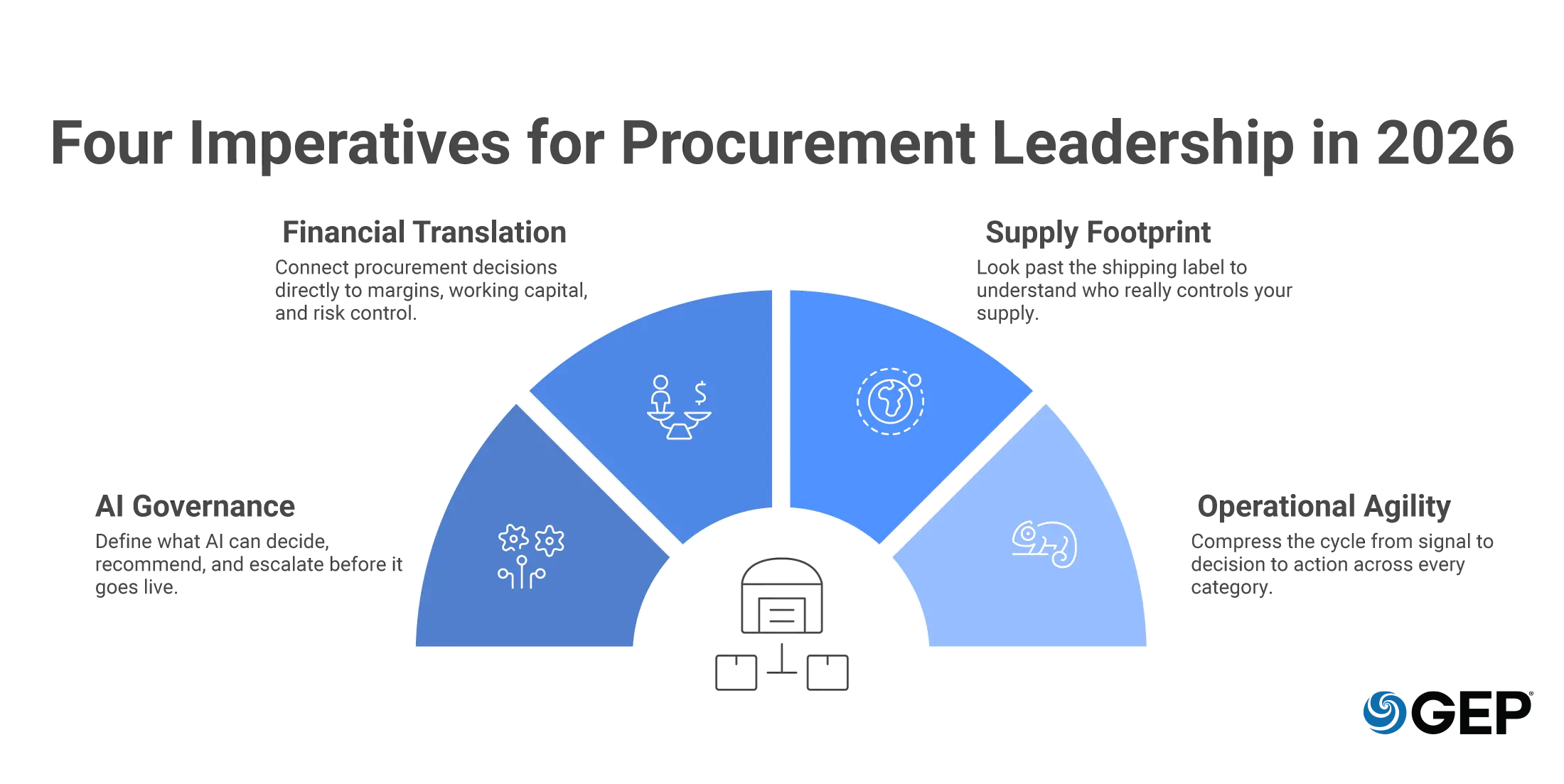
Many organizations are responding to this with training modules and lunch-and-learns. That's a start, but it's nowhere near enough. The teams that will pull ahead are building five concrete capabilities, not as one-time programs, but as ongoing organizational muscle.
1. Real AI Literacy
Procurement professionals don't need to write code. But they do need to understand why an AI system confidently gives a wrong answer. They need to know what a hallucination is, what training data means for bias, and why a deterministic answer from a legacy system behaves very differently from a probabilistic one from a language model.
Without that foundation, teams either over-trust the tools or dismiss them entirely. Either way, the organization ends up leaving value on the table.
Procurement professionals don't need to write code. But they do need to understand why an AI system confidently gives a wrong answer. They need to know what a hallucination is, what training data means for bias, and why a deterministic answer from a legacy system behaves very differently from a probabilistic one from a language model.
Without that foundation, teams either over-trust the tools or dismiss them entirely. Either way, the organization ends up leaving value on the table.
2. Cutting Through Supplier AI Claims
Walk into any procurement conference today, and half the supplier booths will have "AI-powered" on their banners. Evaluating those claims now requires a different kind of rigor.
What data was the model trained on? Who owns outputs generated using your data? What happens when the system is wrong, and who's liable? Can the decision be audited? These aren't theoretical questions. They're the new standard of due diligence, and procurement needs to own them.
Walk into any procurement conference today, and half the supplier booths will have "AI-powered" on their banners. Evaluating those claims now requires a different kind of rigor.
What data was the model trained on? Who owns outputs generated using your data? What happens when the system is wrong, and who's liable? Can the decision be audited? These aren't theoretical questions. They're the new standard of due diligence, and procurement needs to own them.
3. Contracts That Actually Fit
Standard master service agreements were not written for AI. They don't address model transparency, data usage rights, or accountability for AI-generated errors. Updating contract playbooks isn't glamorous work, but it's where procurement can prevent significant risk from slipping through the cracks.
Legal and information security can't do this alone. Procurement needs to be in the room, not rubber-stamping, but shaping the framework.
4. Knowing How to Use Tools
There's a difference between knowing AI exists and knowing how to prompt a copilot effectively, configure an agentic workflow, or catch when an output needs human review.
Operational fluency, meaning the ability to interact with, guide, and audit AI systems, is becoming a core job skill. Governance sits right alongside it: who's accountable when an AI-assisted sourcing recommendation turns out to be wrong? That answer needs to exist before the problem does.
Also read: Artificial Intelligence in Procurement Guide
5. Leading Change Without Losing People
This is the one that most capability-building frameworks skip over, and it's the one that kills adoption most often.
When teams don't trust AI outputs, or when they feel like risk has been pushed onto them without clarity or support, they quietly route around the tools. They do the work manually. They smile at the demo and then go back to what they know.
Trust-building is often treated as a soft skill. In AI adoption, it functions more like infrastructure. It means transparent processes, clear escalation paths, feedback loops, and honest conversations about what roles will look like as these tools mature. Leaders who skip this step will find themselves with licenses they paid for and a team that doesn't use them.
Ready to Build an AI-Ready Procurement Function?
Talk to our experts and find out where to start
What CPOs Should Do Next
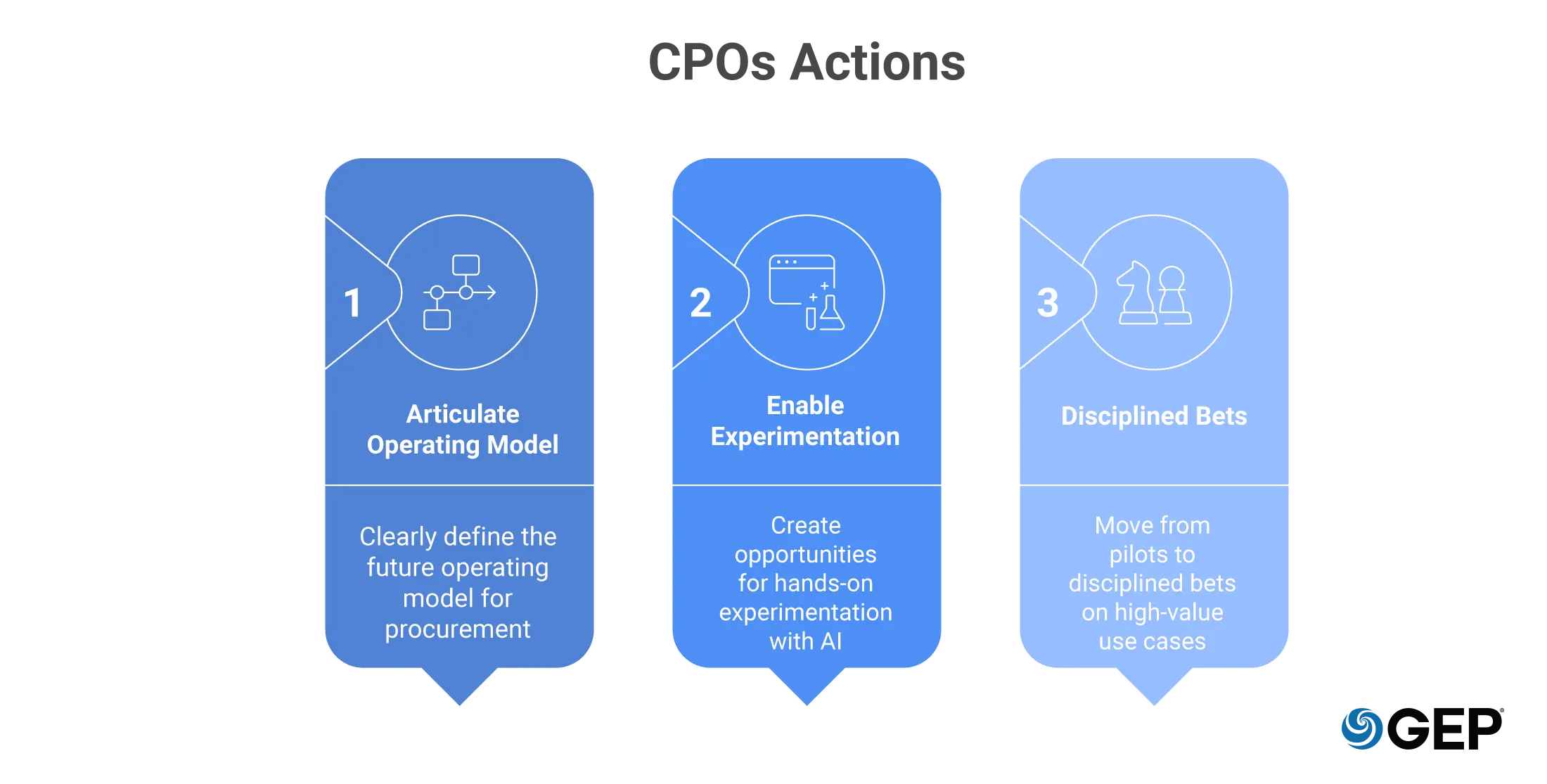
Capability building at this scale doesn't happen through a training budget. It requires a shift in how procurement thinks about its own development.
1. Articulate the future operating model clearly
Not as a slide in a quarterly business review, but as a real answer to: what will a category manager's job look like in three years? What decisions will AI handle? Which will require human judgment? People need that picture to make sense of the changes happening around them.
2. Make space for hands-on experimentation
Controlled sandboxes, cross-functional AI working groups, internal case competitions, whatever fits your culture. Real capability is built through practice, not passive learning. A one-hour webinar on large language models won't change behavior.
3. Move from pilots to disciplined bets
Most organizations have run some experiments by now. The next move is selecting two or three high-value use cases, assigning real ownership, defining measurable outcomes, and scaling what works. Leadership is expecting ROI, and procurement needs to show it.
The Bigger Picture
AI will reduce transactional workload. Some roles will be compressed. That's a real consequence and glossing over it doesn't help anyone plan.
But the procurement function that emerges from this transition has a genuine opportunity to become something more strategic than it's ever been. A function that shapes supply market innovation, leads risk management conversations, and holds a meaningful voice in enterprise decision-making.
None of that happens on its own. It requires deliberate investment and the willingness to treat procurement capability as seriously as procurement technology. The organizations doing that work right now will have a significant head start on everyone still waiting to see how things shape out.




FAQs
Start where the data is cleanest, and the stakes of a wrong answer are manageable. Spend analysis, supplier risk monitoring, and contract clause extraction are common early wins because they augment human judgment rather than replace it. Avoid starting with high-stakes, low-visibility processes where an error would be hard to catch and costly to fix.
Ask for specifics rather than accepting marketing language. Key questions include: What data was the model trained on, and how recent is it? How is the system validated and audited? What happens when the output is wrong? Can the decision be explained in plain terms? Legitimate vendors will have clear answers. Vague ones are a signal worth acting on.
No, though the starting point looks different. Larger organizations may be building internal AI centers of excellence, while smaller teams might focus on embedding AI into two or three core workflows using commercially available tools. The five capability areas apply regardless of size. The scale and pace of investment will vary.