


Inflation-Proof Procurement: Strategies for Resilience in Volatile Markets
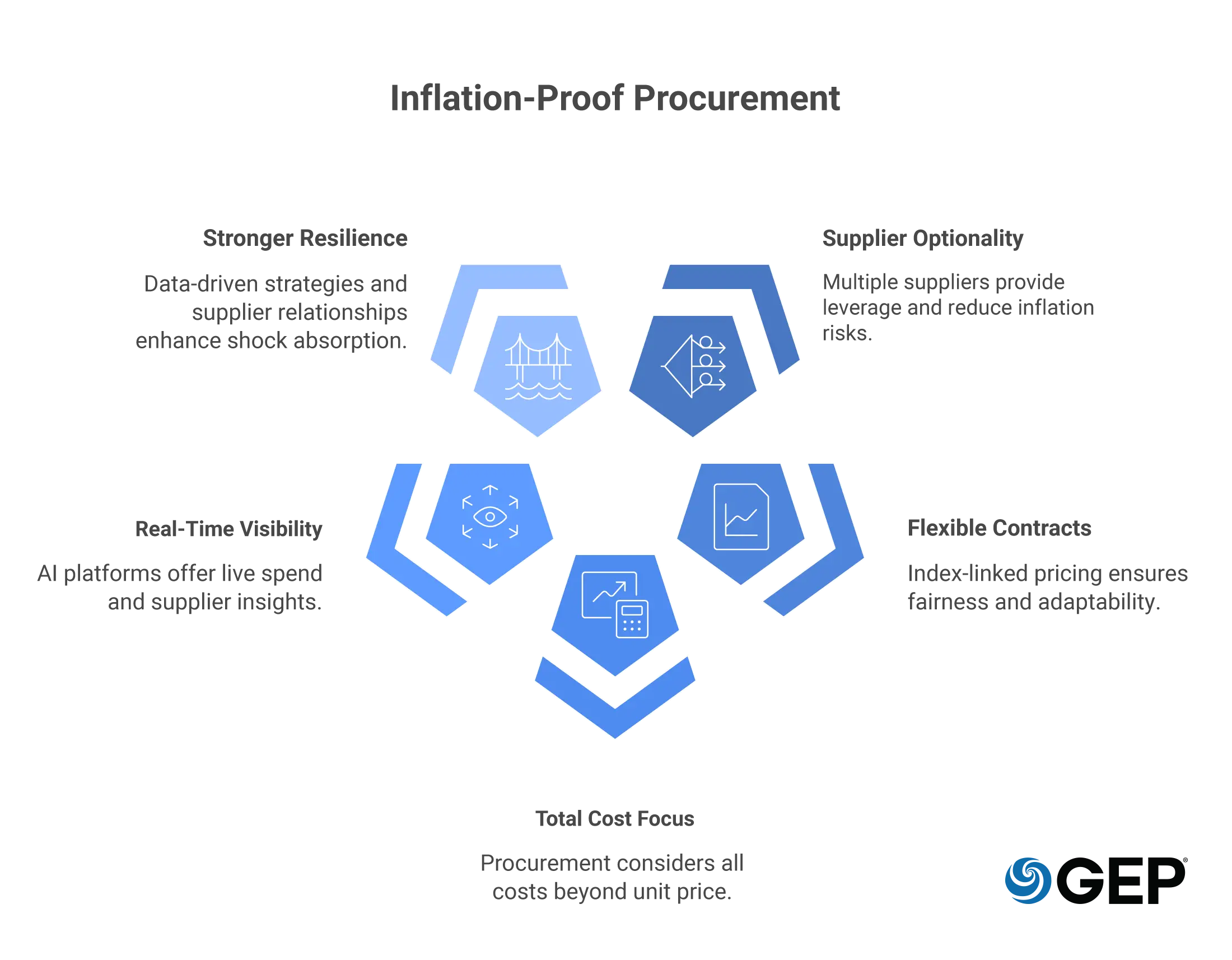
- Inflation exposes rigid procurement models; flexibility, optionality, and real-time data are now non-negotiable.
- Supplier diversification and index-linked contracts turn volatility into leverage instead of risk.
- Total cost of ownership, not unit price, is the only metric that holds up under inflation pressure.
June 17, 2026 | Procurement Strategy 7 minutes read
Let's be honest. Inflation does not just sting at the grocery store. For anyone running procurement, it is a full-blown operational crisis hiding behind polite boardroom language like "cost pressures" and "margin compression." Supplier invoices climb faster than your contracts can keep up. Budget approvals become awkward conversations. And the strategies that worked beautifully in stable times suddenly feel like you are navigating a highway in a rearview mirror. Procurement teams are being asked to do more with less, faster than ever, while the ground keeps shifting beneath them. The question is not whether inflation affects procurement. It is whether your function is built to absorb it.
The Economic Impacts of Inflation on Procurement
Here is what inflation actually does to procurement, beyond the obvious price hikes.
First, it erodes the real value of long-term contracts almost overnight. A fixed-price agreement you signed eighteen months ago now has your supplier quietly resenting you, or worse, looking for exit clauses. Second, supply chain disruptions become more frequent because your suppliers are also getting squeezed upstream. When their raw material costs jump, their reliability often drops. Third, economic uncertainty makes forecasting nearly impossible. Your demand planning team is working with assumptions that may already be stale by the time the ink dries.
Procurement leaders who have seen a few cycles know that inflation rarely hits uniformly. It is category-specific, geography-specific, and timing-specific. One quarter it is semiconductors. The next it is logistics. Then energy costs blow up your indirect spend. The compounding effect is what makes inflationary periods so punishing for procurement teams that lack flexible, real-time sourcing strategies.
Build a Procurement Function That Thrives Under Pressure
Move beyond reactive cost control with real-time insights and AI-powered decision-making through GEP.
Key Strategies for Managing Procurement in Inflationary Times
1. Build Optionality Into Your Sourcing Strategies
If the pandemic taught procurement anything, it is that single-source dependency is a liability dressed up as efficiency. During inflationary periods, that risk multiplies. Building optionality means deliberately qualifying two or three suppliers per critical category, even if you do not use them all at full volume today. Think of it as insurance that pays dividends. When your primary supplier comes back with a 14 percent price increase, you want the credible alternative ready, not the theoretical one. This is not just diversification for its own sake. It is structured leverage. Procurement teams that do this well often find that the mere existence of a qualified backup supplier moderates how aggressively a primary one pushes pricing.
2. Renegotiate Contracts With Elastic Pricing Mechanisms
Static pricing in volatile markets is a trap. The smarter move is to build elastic pricing strategies into your supplier agreements from the start. This means indexing contract prices to publicly available benchmarks like commodity indices, energy price indexes, or freight rates rather than locking in a flat number. When input costs fall, you benefit automatically. When they rise, the increase is transparent, capped, and agreed upon in advance. This approach also reduces the adversarial dynamic that often poisons supplier relationships during price escalation talks. You are not arguing about whether a price increase is justified. You are simply reading the index together.
3. Align Internal Stakeholders for Supplier Cost Transparency
One of the most underrated challenges in inflation management is internal. Procurement leaders often know exactly what is happening in the market, but finance, operations, and leadership are still working from last quarter's numbers. The fix is getting everyone into the same data room. That means sharing supplier cost breakdowns, commodity trend reports, and forward-looking inflation models with your internal stakeholders proactively, not reactively. When finance understands why a category budget needs to flex, approvals come faster. When operations understands lead time risks, they stop making last-minute urgent orders that blow up your negotiating position. Alignment is not a soft skill here. It is a procurement strategy.
4. Deepen Supplier Relationships Before You Need Them
Inflation is not the time to start building supplier relationships. It is the time to cash in the ones you already built. Suppliers, like everyone else, prioritize the customers they like doing business with when capacity gets tight or when they have to choose who absorbs a cost increase first. Procurement teams that have invested in regular business reviews, shared forecasts, and genuine partnership conversations tend to get better terms, earlier warnings about supply chain disruptions, and more flexibility on payment timing. The supplier relationship is not a procurement luxury. Under difficult market conditions, it is a strategic asset.
5. Shift from Price Focus to Total Cost of Ownership
During inflation, chasing the lowest unit price often leads you straight into higher total costs. A cheaper supplier that misses delivery windows forces you into premium freight. A low-cost option with inconsistent quality generates returns, rework, and production downtime that dwarfs the savings on paper. Sophisticated procurement strategies in inflationary periods measure total cost of ownership, not just the line item. This includes carrying costs, risk of disruption, quality failure rates, and the administrative overhead of managing a difficult supplier. When you present total cost analysis to internal stakeholders, the conversation shifts from "why are we paying more per unit" to "here is what this decision actually costs the business."
Leveraging Digital Procurement Platforms for Cost Control
This is where the conversation gets practical in a way that genuinely changes outcomes. Manual procurement processes during inflation are like trying to steer a tanker with a paddle. By the time your team has gathered quotes, analyzed spend, and escalated a decision, the market has moved.
GEP's procurement platform gives teams real-time spend visibility across categories, geographies, and suppliers so you are not making sourcing decisions on stale data. The AI-powered analytics surface cost-saving opportunities that manual analysis routinely misses, whether that is consolidating fragmented spend with fewer suppliers for volume leverage, identifying categories ripe for renegotiation, or flagging suppliers whose pricing has drifted outside market benchmarks.
GEP's unified procurement platform brings sourcing, contracts, supplier management, and spend analytics into a single environment. That integration matters enormously during inflation because your sourcing decision, your contract clause, your supplier risk rating, and your spend trend need to talk to each other in real time, not sit in four different spreadsheets across three departments.
For procurement teams managing economic uncertainty, the ability to model scenarios, "what does our spend look like if steel prices rise another eight percent?" is not a nice-to-have. It is how you get ahead of the budget conversation instead of reacting to it.
Stay ahead of shifting spend dynamics across key categories.
Explore the GEP Spend Category Outlook to inform data driven decisions.
Inflation-Proofing Procurement: Practical Steps for Long-Term Resilience
Think of this as your quick-reference checklist for getting ahead of the next inflationary wave before it arrives.
Audit your single-source dependencies right now. Map every critical category and flag where you have no qualified alternative. Then build a twelve-month plan to fix it.
Review your existing contracts for pricing mechanisms. Any agreement without an index-linked clause or a formal price review schedule is a vulnerability.
Create a monthly inflation dashboard for leadership. Include commodity trends, supplier cost index movements, and freight benchmarks. Make inflation visible before it becomes a crisis.
Run a total cost of ownership analysis on your top twenty suppliers. You will almost certainly find that your cheapest suppliers are not your lowest-cost suppliers when all factors are counted.
Invest in at least one senior-level supplier relationship in each strategic category. Not a transactional check-in. A genuine partnership conversation about what they are seeing in their own supply chain.
Building a Future-Proof Procurement Function
Inflation comes and goes, but the procurement functions that survive it are the ones that use it as a forcing function for building something better. The strategies, the systems, the relationships, and the internal alignment you build under pressure do not disappear when conditions ease. They become the foundation that lets you move faster, negotiate harder, and absorb the next shock with considerably less drama.




FAQs
AI-powered procurement platforms help in three concrete ways. They give you real-time spend visibility so price drift does not sneak up on you. They automate supplier benchmarking, so you always know whether you are paying a fair market rate or getting quietly overcharged. And they can model cost scenarios forward, letting procurement teams present finance with "here is what happens to our spend if this commodity moves ten percent" rather than discovering the damage after the fact. The shift from reactive to predictive is where AI earns its keep during inflationary periods.
Absolutely, and not just for the reasons most people cite. Yes, having backup suppliers protects you when a primary one cannot deliver. But supplier diversification during inflation also restores your negotiating leverage. A supplier who knows they are your only option behaves very differently in a price discussion than one who knows you have qualified alternatives ready to scale. Think of diversification as both a risk management tool and a commercial strategy running simultaneously.
Beyond basic spend variance, procurement leaders should be tracking price index alignment by category (are your contracted prices moving in line with the underlying commodity index?), supplier-on-time delivery rates (a leading indicator of supply chain stress before it becomes a crisis), total cost of ownership by supplier (not just unit price), contract coverage ratios (what percentage of your spend is under formal agreement with price protection clauses?), and savings realization rates (are the savings you are identifying actually landing in the P&L?). These five together give you a real picture of how inflation-resilient your procurement function actually is, not just how it looks on paper.