



Understanding the Role of Reinforcement Learning in Procurement
- Reinforcement learning helps procurement systems learn from outcomes, not just analyze past data.
- In volatile markets, reinforcement learning adapts sourcing and supplier decisions as conditions change.
- The strongest results come when human judgment sets direction and learning agents handle execution.
July 23, 2026 | Procurement Strategy 5 minutes read
Anyone who has spent time in procurement has seen technology cycles repeat. New tools arrive with big promises. Some stick. Some quietly fade into the background. AI is the latest wave, but reinforcement learning in procurement feels different for a simple reason. It is not just telling you what happened. It is learning from what happens next.
Most AI tools today are very good at hindsight. They analyze spend, flag supplier risks, and surface patterns that humans might miss. That is useful, but it still leaves decision-making largely unchanged. Reinforcement learning moves the focus forward. It pays attention to the decisions you make, watches how the market responds, and adjusts its behavior based on whether those decisions actually worked.
When supply chain volatility becomes the default rather than the exception, that ability to learn from outcomes starts to matter more than static insight.
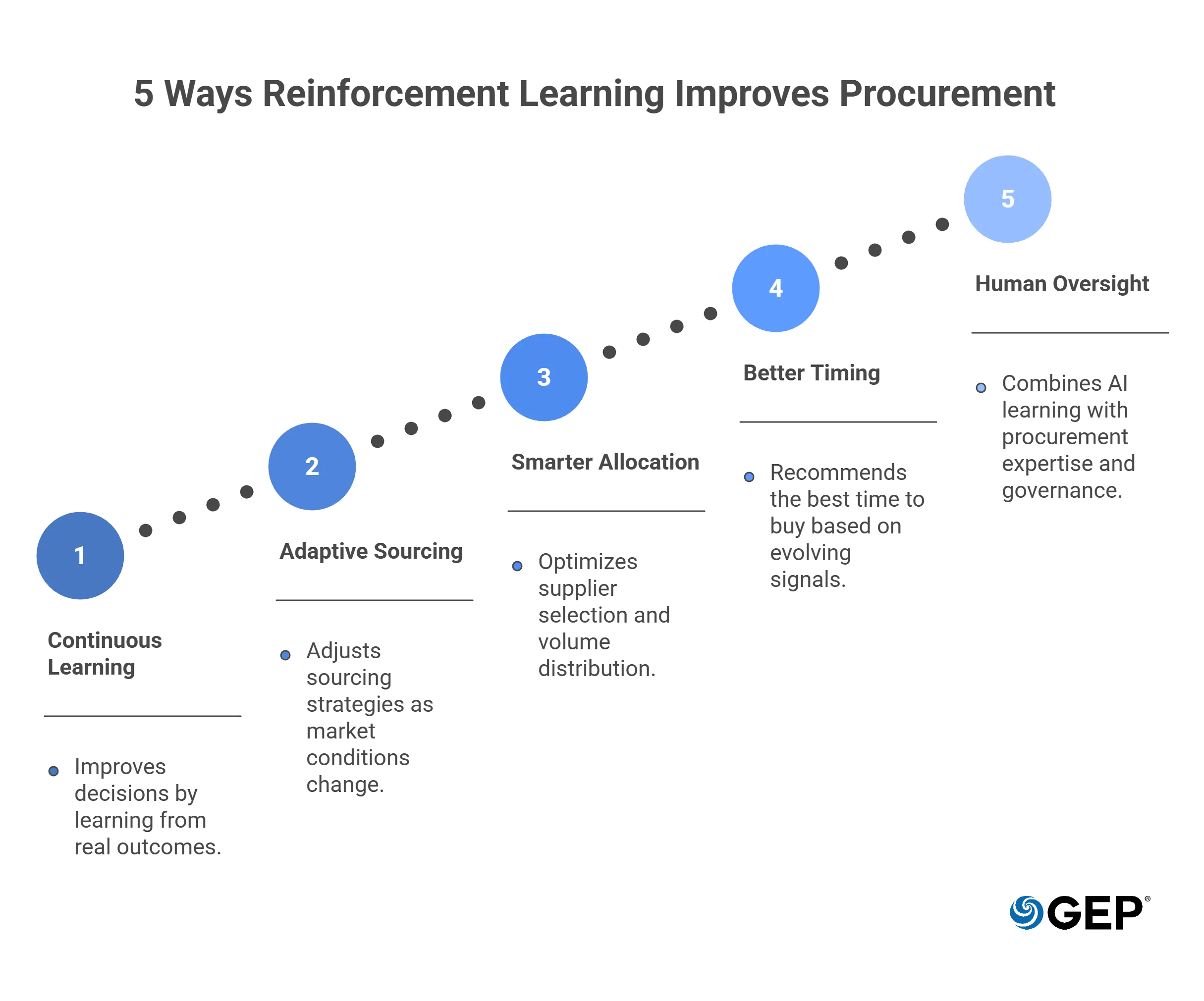
What is Reinforcement Learning in Procurement?
At its simplest, reinforcement learning is about learning through experience. Instead of being trained once on historical data and left unchanged, the system keeps learning as it operates.
In a procurement context, this means an agent working inside real workflows. It might influence when to buy, how to distribute volumes across suppliers, or whether to revisit contract terms as market conditions shift. Each decision leads to an outcome. That outcome becomes feedback.
When a decision results in savings, better service, or lower risk, the system takes note. When it leads to problems, the system adjusts. Over time, reinforcement learning develops a practical sense of what tends to work in your supply chain, not in theory, but in practice.
Stay ahead of shifting spend dynamics across key categories
Explore the GEP Spend Category Outlook to inform data-driven decisions
How Reinforcement Learning Works in Procurement
Reinforcement learning works through a repeating loop. First, the system looks at the current situation. Pricing signals. Supplier performance. Demand changes. Inventory positions.
Based on what it has learned so far, it chooses an action within defined limits. That action might be delaying a purchase, splitting volumes differently, or committing earlier than usual. Once the outcome becomes clear, the system evaluates whether that choice helped or hurt.
That feedback influences the next decision. The more cycles the system runs, the more refined its behavior becomes. This matters in procurement because decisions are rarely isolated. One sourcing choice affects supplier relationships, future pricing, and negotiation leverage down the line. Reinforcement learning is built to handle these connected decisions rather than treating each one as a standalone event.
Traditional AI vs. Reinforcement Learning: Key Distinctions
This is where the contrast becomes clear in day to day work.
Traditional AI tools focus on learning from the past. They are excellent at spotting trends and highlighting risk based on historical data. Reinforcement learning focuses on learning from outcomes as they happen.
Traditional AI supports decisions by making recommendations. Reinforcement learning improves decisions by adapting behavior over time. One is analytical. The other is experiential.
In procurement, both approaches have value. Spend analysis and risk scoring benefit from traditional AI. Areas like sourcing timing, supplier allocation, and negotiation strategy benefit more from systems that learn through action.
Why Procurement is Perfect for Reinforcement Learning
Procurement operates in an environment that is constantly shifting. Markets move quickly. Suppliers respond to pressure. Demand changes without much warning. Few functions deal with this level of uncertainty at such scale.
This is exactly where reinforcement learning performs well. It does not rely on perfect forecasts or stable conditions. It improves by responding to change. Every sourcing event, supplier interaction, and pricing decision becomes another learning opportunity.
Procurement also has clear goals. Cost control. Risk management. Service reliability. Compliance. These outcomes are measurable, which makes it easier for reinforcement learning systems to understand what success looks like and adjust accordingly.
Where Reinforcement Learning Makes Impact
One area where reinforcement learning stands out is timing. In volatile markets, buying too early or too late can have a real financial impact. Reinforcement learning can predict price trends and recommend when to lock in contracts by learning how markets behave under different conditions.
Supplier allocation is another example. Rather than relying on fixed splits, the system learns how suppliers perform when conditions change. It adapts volume allocation to balance cost efficiency with resilience.
Negotiation strategy also improves over time. By observing outcomes across many interactions, the system begins to understand which approaches tend to work with specific suppliers and in specific market environments. Those lessons feed directly into future procurement decisions.
What Reinforcement Learning Looks Like Practically
In practice, reinforcement learning does not replace procurement professionals. It operates within boundaries that you define.
Low risk adjustments can be handled automatically, such as shifting purchase timing within contract windows or reallocating volumes among approved suppliers. Higher impact decisions still involve human review and approval.
What really changes is consistency and scale. The system applies what it has learned across thousands of decisions, capturing insights that would otherwise remain scattered across teams and regions. Over time, procurement teams spend less time reacting and more time anticipating.
Get The Best For Your Procurement Team
Build smarter procurement strategy with AI-native software
What are the Possible Challenges in the Reinforcement Learning Journey?
Data quality is often the first challenge. Reinforcement learning depends on timely and reliable feedback. If supplier performance data is incomplete or delayed, learning slows down.
Trust is another factor. Teams need to understand why a system made a particular decision. Without transparency, adoption becomes difficult. Explainable AI capabilities help bridge that gap.
There is also a cultural shift involved. Moving from tools that suggest actions to systems that learn and act requires comfort with a degree of autonomy. That transition works best when introduced gradually with clear governance.
How to Start with the Reinforcement Learning Implementation
A practical approach is to start small. Focus on categories where decisions are frequent and outcomes are easy to measure. Logistics, spot buying, and volatile raw materials are often good entry points.
Stable data flows matter more than perfect data. Consistent signals around pricing, demand, and supplier performance provide a strong foundation.
Embedding reinforcement learning into existing procurement systems is also critical. When learning agents operate inside familiar workflows, adoption feels natural and value scales faster.
Check Out GEP’s Procurement Software
Build Systems That Learn from Experience
Reinforcement learning in procurement is not about chasing the latest technology trend. It is about building systems that improve through experience, much like seasoned procurement professionals do.
By combining human judgment with adaptive agents, procurement teams can make better decisions under pressure, respond more effectively to changing market conditions, and continuously improve outcomes.
In an environment where uncertainty is permanent, systems that learn from experience offer a real advantage.




FAQ's
Categories with high transaction volumes, frequent price movement, and multiple supplier options tend to benefit the most.
Supplier performance data, pricing history, demand signals, and contract parameters form the foundation.
Yes. Reinforcement learning improves through interaction and does not depend solely on long historical datasets.
Modern reinforcement learning solutions are designed to integrate directly into procurement platforms and workflows.