


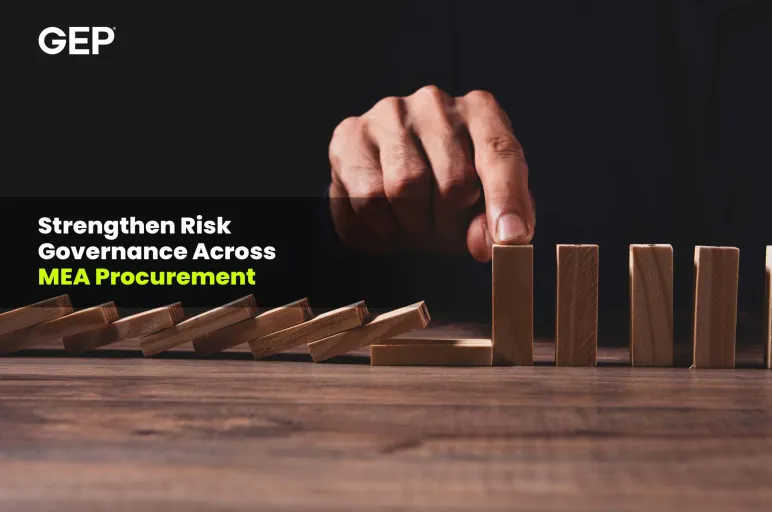
Why MEA Energy Procurement Needs Smarter Risk Governance
- Risk governance works best when it's embedded directly into procurement workflows, not added after the fact.
- Real-time sanctions and ESG screening help procurement teams identify supplier risks before they become business risks.
- Standardized digital controls allow global procurement policies to be applied consistently across every subsidiary.
August 24, 2026 | Procurement Strategy 5 minutes read
If you manage procurement for an energy business operating across the Middle East and Africa, you already know the role has moved well beyond negotiating prices and managing lead times. Today, you're balancing sanctions compliance, ESG expectations and a network of subsidiaries that don't always follow the same rules or processes.
The traditional approach; where sourcing teams focus on savings and compliance steps in at the end; simply isn't enough anymore. The old model, where sourcing teams chased savings and compliance checked boxes after the fact, doesn't hold up anymore. What you need is a shift from transactional buying to real risk governance that is built into the process, not bolted on at the end.
Is Your Procurement Organization Ready for What's Coming?
Download the 2026 Procurement Executive Insight Report and find out where you stand.
The Policy Enforcement Gap in Complex MEA Regional Energy Subsidiaries
Here's a problem you've probably lived through: corporate writes a solid supplier risk policy, and then it quietly falls apart the moment it reaches your subsidiaries in Nigeria, Angola, or Saudi Arabia. Local teams have their own vendor relationships, their own urgency, and their own interpretation of what "compliance" actually requires. The result is a policy enforcement gap; the rules exist on paper, but they're applied inconsistently, or not at all, at the point where sourcing decisions actually get made.
This gap isn't usually about bad intent. It's about infrastructure. Without a shared digital backbone, each subsidiary is left to self-police, and self-policing under deadline pressure tends to lose. You end up finding out about a sanctioned entity or a non-compliant supplier during an audit, months after the contract was signed; not exactly the moment you want that news.
Integrating Real-Time Intelligence for Sanctions and ESG Screening
The fix starts with visibility that doesn't depend on someone remembering to check a list. Sanctions regimes shift constantly; a supplier that was clean in January can land on an OFAC or EU list by March, and if your screening only happens at onboarding, you're flying blind for the rest of the relationship. Real-time intelligence feeds change that. They pull continuously from sanctions databases, adverse media, ownership structures, and watchlists, so a flag surfaces the moment it appears, not at the next scheduled review.
The same logic applies to ESG screening, which matters even more in energy, where scope 3 emissions, labor practices, and environmental incidents get examined closely by regulators and investors alike. Static ESG questionnaires filled out once a year tell you almost nothing about a supplier's current state. Continuous monitoring, pulling from news sources, NGO reports, and regulatory filings, gives you a living picture instead of a stale snapshot.
For MEA operations specifically, this integration matters because the region carries layered risk: sanctions complexity around certain jurisdictions, beneficial ownership structures that can obscure who you're really dealing with, and ESG standards that vary by country but not by your investors' expectations. Real-time intelligence, embedded directly into your procurement systems, closes the gap between "we have a policy" and "we're actually enforcing it" every single day, across every subsidiary, without adding headcount to watch it manually.
Transform MEA Energy Procurement
Embed risk governance, real-time intelligence, and digital controls into every sourcing decision
How Energy Sector CPOs Can Operationalize Risk Controls Directly Inside Digital Tendering Workflows
Knowing you need better risk controls is one thing; getting them embedded where your teams actually work is another. Here's how you make it real.
1. Build screening into the tender, not around it.
Instead of running sanctions and ESG checks as a separate task before or after tendering, embed them directly into your digital tendering platform. So, when a supplier submits a bid, the screening happens automatically, as part of the workflow. No one needs to remember to trigger it, and no bid moves forward in its absence.
2. Set hard stops for critical risk categories.
Not every flag needs to halt a process, but some should. Sanctions hits, for instance, deserve an automatic block, not a warning that a busy category manager might skim past. Configure your system so that specific risk thresholds trigger mandatory holds, requiring sign-off from compliance or legal before the tender can proceed.
3. Standardize the policy layer across subsidiaries, then let local teams operate within it.
The enforcement gap closes when every regional office is working off the same digital rulebook, even if their supplier base and sourcing categories differ. A centralized platform lets you set the guardrails once and apply them everywhere, while still giving local buyers room to make decisions within those boundaries.
4. Give category managers visibility, not just alerts.
A flag without context just creates friction. Pair every risk alert with enough detail, ownership structure, source of the finding, severity, so your team can make a fast, informed call instead of escalating everything to compliance by default.
5. Track enforcement, not just policy existence.
You need dashboards that show you where risk controls are actually being applied consistently and where they're being skipped or overridden. This is what turns governance from a document into a discipline; you can see, subsidiary by subsidiary, whether the rules are holding.
None of this requires ripping out your existing procurement stack. It requires connecting the intelligence layer to the workflow layer so risk management stops being a separate task and becomes part of how sourcing decisions get made in the first place.
The Bottom Line
MEA energy procurement doesn't need more policy documents; it needs enforcement built into the workflow. Real-time screening and standardized digital tendering close the gap between what your policy says and what actually happens at the subsidiary level, every day.



Frequently Asked Questions
Traditional checks happen once, at onboarding. Real-time screening runs continuously, catching sanctions or ESG changes the moment they occur, not months later during an audit.
By embedding screening directly into the tendering platform, setting automatic holds for critical flags, and standardizing policy rules across all subsidiaries.
It's the disconnect between corporate risk policy and how consistently that policy is actually applied at the local subsidiary level.