




Three-way matching is how accounts payable teams verify an invoice before paying it: the invoice is checked against the purchase order and the goods receipt, and payment is released only when all three agree. No corroboration, no payment. It is one of the oldest and most effective financial controls in the procure-to-pay cycle, yet one of the most commonly mishandled.
This guide covers the process end to end: what three-way matching is, why it matters, how it works step by step, who is involved, how it compares with two-way and four-way matching, and how to streamline it through best practices and automation.
What is Three-Way Matching in Accounts Payable?
Look at three-way matching as an internal control process used in accounts payable (AP) to verify that a supplier invoice is legitimate and accurate before it’s approved for payment. The process compares three separate documents, the purchase order (PO), the goods receipt note (GRN) or receiving report, and the supplier invoice, to confirm that the details on all three align.
In practice typically, the AP team checks the following:
- What was ordered (per the purchase order)
- What was actually received (per the goods receipt or receiving report)
- What the supplier is billing for (per the invoice)
There has to be a consensus on data points such as item descriptions, quantities, unit prices, part numbers, payment terms, as well as total amounts. Only when the three documents reconcile, either exactly or within a pre-defined tolerance, is the invoice released for payment.
The logic is straightforward: no single document, on its own, proves a payment is warranted. A purchase order shows intent to buy but not if goods arrived; a receiving report shows goods arrived but not what was agreed commercially; an invoice shows only what a supplier claims is owed. Only when all three corroborate with one another can the organization be confident that it’s paying the right supplier the right amount for goods it genuinely ordered and received.
Three-way matching applies typically to physical goods, where receipt can be objectively confirmed at a dock or warehouse. It also works for services, provided the organization captures a service entry sheet, timesheet approval or completion confirmation to act as the "receipt" leg of the match.
The Future-Ready CPO: From Cost Control to Value Protection
Learn how AI-driven risk monitoring and clean data are helping CPOs at P&G, J&J and Schneider Electric protect enterprise value, not just margins.
Why is Three-Way Matching Important in Accounts Payable?
Three-way matching is one of the most fundamental financial controls in the procure-to-pay (P2P) cycle, and its importance spans risk management, cash preservation, compliance and supplier trust.
Fraud Prevention
Invoice fraud, such as fake, duplicate or inflated invoices, or bills for goods never delivered, remains one of the most common ways organizations lose money. Because a fraudulent invoice rarely has a matching purchase order and receiving record behind it, three-way matching acts as a structural barrier: an invoice with no corroborating PO and receipt simply cannot pass.
Overpayment and Error Prevention
Even honest suppliers make billing errors, including outdated prices, full-quantity billing on partial shipments, incorrect taxes, or the same invoice sent twice. Matching catches these discrepancies before cash leaves the business, which is considerably cheaper than going for a recovery on overpayment afterward.
Accurate Financial Records
Verifying payments against POs and receipts ensures the books match reality: accruals, inventory values and expenses are recorded accurately, the general ledger stays reliable, and month-end close gets easier.
Audit and Regulatory Compliance
Auditors expect evidence that payments were authorized and verified. For public companies subject to the U.S. federal law Sarbanes-Oxley (SOX) and organizations under comparable governance frameworks, three-way matching provides a documented, repeatable control in which every paid invoice traces back to an approved order and a confirmed receipt.
Stronger Supplier Relationships
Disputes resolve faster when both parties reference the same PO and delivery documentation, and suppliers whose accurate invoices are paid promptly gain confidence that can translate into better terms and early-payment discounts.
Better Spend Visibility and Control
Requiring every payment to trace to an approved order discourages maverick (off-contract) buying and gives procurement reliable data on what the organization actually buys, which is in fact fuel for category strategies and negotiations.
In short, three-way matching converts accounts payable from a passive bill-paying function into an active line of defense for the organization's cash and compliance posture.
How Does the Three-Way Invoice Matching Process Work in Accounts Payable?
While details will definitely vary by organization and by system, the three-way matching process generally follows a consistent sequence across the procure-to-pay cycle:
Step 1: Purchase order creation and approval
A business need triggers a purchase requisition; once approved through the authorization workflow, procurement issues a purchase order recording the items or services, quantities, agreed unit prices, taxes, delivery and payment terms, and the PO number that anchors all subsequent matching.
Step 2: Goods delivery and receipt confirmation
When the supplier delivers, the receiving team inspects the shipment against the packing slip and PO, notes any damage or shortfalls, and records a goods receipt note confirming what was received, in what quantity and condition, and on what date.
Step 3: Invoice submission and capture
The supplier issues an invoice referencing the PO number via portal, e-invoicing network, EDI, email, or via paper. AP captures the invoice data, increasingly through automated extraction rather than manual keying, and registers it in the ERP or AP system.
Step 4: The match
The AP system (or an AP clerk, in manual environments) compares the invoice line by line against the PO and the goods receipt. Typical fields checked include:
- Supplier name and details
- PO number and line references
- Item descriptions and part numbers
- Quantities ordered vs. received vs. invoiced
- Unit prices and extended line totals
- Taxes, freight and other charges
- Payment terms and currency
Step 5: Tolerance evaluation
Few organizations demand a match to the penny. Most define tolerance thresholds (for example, price variances within 2% or $50, or quantity variances within 1%) inside which small discrepancies are automatically accepted. Variances within tolerance pass, but variances outside tolerance create an exception.
Step 6: Exception handling
When a match fails, the invoice is blocked and routed to the appropriate resolver (a buyer for price discrepancies, the receiving team for quantity issues, or the supplier for billing errors) and then corrected via a credit note, revised invoice, updated receipt or PO amendment, and re-matched.
Step 7: Approval and payment
Once the documents reconcile, the invoice is approved and paid per the agreed terms, ideally capturing any early payment discount. The full set, comprising PO, receipt, invoice, match result and approvals, is retained as the audit trail.
In automated environments, steps 4 through 7 can occur in seconds for clean invoices, with human attention reserved only for genuine exceptions, a model often described as "touchless" or straight-through invoice processing.
Also Watch - From E-Invoice Strategy to Intelligent AP With Agentic AI Orchestration Webcast
What Documents are Used for Three-Way Matching in Accounts Payable?
Three documents form the backbone of the process, each answering a different question.
Purchase Order (PO)
The PO is the buyer's formal, approved commitment to purchase, specifying the supplier, items or services, quantities, unit prices, taxes, delivery schedule and payment terms. Because it passes through the approval hierarchy before issuance, it also serves as proof of authorization, and its unique number links the other two documents to it.
Goods Receipt Note (GRN)/Receiving Report
Created by the receiving team at the point of delivery, the GRN documents the items received, quantities accepted, delivery date, condition and any rejections or shortages. For services, the equivalent is a service entry sheet, signed timesheet or completion certificate. The receipt is the evidence that the organization actually obtained value.
Supplier Invoice
The invoice is the supplier's formal demand for payment, listing the items or services billed, quantities, unit prices, taxes, freight, invoice number and date, PO reference and payment terms. It is the document under scrutiny, the one that the other two must validate before money moves.
Supporting documents enrich the process even when they are not formal legs of the match: packing slips help receivers verify contents, contracts and rate cards define the pricing the PO should reflect, quality inspection reports (used in four-way matching) confirm goods meet specification, and credit notes document corrections when discrepancies are found.
Who Are the Key Stakeholders in Accounts Payable Three-Way Matching?
Three-way matching is a cross-functional control. Its effectiveness depends on several teams performing their part accurately and on time.
Procurement/buyers create accurate, complete purchase orders (which is the foundation of the entire match), keep POs updated when quantities or prices legitimately change, and resolve price-related exceptions.
Receiving/warehouse teams physically verify deliveries and post goods receipts promptly. A late or missing receipt is one of the most common causes of match failure, so same-day receipt posting has an outsized effect on AP throughput. For services, budget owners play this role by confirming completion.
Accounts payable owns the matching step itself: capturing invoices, executing the match, managing tolerances, investigating exceptions, scheduling payments and maintaining the documentation trail auditors will later review.
Suppliers are active participants. Invoices that quote the correct PO number, mirror PO line structures and reflect agreed prices match cleanly; those that don't create exceptions, which is one reason many organizations onboard suppliers to portals or e-invoicing channels.
Finance leadership and controllers set the policy framework, such as matching requirements, tolerances, approval hierarchies, escalation rules, and then monitor performance through metrics such as first-pass match rate and exception aging.
Internal audit and compliance periodically test that the control operates as designed, review overrides, and verify segregation of duties, for example, that the person who creates a PO cannot also approve the resulting payment.
IT systems teams configure matching logic, maintain integrations between procurement, receiving and invoicing systems, and manage master data such as supplier records and item catalogs.
When any one group underperforms, such as POs raised retrospectively, receipts posted late, invoices keyed incorrectly, exceptions pile up. Three-way matching is a shared discipline as much as an AP task.
Benefits of Three-Way Matching for Enterprises
For large organizations processing thousands or millions of invoices annually, the benefits of a well-run three-way matching program compound significantly.
Reduced Financial Leakage
Duplicate payments, overbilling and payments for undelivered goods can cost unmatched-payment environments a meaningful fraction of total spend. Matching stops this leakage before payment, avoiding slow and often unsuccessful post-payment recovery.
Lower Fraud Exposure
Requiring corroboration across three independently created documents makes both external invoice fraud and internal collusion substantially harder to execute undetected.
Stronger Compliance Posture
A consistent, documented matching control simplifies SOX testing, statutory audits and control certifications; every payment carries a self-contained evidence package.
Improved Working Capital Management
Verified invoices can be paid on optimal dates, that is, late enough to preserve cash, early enough to capture discounts, while more accurate accruals give treasury a truer picture of upcoming obligations.
Higher AP Productivity
Clean matching rules paired with automation let the bulk of invoices flow through untouched, so cost per invoice falls and invoices processed per FTE rises, freeing staff for exceptions and improvement work.
Better Supplier Experience
Suppliers are paid accurately and predictably, and disputes are grounded in shared documents rather than assertions.
Cleaner Data for Procurement
Because every payment traces to a PO, spend data becomes more complete and classifiable, sharpening category analysis and negotiations.
Scalability
A rules-based process scales with transaction volume in a way headcount-based checking cannot, supporting growth and shared-services consolidation without proportional cost increases.
Cut Invoice Processing Costs by Half
Explore how enterprises achieve 90%+ first-pass match rates and touchless AP with AI-driven automation
2-way vs. 3-way vs. 4-way Matching in Accounts Payable
Matching comes in several levels of rigor. The right level depends on the nature, value and risk of the purchase.
Two-way matching compares only the invoice and the purchase order, verifying that billed prices and quantities agree with what was ordered, but not confirming receipt. It suits low-risk transactions such as subscriptions, utilities and recurring fixed-fee services, where the cost of verifying receipt exceeds the risk of skipping it.
Three-way matching adds the goods receipt, confirming that the organization actually received what it is being billed for. This is the standard control for physical goods and for services where completion can be documented. It balances rigor with practicality and is the default for most enterprise spend.
Four-way matching adds a fourth document: a quality inspection or acceptance report, confirming goods not only arrived but passed inspection before payment. It suits categories where defects are costly, such as pharmaceuticals, aerospace, medical devices, food production, or high-value capital equipment subject to formal acceptance testing.
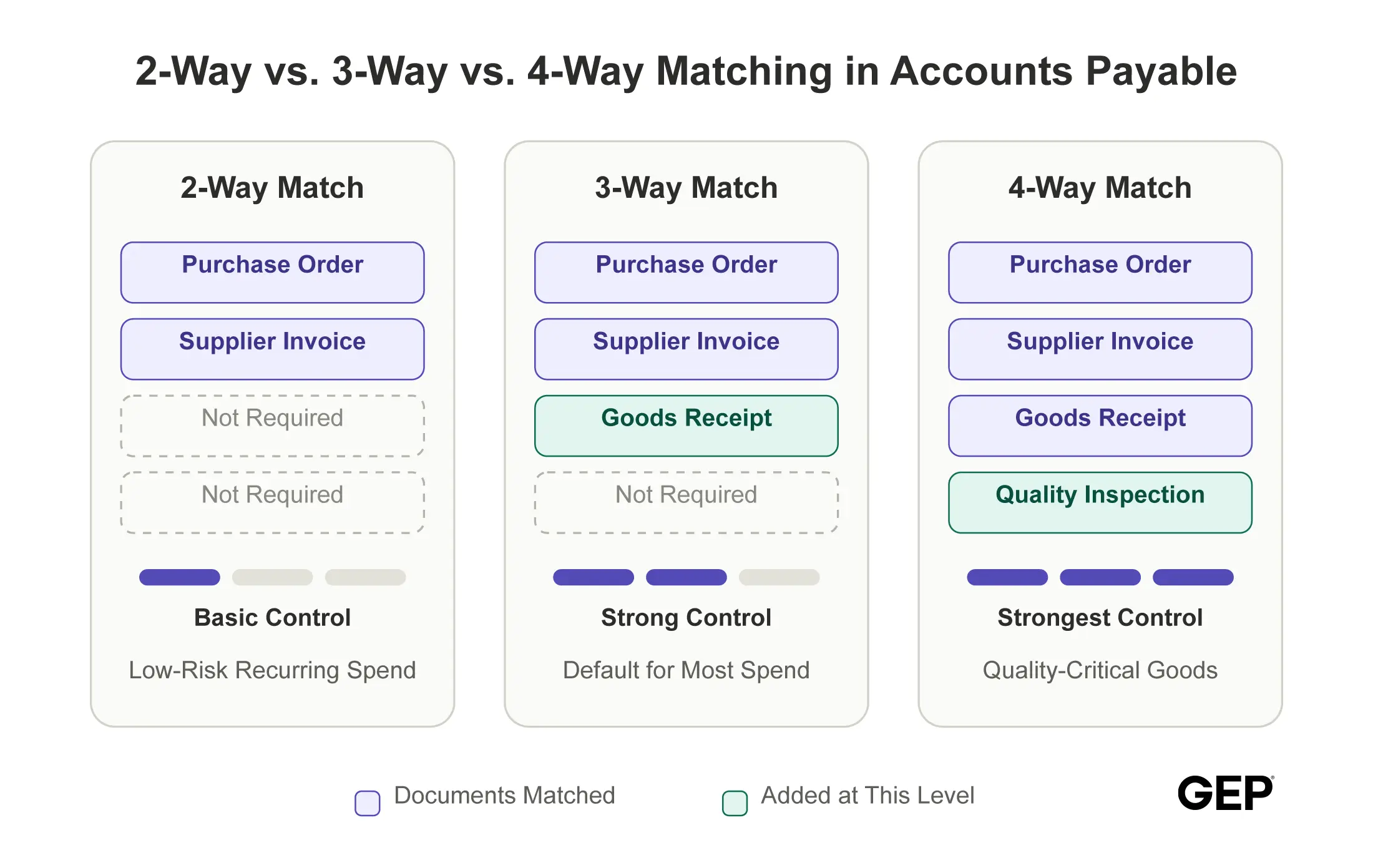
Mature organizations rarely pick one level for everything. They segment: two-way for defined low-risk categories, three-way as the default, and four-way reserved where quality risk justifies the extra step. The idea is to control effort where it protects the most value.
Best Practices for Streamlining Three-Way Matching in Accounts Payable
A matching program can be rigorous without being slow. The following practices separate high-performing AP functions from those drowning in exceptions.
Enforce a "no PO, no pay" policy
Matching only works when purchases start with a purchase order. Requiring an approved PO before ordering — and declining to process invoices without one, outside defined exemptions — is the single most important enabler of a clean match.
Fix data quality at the source
Accurate supplier master data, catalogs and contract prices flow into accurate POs; duplicate supplier records, stale prices and vague line descriptions surface downstream as match exceptions.
Set intelligent tolerance thresholds
Zero tolerance floods the team with trivial exceptions; overly loose tolerance weakens the control. Calibrate thresholds by category, value band and supplier history — tighter for high-value capital purchases, looser for low-value indirect spend — and review them against exception data.
Make goods receipting a same-day discipline
Late receipt posting is a leading cause of blocked invoices. Give receiving teams mobile or barcode-enabled tools and monitor receipt timeliness as a KPI.
Onboard suppliers to structured invoicing channels
Portals, e-invoicing networks and EDI enforce PO references and line-level structure at submission, raising first-pass match rates. Publish clear invoicing requirements and give suppliers self-service visibility into payment status.
Automate the match itself
Configure the ERP or AP automation platform to perform line-level matching automatically, approve in-tolerance invoices without human touch, and route only genuine exceptions to resolvers.
Build clear, owned exception workflows
Every exception type needs a defined resolver, a target resolution time and escalation rules. Track exception aging so blocked invoices don't silently miss payment terms.
Analyze exceptions for root causes
Recurring price mismatches from one supplier may indicate an outdated contract price; recurring quantity mismatches at one site may signal a receiving problem. Fixing root causes shrinks exception volume permanently.
Measure what matters
Track first-pass match rate, touchless processing rate, exception rate by type and supplier, resolution time, cost per invoice and discounts captured. Improvement programs need a baseline and a trend line.
Preserve segregation of duties
Keep PO creation, goods receipting, invoice matching and payment approval in separate hands (or separately controlled system roles). Automation should strengthen, not blur, these boundaries.
Train continuously and document policy
Buyers, receivers, AP staff and suppliers all need to understand what requires a PO, how to receipt, what tolerances apply and how exceptions are resolved. A documented policy also anchors audit testing.
Also Watch - What Happens When Agentic AI Orchestrates Invoice Intake and AP
Examples of Three-Way Matching
Example 1: A clean match
A manufacturer issues PO #45210 for 500 hydraulic valves at $120 each ($60,000, net 30). The warehouse receives 500 valves in good condition and posts GRN #78834 the same day. The invoice arrives referencing PO #45210: 500 valves at $120, total $60,000. The AP system matches all three documents line for line and auto-approves the invoice for payment on day 30. No human touched the transaction.
Example 2: A quantity exception
A retailer orders 1,000 storage bins at $8 each; the supplier ships only 850, and the receiving report records 850, but the invoice bills for the full 1,000 ($8,000). The match fails because invoiced quantity exceeds received quantity. The system blocks payment, AP requests a credit note for the 150 undelivered bins, the supplier issues a $1,200 credit, and the invoice re-matches at $6,800, a $1,200 overpayment prevented.
Example 3: A price exception within tolerance
A PO lists office paper at $34.00 per case for 200 cases; the invoice bills $34.30 per case. The variance ($60 total, under 1%) falls within the organization's 2% price tolerance, so the system accepts the match automatically and payment proceeds without an exception — rigor preserved, trivial friction avoided.
Example 4: A missing-receipt exception
An invoice arrives referencing a valid PO, but no goods receipt exists. The system holds the invoice and prompts the receiving site; investigation shows the shipment arrived but was never posted. The receipt is entered, the match completes and the invoice is released — while a genuine non-delivery would have been caught before payment.
What are the Pitfalls of Manual Three-Way Matching for Businesses?
Done manually, including pulling paper POs, chasing receiving reports, keying invoices and comparing fields visually, three-way matching becomes slow, costly and error-prone.
Slow Cycle Times
Manually matching an invoice can take minutes to days when documents must be chased across departments; invoices miss payment terms, discounts lapse and late fees accrue.
Human Error
Manual data entry and visual comparison invite transposed digits, missed line items and inconsistent judgment, ironically allowing the errors the control exists to catch.
High Processing Cost
Labor-intensive matching drives cost per invoice many times higher than automated processing, and cost scales linearly with volume.
Lost Documents and Weak Audit Trails
Paper and email-based processes lose documents, obscure approval history and turn audit preparation into a scramble.
Exception Overload and Inconsistency
Without systematic tolerances, clerks either escalate everything or apply personal judgment inconsistently. This is where one path buries the team, the other weakens the control.
No Visibility
Leaders cannot see invoice status, accrued liabilities or bottlenecks in real time, hampering cash forecasting and month-end close.
Fraud gaps and Strained Relationships
Overloaded manual processes create pressure to rubber-stamp matches, while suppliers chase payments and AP staff burn out on repetitive clerical work.
Listen to Our Podcast on - The Hidden Leakage in Procurement Savings and How to Fix It
How Automation Improves Three-Way Matching in Accounts Payable
Modern AP automation and procure-to-pay platforms transform matching from a clerical task into a largely touchless, exception-driven control.
Automated Invoice Capture
OCR and AI-based extraction read invoices from any channel, such as portal, e-invoice, EDI, email, paper, into structured line-level data, eliminating entry errors at the source.
Instant, Line-Level Matching
The system pairs each invoice with its PO and goods receipt and compares every line in seconds; in-tolerance invoices flow straight through to approval, and humans see only true exceptions.
Configurable Tolerance and Rules Engines
Tolerances set by category, supplier, value band or business unit are applied consistently to every transaction and adjusted centrally.
Intelligent Exception Routing
Failed matches are automatically classified (price, quantity, missing receipt, duplicate) and routed to the right resolver with documents attached, with reminders and escalations tracking aging.
Duplicate and Fraud Detection
Algorithms flag duplicate invoice numbers, near-duplicate amounts, bank-detail changes and anomalous patterns manual review would miss.
Real-Time Visibility and Analytics
Dashboards show match rates, exception trends, blocked-invoice aging, accruals and discount capture, turning AP data into working-capital insight.
A Complete Digital Audit Trail
Every document, match result, override and approval is time-stamped and stored together, making audits faster and controls demonstrably effective.
Scalability and supplier self-service
Volume growth no longer demands headcount growth, and supplier portals answer "where's my payment?" without a phone call.
Organizations that automate matching commonly see first-pass match rates rise toward 80%–90% or beyond, with dramatic reductions in cost per invoice and cycle time. AI pushes further still, learning from historical resolutions to suggest fixes, predicting which invoices will fail, and handling routine exceptions autonomously.
Conclusion
Three-way matching endures because it solves a permanent problem: ensuring that money leaves the business only for goods and services that were genuinely ordered, received and correctly billed. By reconciling the purchase order, goods receipt and supplier invoice, it protects cash, deters fraud, satisfies auditors and keeps supplier relationships on a foundation of shared facts.
The control's rigor has never been in question; its efficiency has. Done manually, matching strains AP teams and slows payments; done with modern automation, it becomes a fast, touchless process in which people handle only the exceptions that truly need judgment. The path forward for enterprises is clear: enforce PO-backed buying, calibrate tolerances intelligently, hold every stakeholder to their part, and let technology do the comparing. The result is an AP function that is at once a stronger control and a better business partner.
Explore GEP’s - AI-Native AP Automation Software for the Autonomous Enterprise
Frequently Asked Questions
The purchase order (what was ordered and at what agreed price), the goods receipt note or receiving report (what was actually delivered and accepted), and the supplier invoice (what the supplier is billing). An invoice is approved for payment only when all three agree within defined tolerances.
The invoice is blocked from payment and logged as an exception. It is routed to the appropriate resolver, typically the buyer for price variances, the receiving team for quantity or missing-receipt issues, or the supplier for billing errors. The discrepancy is investigated and corrected through a revised invoice, credit note, updated goods receipt or PO amendment, after which the invoice is re-matched and, if it passes, released for payment.
No. It is a best-practice control, not a legal requirement, and most organizations apply it on a risk basis. Physical goods and higher-value purchases typically require a three-way match, while low-risk spend such as utilities, subscriptions and recurring fixed-fee services may be handled with two-way matching or contract-based approval. Regulated or quality-critical categories may go further to four-way matching.
An exception is any discrepancy among the PO, goods receipt and invoice that exceeds the organization's tolerance thresholds. For example, an invoiced price higher than the PO price, an invoiced quantity greater than the received quantity, a missing goods receipt, or an invoice with no valid PO reference. Exceptions block payment until they are investigated and resolved.
Yes, provided the organization creates a document that serves as the "receipt" for services such as a service entry sheet, approved timesheet, milestone sign-off or completion certificate. The match then compares the service PO, the confirmation of work performed and the invoice. Where such confirmation is impractical, organizations often fall back to two-way matching combined with budget-owner approval.
The most frequent discrepancies are price variances (invoice price differs from PO price), quantity variances (invoiced quantity differs from received quantity), missing or late goods receipts, invoices lacking a PO reference, duplicate invoices, and tax, freight or unit-of-measure mismatches. Common handling errors include keying mistakes during manual entry, posting receipts late or against the wrong PO line, setting tolerances too tight or too loose, overriding blocks without documentation, and letting exceptions age without an owner, all of which are mitigated by clear workflows, good master data and automation.