


Common Schemes and Practical Prevention Tips For Invoice Frauds
- Invoice fraud is no longer random. It is targeted, patient, and designed to exploit trust and process gaps.
- Most fraud schemes succeed because of weak controls in vendor management, invoice validation, and approvals.
- The combination of strong processes, trained teams, and intelligent AI-native platforms is what actually prevents fraud at scale.
July 28, 2026 | Procurement Software 7 minutes read
Here is something that does not get talked about enough in procurement circles. Invoice fraud is no longer something that happens to other companies. It is happening to well-run organizations, with experienced teams, right now.
Fraudsters have gotten smarter. They are not just sending random fake invoices. They are studying your vendor relationships. They are learning your invoice formats, your approval rhythms, your communication patterns. And then they strike at exactly the right moment.
The numbers are sobering. Businesses lose billions globally every year to invoice fraud. And as supply chains get more complex? The attack surface only grows.
But here is the thing. Most of this fraud is entirely preventable. You do not need to overhaul everything overnight. You just need to know what to look for, and where to tighten the gaps. That is exactly what this guide is going to walk you through.
Ready to close the gaps in your invoice process?
Explore how GEP can help build stronger controls into every payment workflow
Common Invoice Fraud Schemes to Watch Out For
Before you can stop fraud, you need to understand how it actually works. These are the five schemes that show up again and again, across industries.
1. Vendor Impersonation Fraud
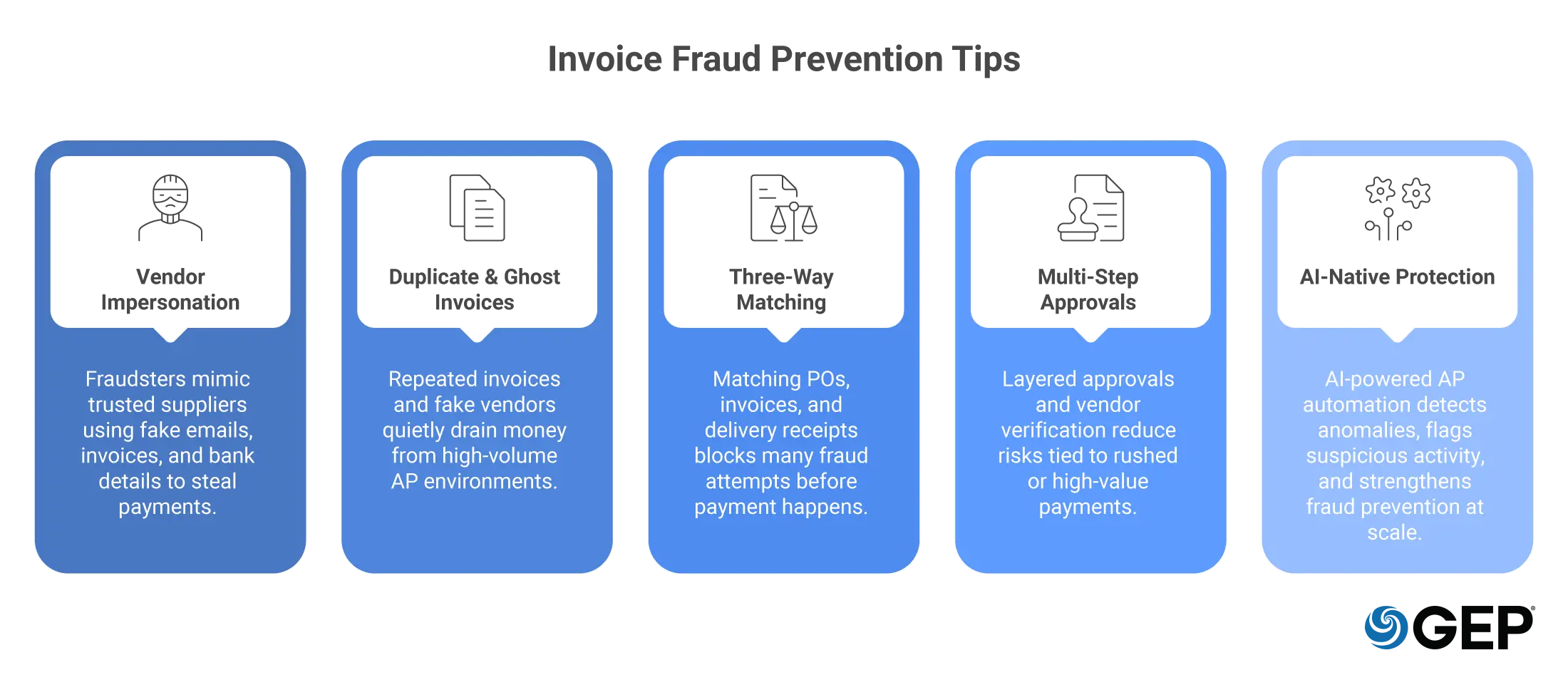
This one is frighteningly effective. A fraudster studies your supplier relationships carefully. Then they send you an invoice that looks almost identical to what you normally receive from a legitimate vendor. Almost. The email domain is off by one character. The bank account number has changed. The logo looks slightly different if you zoom in.
By the time your team catches it? The payment has already gone through. This is not a smash-and-grab operation. It is calculated, patient, and it works because it exploits the trust you have already built with real suppliers.
2. Duplicate Invoice Fraud
This one is sneaky precisely because it looks so ordinary. The same invoice gets submitted twice for payment, sometimes with tiny tweaks to the invoice number or date to avoid suspicion. In high-volume AP environments, where your team is processing hundreds of invoices a week, duplicates slip through. They add up quietly. You often do not notice until an audit.
And this one? It does not always come from outside your organization. Dishonest insiders know this game too.
3. Ghost Vendor Fraud
A fictitious supplier gets created in your vendor master. Invoices start flowing in for goods never ordered, services never rendered. Because the vendor exists in your system, payments move through without triggering any alarms. This scheme almost always has an insider involved. It is one of the hardest to spot without systematic audits of your supplier database.
4. Billing for Undelivered Goods or Services
This one thrives wherever procurement and accounts payable are not talking to each other properly. A supplier, real or fake, invoices you for a delivery that never happened. If nobody is cross-checking the invoice against a purchase order and a confirmed delivery receipt, the payment goes out. Simple as that. No delivery. No problem. At least, not for the fraudster.
5. Business Email Compromise (BEC)
This is the one that keeps AP managers up at night. A fraudster either hacks or spoofs a trusted email account, often a senior executive or a key supplier contact. Then they send an urgent message. Change this bank account. Process this invoice immediately. It cannot wait.
The urgency is intentional. The authority is borrowed. And it works because people do not want to slow things down when it appears the CFO is asking. BEC losses have reached staggering levels globally. Procurement and software teams are among the most frequently targeted.
Stay ahead of shifting spend dynamics across key categories
Explore the GEP Spend Category Outlook to inform data-driven decisions
Tips to Prevent Invoice Fraud
Knowing the schemes is step one. Here is what you actually do about them.
1. Tighten Your Vendor On-boarding Process
Every new supplier needs to go through proper verification before they ever receive a payment from you. That means independently confirming their business registration, tax details, and banking information. Do not just accept the documents they send you. Call them. Use a phone number you sourced yourself, not the one on their on-boarding form.
And do not stop there. Existing vendors need periodic re-verification too, especially any time their banking or contact details change. That moment of change is exactly when fraudsters strike.
2. Make Three-Way Matching Non-Negotiable
A three-way match is simple in concept. Before any invoice gets paid, you compare three documents: the purchase order, the delivery confirmation, and the invoice itself. All three need to line up. If they do not, the invoice gets flagged for review before it moves anywhere near a payment queue.
This single control knocks out a huge proportion of fraud attempts. It also catches honest errors before they become expensive problems. Automate it where you can. Human eyes get tired. Systems do not.
3. Build a Multi-Step Approval Workflow
No invoice, particularly above a set threshold, should be a one-person decision. Multi-step approvals mean that even if a fraudulent invoice gets past one reviewer, another person in the chain has a chance to catch it.
And whenever a vendor's banking details change? That should trigger its own elevated approval process, completely separate from the normal invoice flow. Direct verbal confirmation with the supplier, through a contact you already have on file, should be mandatory. No exceptions.
4. Train Your People Like You Mean It
Technology is powerful, but your team is still the first point of contact when fraud is attempted. Regular, realistic training matters. Not a once-a-year slide deck. Actual walkthroughs of real BEC examples, real impersonation tactics, real scenarios that your team might encounter on a Tuesday afternoon.
More importantly, create a culture where it is completely acceptable to slow down and question an unusual request. Fraudsters rely on people feeling too junior, too busy, or too pressured to push back. Remove that dynamic and you remove a lot of their leverage.
5. Audit Regularly and Look for the Patterns That Should Not Be There
Schedule routine audits of your vendor master and your payment records. You are looking for things like multiple vendors sharing the same bank account, invoices that consistently land just below approval thresholds, new vendors with no purchase order history receiving payments, or invoice sequences that do not match a supplier's normal pattern.
A quarterly review is often enough to surface fraud that might otherwise run undetected for years. The point is not to catch every single anomaly. The point is to make your organization a harder target than the one next door.
How an AI-Native Software Helps Prevent Invoice Fraud
Tightening your processes manually only gets you so far, especially when your invoice volumes are high and your supplier base spans multiple countries and formats.
That is where automation software comes in.
An AI-native invoicing and AP automation platform directly addresses the vulnerabilities fraudsters exploit. It automates the three-way match process, so every invoice is validated against the corresponding purchase order and delivery record in real time, before it ever reaches a payment queue. Discrepancies get flagged automatically. Nothing slips through because someone was overwhelmed that afternoon.
Its AI-native anomaly detection continuously monitors invoice patterns. Duplicate amounts, mismatched vendor details, unusual payment routing, atypical submission behavior. Additionally, it catches these signals and routes suspicious invoices for human review before any payment is released.
Such platforms also support e-invoicing compliance across countries, meaning your incoming invoice data is structured, standardized, and significantly harder to manipulate than unstructured PDFs or paper invoices. And because such software connects directly with suppliers through its global e-invoice network, you dramatically reduce the risk of invoice interception or impersonation in transit.
The result is operation that is faster, more transparent, and genuinely resilient to fraud. Protect Your Business From Invoice Fraud
Invoice fraud is not going away. But it is beatable. Understand the schemes, close the process gaps, invest in your people, and back it all with smart technology like GEP Quantum Intelligence. That combination is what separates organizations that get hit from the ones that do not.




FAQs
The ones you need to know are vendor impersonation, duplicate invoice submission, ghost vendor fraud, billing for goods or services never delivered, and business email compromise. Each of these exploits a different gap: vendor verification, invoice matching, supplier master integrity, procurement to AP alignment, and human behavior under pressure. Knowing how each one works is genuinely the first step to stopping them.
The most effective early detection comes from combining automated controls with regular, disciplined oversight. A three-way match process catches billing discrepancies before payment. Routine audits of your vendor master surface ghost vendors and shared banking details. AI-powered invoice processing tools go a step further, flagging behavioral anomalies in invoice patterns that no human reviewer would realistically catch at scale. The earlier your detection, the less your exposure.
Because no single person should be the only line of defense between a fraudulent invoice and your bank account. Multi-step approval means that even if one reviewer misses something, another has a chance to catch it. It also creates an audit trail, deters internal fraud, and ensures that high-risk moments, like changes to vendor payment details, get the additional scrutiny they deserve. It is one of the simplest structural controls you can put in place, and one of the most effective.