



Inside the Numbers: How CPOs Are Measuring Success in 2026
- Savings performance still separates average teams from best-in-class ones, and the gap runs wider than most CPOs expect.
- Spend visibility and contract compliance move together, so weakness in one usually shows up in the other.
- AI adoption is accelerating fast, but most organizations haven't solved the data problem underneath it.
July 31, 2026 | Procurement Process and Excellence 5 minutes read
Procurement teams are now well into 2026, and the year is proving as demanding as expected. New research from Ardent Partners, sponsored by GEP, surveyed 311 CPOs and senior procurement leaders between January and March 2026. The picture that emerges isn't subtle: a function asked to deliver more, without much more to work with.
Nearly eight in ten procurement leaders went into the year expecting it to be tougher than the last, and for many, that's exactly how it's played out so far. Budget constraints top the list of worries, cited by more than half of respondents. Fragmented systems and misaligned processes aren't far behind. Even so, three out of four CPOs still believe their teams will finish the year performing better than they did in 2025. Tougher conditions, higher expectations. That's the tension running through this year's data.
Savings Still Sets the Agenda
Cost savings remain the top priority for CPOs, cited by 75% of respondents. Procurement organizations delivered a 7.6% savings rate in 2025 and are targeting 7.8% this year. Small movement on paper. But when budgets are this tight, even a few tenths of a point get noticed in the boardroom.
Here's where it gets interesting. Best-in-class teams delivered 9.2% in savings compared to 7.3% among everyone else. They also sourced far more of their spend competitively (69% versus 45%). Coincidence? Not really. Savings tends to follow how much spend a team actually touches.
See Where Your Procurement Metrics Stand
Compare your team's performance against best-in-class benchmarks from Ardent Partners' latest research
Spend Visibility Remains Unfinished Business
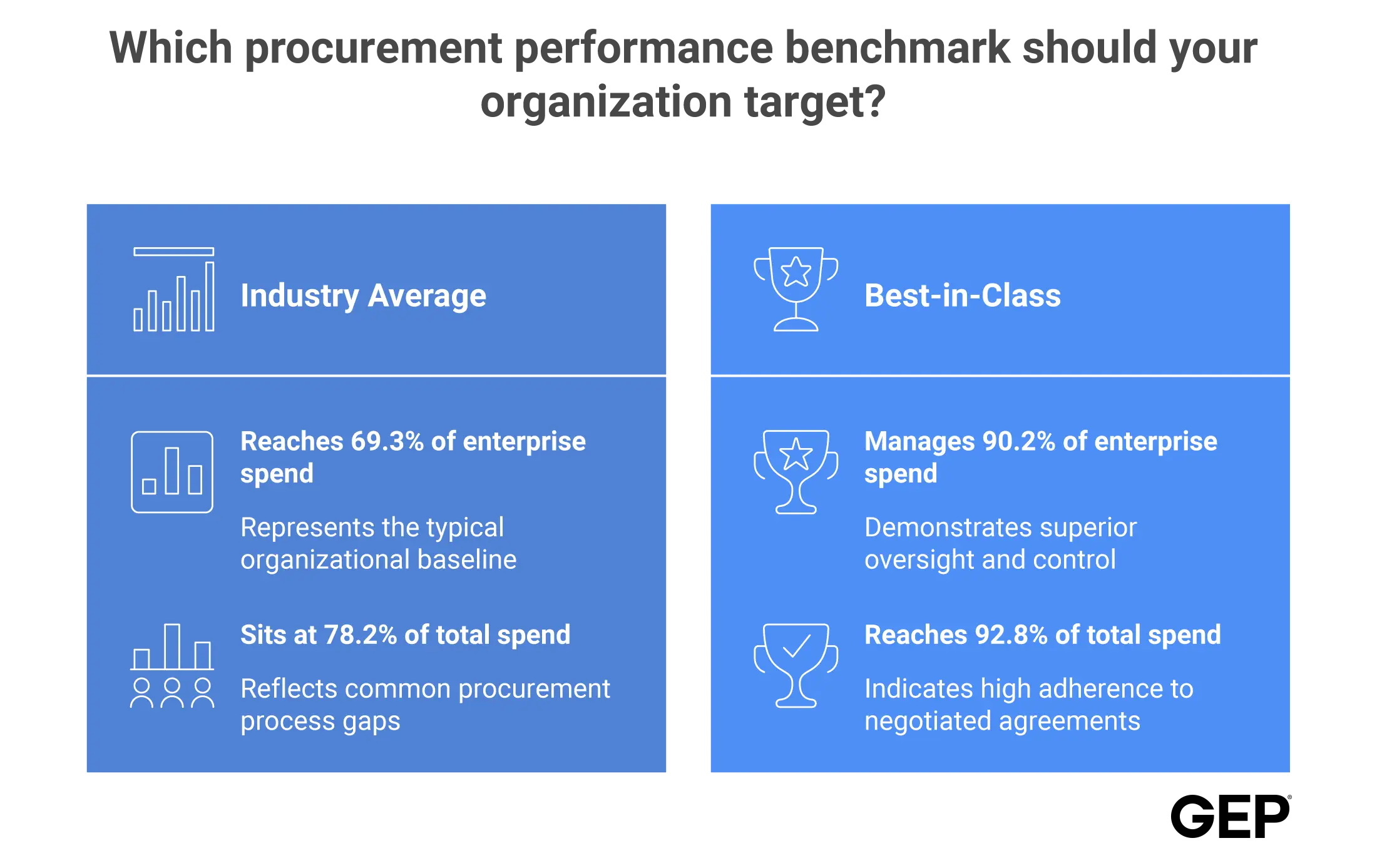
Total spend under management hit 69.3% in 2026. That sounds decent, until you place it next to best-in-class organizations, which manage 90.2% of enterprise spend on average. What's left untracked isn't harmless. It's missed savings, weaker negotiating positions, and compliance exposure nobody wants to explain later.
Contract-compliant spend tells a similar story. The industry average sits at 78.2%, while best-in-class teams reach 92.8%. Every dollar spent outside a negotiated agreement skips procurement's process entirely, and across a large enterprise, that adds up faster than most people assume.
Supplier Enablement Has Room to Run
Only 61% of the average organization's supply base is electronically enabled this year. That means nearly four in ten suppliers still sit outside digital procurement channels, which slows onboarding and adds manual work for procurement and accounts payable teams alike. Best-in-Class organizations enable 74.1% of suppliers. The difference shows up in cycle time. It shows up in data quality too.
AI Adoption Is Real, But Maturity Is Uneven
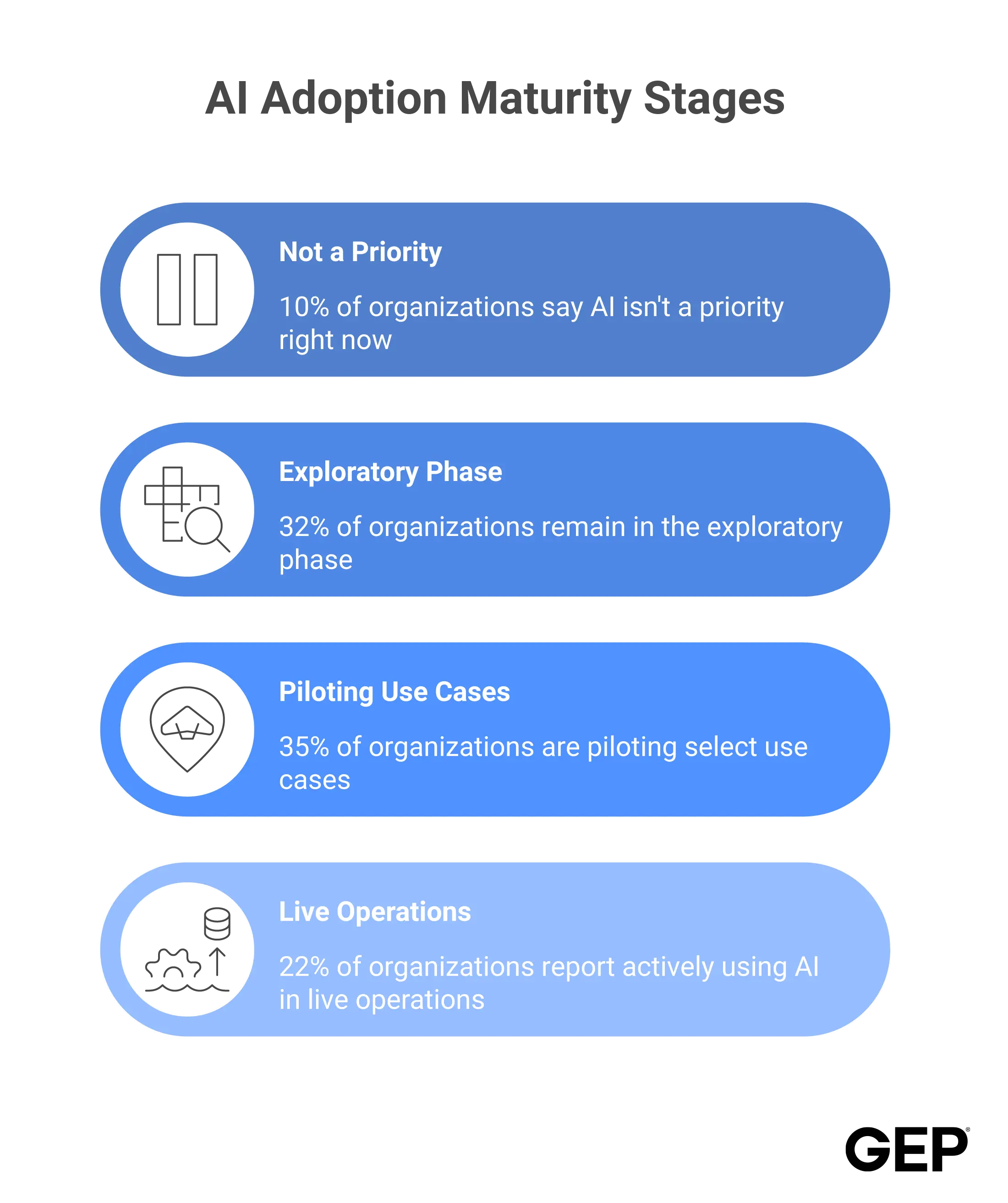
The maturity curve for AI in procurement doesn't look like a straight line. It looks more like a cluster. Just 22% of organizations report actively using AI in live operations. 35% are piloting select use cases, and 32% remain in the exploratory phase. The remaining 10% say AI isn't a priority right now, and that's fine, honestly. Not every team needs to move at the same speed.
Most CPOs, 61% of them, see AI mainly to boost productivity and scale, not as a tool for cutting headcount. That distinction matters more than it sounds. Among teams already using AI, only 42% point to operational efficiency as the most visible impact so far. Nearly a quarter admit the impact still isn't clear. Adoption is moving quickly. Results take longer.
What's slowing things down? Data quality is most often cited by 59% of teams actively working with AI. Integration with existing systems comes closely. Neither gets fixed by buying another tool. Both need cleaner data pipelines and systems that actually talk to each other before AI can do what it's supposed to do.
Explore GEP’s – AI-Native Procurement Software
The Four Factors That Move AI From Pilot to Production
Organizations that scaled AI successfully tend to share a few conditions. Clear, proven ROI matters most, cited by 61% of CPOs as the top adoption accelerator. Strong data foundations follow at 33%. The ability to configure use cases without heavy IT involvement and executive sponsorship each land at 21%.
None of these work well on their own. Executive backing helps, sure, but without clean data behind it, an AI initiative struggles to prove its worth. GEP Quantum Intelligence was built around this exact problem, pairing AI-native workflows with the data structure procurement teams actually need to get past pilots and into daily use.
Ready to Match Best-in-Class Performance?
Talk to GEP about building the data foundation and AI-native tools your team needs
Turning These Metrics Into Action
So, what do these numbers add up to? Savings, spend visibility, compliance, and supplier enablement all move together. Teams that lead in one area tend to lead across the board. AI adds a new layer of opportunity on top of that, but mostly for teams that already have their data house in order.
For procurement leaders mapping out next year, the real question isn't which metric to chase first. It's understanding that these benchmarks reinforce each other. Progress in one area tends to pull the rest along with it.




BLOG CATEGORIES
FAQs
Spend under management measures how much of an organization's total spend procurement actively influences or controls. In 2026, the average sits at 69.3%, while best-in-class teams manage 90.2%. Better visibility here supports stronger savings, tighter compliance, and smarter supplier decisions.
Most teams access AI through general-purpose tools and copilots first, then move toward internally developed models and embedded AI within their procurement platforms. Adoption is still uneven. 22% of organizations are actively using AI in live operations, while the rest are piloting, exploring, or not prioritizing it yet.
They combine higher spend under management, more competitive sourcing coverage, stronger contract compliance, and greater supplier enablement. Their advantage compounds over time, since better data and stronger governance tend to reinforce each other.
Digitally enabled suppliers can exchange transactions electronically, which cuts down manual effort and improves compliance and data quality. With only 61% of the average supply base enabled, most organizations still have meaningful room to close the distance with best-in-class performance.