Without AI-Native Architecture, Orchestration Is Incomplete
- Connecting procurement systems is an integration problem. Orchestrating outcomes across them is an AI problem — and the two are not the same.
- Total agentic orchestration requires an AI-native foundation that can reason, execute and learn across intake, end-to-end procurement, and the supply chain ecosystem.
- Without AI at each dimension of orchestration, the gaps persist and value leaks out.
June 30, 2026 | Procurement Software 4 minutes read
Most enterprises have spent years connecting their procurement systems to streamline workflow. ERPs talk to sourcing tools, which then hand off to contract systems. Contract systems feed into accounts payable. The data moves thanks to integrations, but for most procurement teams, the work still doesn’t move as one.
The reason is that connectivity and orchestration are not the same problem. Connectivity moves data between systems, but doesn’t orchestrate workflows. True orchestration requires an AI-native system that can reason and make decisions based on data, and then take action inside the relevant system and improve from what it learns. When AI isn’t part of the architecture layer, orchestration is incomplete, regardless of how well the systems are connected.
What Orchestration Actually Requires
Think about what happens in a well-run procurement operation when an exception arises: an invoice arrives without a PO reference, or a supplier changes their payment details mid-contract. Someone has to notice, interpret, decide and act. In most organizations, that someone is a human.
Agentic orchestration means the system handles it. But for that to happen, it has to perceive the exception, reading unstructured inputs like documents, emails and supplier data and understanding what they mean. It has to reason through it, weighing business rules, historical context and risk signals to determine the right response. It has to execute inside the relevant systems of record, not just flag the issue for a human to resolve. And it has to incorporate the outcome so it handles similar situations better next time.
This is what Total Agentic Orchestration means in practice: AI-native at every layer, built to orchestrate decisions and outcomes rather than route tasks. A platform that meets all four conditions doesn’t just connect procurement processes, it runs them. One that meets only some of them has gaps, and those gaps are where value disappears.
How AI Enables Total Agentic Orchestration Across All Three Dimensions
Dimension 1: Intake
Intake looks, on the surface, like a user experience problem: give every employee one place to start, regardless of what they need. And a well-designed interface matters. But the hard part of intake isn’t the front door, it’s what happens when a request is ambiguous, when the right policy isn’t obvious, or when context from a previous interaction should inform how the request is handled.
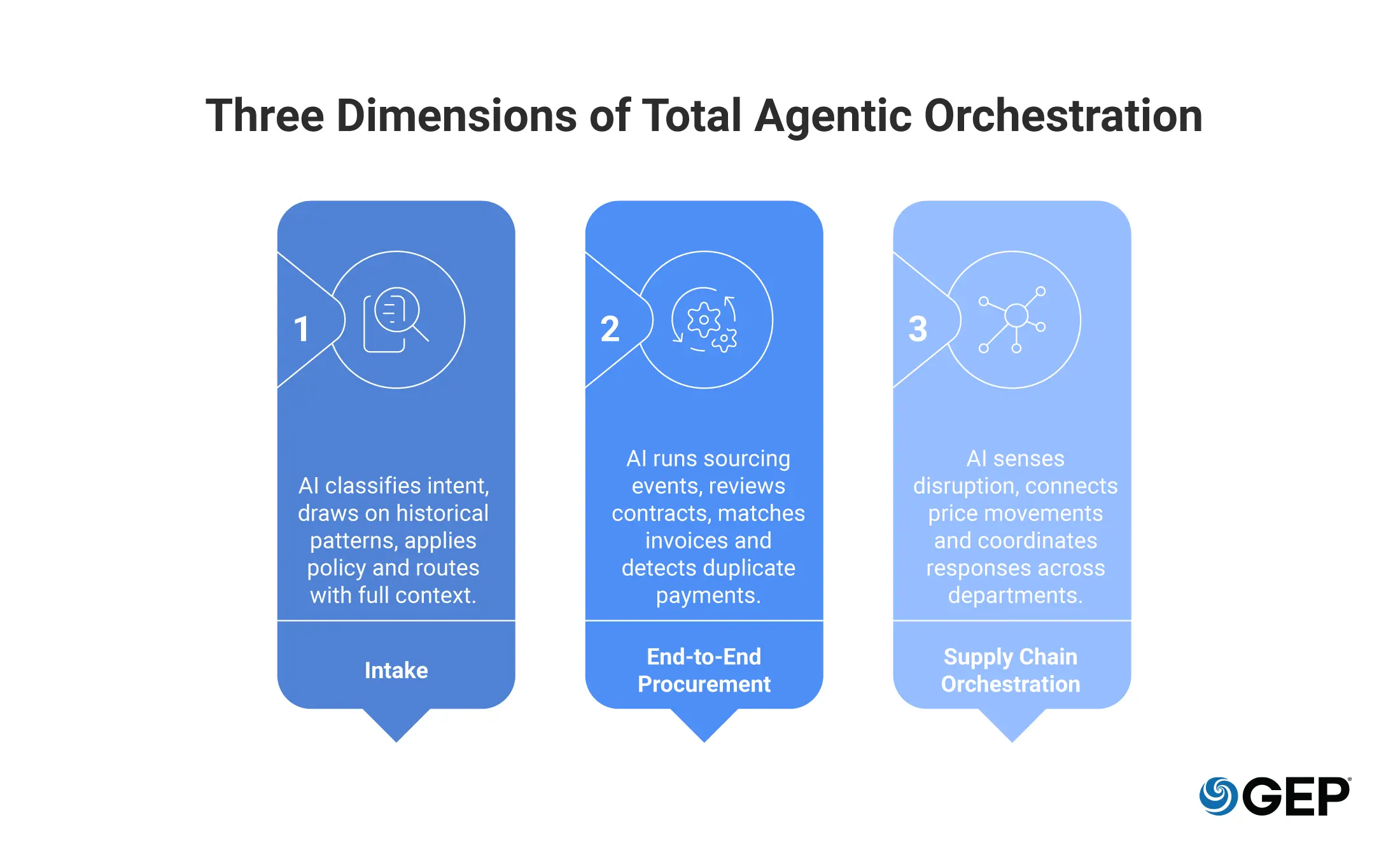
AI-native intake doesn’t just present a form. It classifies intent, draws on historical patterns and category intelligence, applies policy in real time and routes with the full context of what the request actually is.
Without AI, intake is a smarter form that still defaults to a human queue when it hits the edge of its rules. With AI at the foundation, intake becomes a genuinely intelligent front door — the first step in Total Agentic Orchestration, where context is captured once and travels through every downstream step.
Dimension 2: End-to-End Procurement
This is where AI becomes non-negotiable. Running a sourcing event autonomously, reviewing a contract for non-standard risk, matching an invoice without a PO reference, detecting a duplicate payment before it clears: each of these requires AI that lives inside the workflow, not above it. The AI needs access to procurement-specific logic, the data inside the systems of record, and the ability to take action directly rather than surface a recommendation for someone else to execute.
Total Agentic Orchestration at this dimension means AI that doesn’t assist with tasks but completes entire process outcomes: running a sourcing cycle start to finish, reviewing and redlining a contract, matching and approving invoices, without human coordination stitching the steps together. This is the dimension that separates a procurement function that manages work from one that delivers outcomes.
Dimension 3: Supply Chain and Ecosystem Orchestration
At this level, the AI-native architecture is a pre-requisite. Sensing disruption in a sub-tier supplier network, connecting commodity price movements to live contract exposure, coordinating a response across procurement, supply chain and finance: none of this is achievable through workflow design or system integration alone. It requires AI that operates across enterprise and supply chain boundaries: perceiving signals from across the ecosystem, reasoning about their implications, and acting at a speed and scale no human team can match. Gartner forecasts that SCM software with agentic AI will grow from under $2 billion in 2025 to $53 billion by 2030 — yet only 5% of enterprises have adopted agentic AI features today. That gap reflects how much of this dimension remains out of reach for platforms where AI isn’t embedded at the foundation. Platforms that fall short of that standard leave their most strategically valuable orchestration capability unrealized.
See What Orchestration Looks Like in Practice
Eliminate the Gaps That Are Holding Procurement Back
Total Agentic Orchestration Is the Gold Standard
At intake, AI enables organizations to capture context. At the process layer, it turns connected workflows into executed outcomes: sourcing events completed, contracts reviewed, invoices cleared, without needing human coordination to fill the gaps. And at the ecosystem layer, AI turns visibility into decisions and coordinated action across the full supply chain.
Total Agentic Orchestration is the approach that delivers all three, with no gaps to leak value. Platforms built on AI-native architecture deliver orchestration that’s complete, autonomous and continuously improving from every outcome it produces, enabling procurement to orchestrate not just processes, but outcomes.