



How Procurement Leaders Deploy Agentic AI Without Losing Control
- Agentic AI executes decisions, so ungoverned errors compound fast.
- Teams resist the accountability gap, not the technology itself.
- Guardrails, controls, and auditability ensure compliant AI at scale.
July 02, 2026 | Procurement Strategy 5 minutes read
Most procurement technology fails for the same reason. The tools work, but people just never use them the way the business case assumed, so the value never lands.
Agentic AI raises the stakes on that old problem. Buying a new e-sourcing tool that your team completely ignores is a waste of time and resources.
Agentic AI, however, does not wait to be used. It works autonomously in the background, coordinating among multiple AI agents, suppliers, supply chain systems, and people. It makes decisions your team can trust, trace, and stand behind.
This blog discusses the common issues leaders face in change management with agentic AI and how to get it right.
Who Takes the Fall When AI Gets It Wrong?
Agentic AI needs clear accountability before procurement can trust it
What Agentic AI Actually Changes
Agentic AI is software that pursues a goal. Give it an objective like ‘source this category compliantly,’ and it plans the next steps, works across your ERP and sourcing systems, checks results against your rules, and escalates when something falls outside the guardrails.
Generative AI drafts the RFP. RPA clicks through a fixed sequence. Agentic AI decides what to do next and does it.
That distinction is the whole story for change management. Earlier waves asked people to work faster through a new interface. The human stayed in the driver’s seat.
Agentic AI asks people to delegate decision authority to a system that operates between their touchpoints. This time, the change is about decision authority. Who holds it, and who or what decides.
Why Change Management Fails for Agentic AI, and What to Do Instead
Most procurement teams run a training program and call it change management. Training is the easy part, while deeper problems go unaddressed.
Resistance Is Misread by Leadership
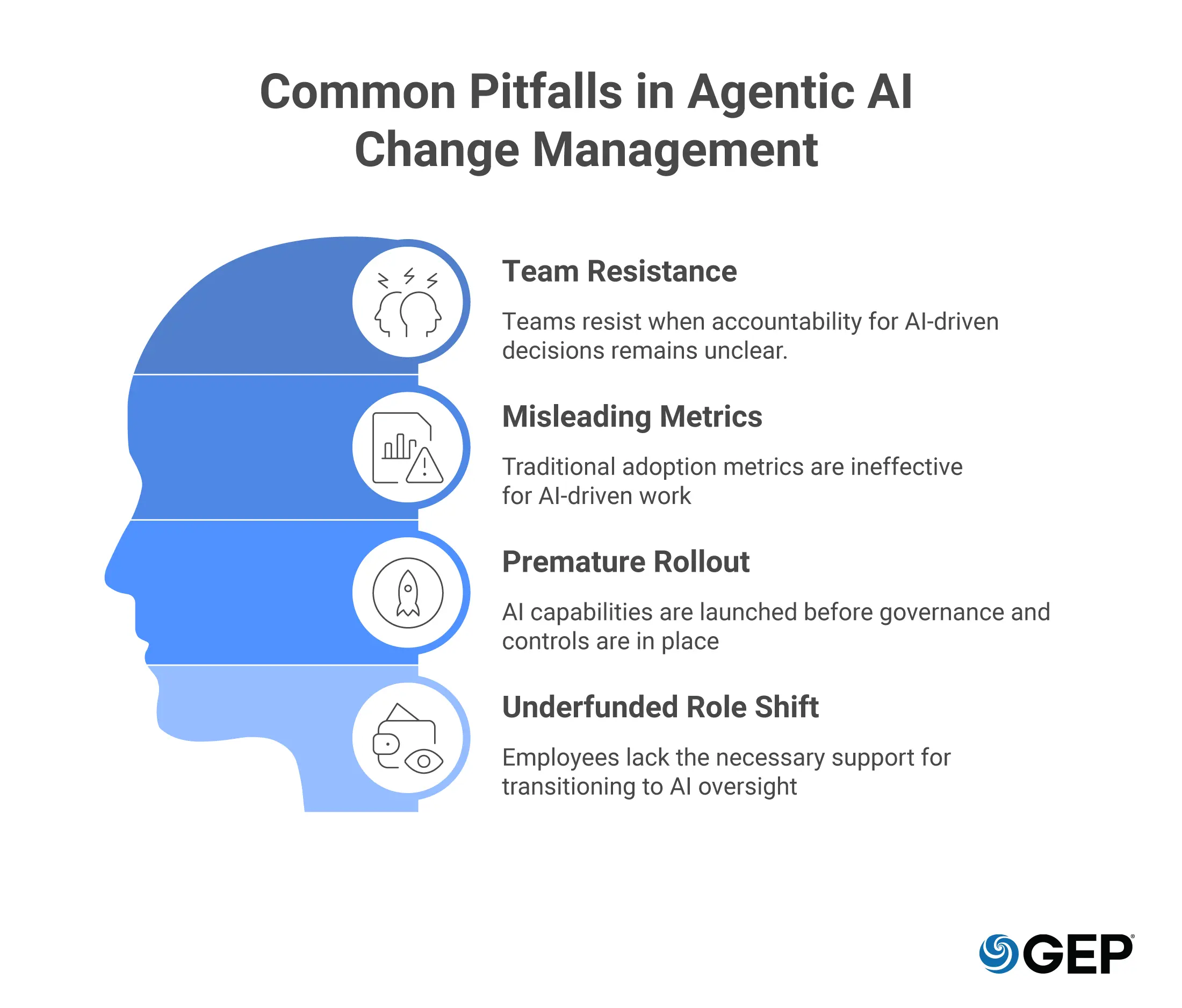
Most procurement professionals fear the accountability gap that comes with using autonomous systems. When an AI agent makes the wrong sourcing call, or a contract slips through because no human reviewed the decision, who owns it?
This resistance is rational. But when leadership has not established clear governance protocols, the burden of proof falls on the teams, and the pressure to catch and resolve every issue on their own creates resistance. This cannot be ignored. Treat it as a training problem, and you lose the room.
When the Metrics Mislead
Legacy dashboards allow you to track individual staff logins and tool usage. When AI agents do the work instead of people, that activity drops by design. A change team watching the old numbers sees the decline and assumes the rollout is failing, then steps in to push usage that was never supposed to be there.
Track the agents instead. Watch how many decisions agents handle on their own, how often a human overrides them, and how quickly exceptions get cleared.
When the Rollout Outruns the Organization
What happens when AI agents are live and making decisions before anyone is ready to govern them?
Turning on agentic capabilities is fast. A vendor flips a switch, and the agents can source, negotiate, and raise POs within weeks. Building the human side takes far longer.
You get a window in which the agents are live and active, but the roles and rules for accountability and damage control are not yet in place.
The Role Shift You Have to Fund
When agentic AI takes over routine sourcing, purchase orders, and supplier monitoring, your people stop doing that work and start supervising the system instead. Train them for the new role before the rollout. It costs money, and more than that, it costs time you cannot buy back later.
Build Trust Before You Scale
Trust calibration is the new core of change management. People either over-trust a new agent and skip the review that catches a bad call, or under-trust it and route everything to manual approval, which kills the value case. Both fail.
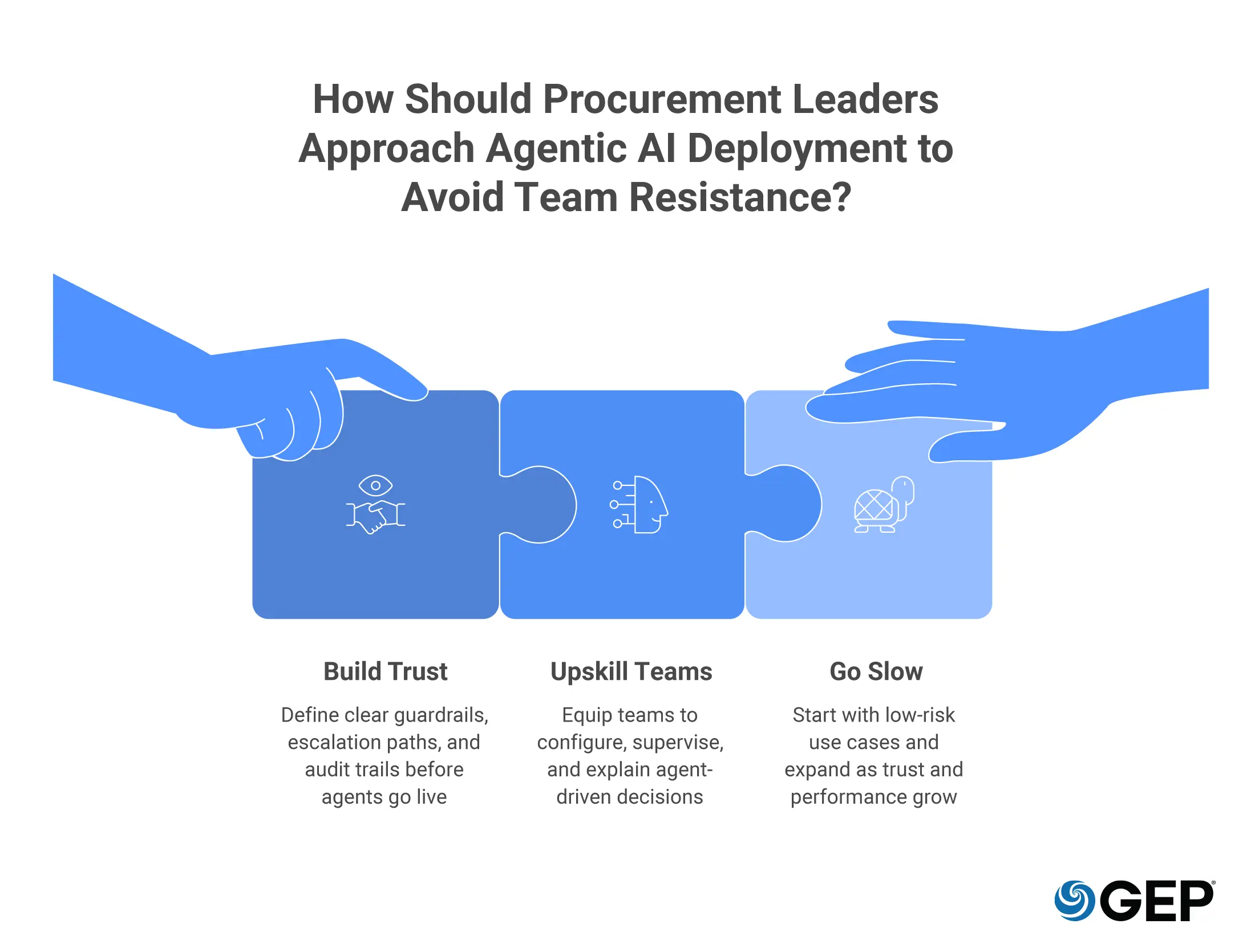
The fix must be structural. Define where agents can act alone and where they must escalate to a human. Write the override protocols and escalation paths before go-live. Document a decision audit trail for every agentic action, making each one traceable and contestable.
Upskill Teams
Orchestrating agentic AI takes specific skills. Teams must:
- Configure how agents are directed and constrained.
- Recognize the exception patterns that signal when a human must step in.
- Translate autonomous decisions for finance, legal, and suppliers who were never in the room.
This equips teams to supervise what the system does.
Go Slow to Go Long
Introduce agentic AI gradually. Start deploying AI agents on low-stakes work where errors are cheap, easy to spot, and easy to correct. Grow their scope in proportion to demonstrated accuracy and earned confidence. Build feedback loops that your frontline can see working, because people trust a system they have helped shape.
Agentic AI Is Going to Be Mainstream
Agentic AI pays off at adoption, and adoption is a human discipline.
- Get the governance in place before go-live.
- Settle role clarity before rollout.
- Align your suppliers before deployment.
The next decade of procurement performance will come down to one thing: how well you built the organization around the technology you bought.
Ready to embed agentic AI across sourcing, supplier management, and spend intelligence? Explore GEP Quantum Intelligence to see an enterprise-grade agentic deployment in practice.




Frequently Asked Questions
Agentic AI in procurement is software that autonomously pursues business goals. It plans the steps, acts across your ERP and sourcing systems, and escalates exceptions, without waiting for a prompt at each stage. Generative AI drafts content, and RPA follows fixed rules. Agentic AI decides and executes multi-step workflows such as sourcing, contracting, and purchase order processing, while humans retain oversight of strategic decisions.
Most fail at adoption. The root cause is the governance and trust gap. Teams deploy autonomous agents without clear override protocols, audit trails, or role clarity, so people will not trust, trace, or defend the system's decisions.
Treat it as a trust architecture. Define where agents act alone versus where they escalate, build decision audit trails before go-live, and shift your people from operators to orchestrators who configure agents, supervise them, and handle exceptions. Then scale autonomy lane by lane, starting with low-stakes tasks and expanding as accuracy and confidence grow.