



Agentic AI for Sourcing: Why Traditional RFX Management Needs a Rethink
- Agentic AI streamlines every stage of the RFX lifecycle, reducing manual work and accelerating sourcing decisions.
- AI-native supplier discovery and bid evaluation help you identify the best suppliers with greater speed, consistency and confidence.
- A unified Source-to-Pay platform enables scalable, transparent and intelligent sourcing while keeping procurement teams focused on strategic value.
October 16, 2026 | Procurement Strategy 5 minutes read
Your sourcing environment today looks nothing like it did a decade ago. Supply chains span continents, supplier ecosystems are more fragmented than ever, and the volume of data you need to evaluate before making a single procurement decision has grown exponentially. Add regulatory requirements, sustainability mandates, and rising stakeholder expectations, and you have a sourcing function under pressure from every direction. Whether you're sourcing direct materials, IT services, or logistics, each category brings its own supplier landscape and risk profile; managing that complexity with static templates and spreadsheets is a significant ask of any procurement team.
The Cost of Manual RFX Workflows
If you've run an RFP recently, you already know where things slow down. Building supplier lists takes time; getting complete, comparable responses takes more. Chasing suppliers for clarifications, aligning stakeholders on evaluation criteria, and documenting decisions for audit purposes: each step adds days or weeks to a process that should be measured in hours. Those delays are costly; they push back contract start dates, limit negotiating leverage, and keep savings on the table longer than necessary.
But the deeper problem isn't just speed. When your team spends most of its time on coordination and document formatting, there's little bandwidth left for the work that actually creates value: supplier relationship management, market analysis, category strategy. Manual processes don't just slow procurement down; they crowd out the strategic thinking your organization needs most from it.
Is Your Procurement Organization Ready for What's Coming?
Download the 2026 Procurement Executive Insight Report and find out where you stand
How Agentic AI Transforms the RFX Lifecycle
Intelligent supplier discovery
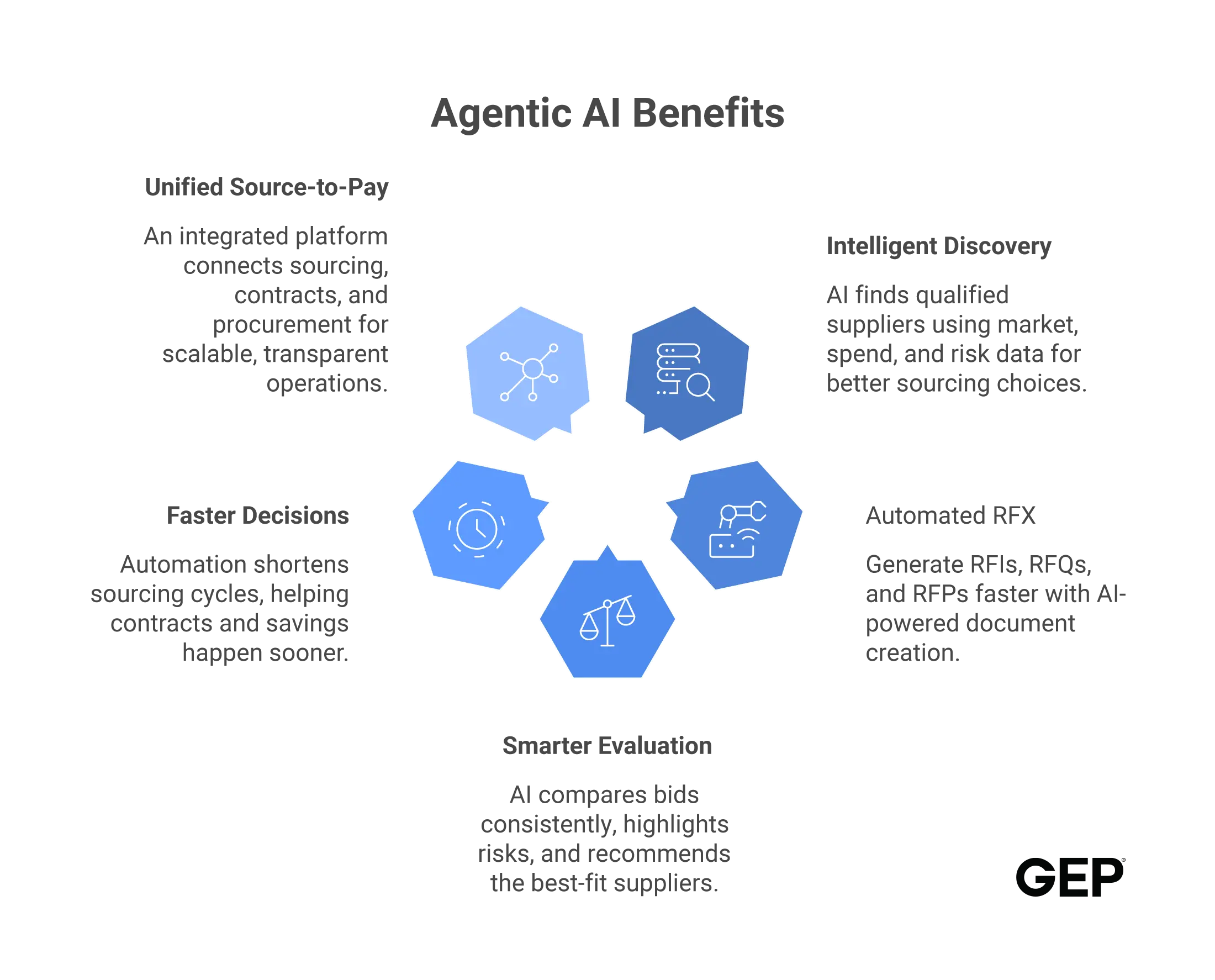
Agentic AI can continuously scan supplier databases, market intelligence feeds, and historical spend data to surface relevant suppliers you might not have considered. Instead of working from a fixed vendor list, you get dynamic, context-aware recommendations based on category, geography, risk profile, and past performance. That means broader competition from the start, which almost always leads to better outcomes.
Automated RFI, RFQ and RFP creation
Rather than starting from a blank template, agentic AI generates tailored RFX documents based on your category requirements, historical sourcing events, and supplier feedback patterns. It pulls in standard terms, compliance requirements, and evaluation criteria appropriate to the category. What used to take days of stakeholder back-and-forth can be ready for review in hours.
Smarter supplier communication
One of the least glamorous parts of running an RFX is managing supplier communications: sending clarification responses, chasing missing submissions, acknowledging receipt. Agentic AI handles these workflows automatically, maintaining consistent, professional communication at scale while flagging anything that genuinely needs human attention.
AI-driven bid evaluation
When responses come in, AI can normalize them against your evaluation criteria; comparing pricing structures, scoring qualitative responses, and flagging anomalies or incomplete submissions. Instead of building evaluation matrices by hand, you get a structured, consistent analysis across all bids. That consistency matters most when you're evaluating ten or twenty suppliers simultaneously under time pressure.
Data backed award recommendations
Rather than relying on instinct or whoever makes the most compelling presentation, agentic AI synthesizes bid data, supplier risk indicators, and historical performance to generate transparent award recommendations. You still make the final call; the AI gives you the evidence to make it confidently and explain it clearly to stakeholders.
The Business Benefits of Agentic AI in Strategic Sourcing
Faster sourcing cycles
When supplier identification, document creation, and bid evaluation are all accelerated by AI, your end-to-end RFX cycle compresses significantly. Sourcing events that previously took six to eight weeks can realistically complete in two to three. That speed compounds: faster sourcing means faster contracts, faster savings realization, and a more agile response to supply disruption.
Better supplier decisions
More suppliers, better evaluation data, and consistent scoring criteria naturally lead to better decisions. You're less likely to default to familiar names out of convenience and more likely to identify genuine best-in-class options across quality, cost, and risk dimensions.
Improved compliance and governance
Every step in an AI-assisted sourcing process is logged, timestamped, and traceable. Evaluation criteria are documented before suppliers respond; scoring is consistent and auditable. That matters when internal audit or external regulators want to understand how an award decision was reached.
Greater procurement productivity
When AI handles the repetitive, time-consuming parts of RFX management, your team gets time back for supplier development, category strategy, and the kind of cross-functional partnership that positions procurement as a genuine business driver rather than a back-office function.
Ready to Transform Your RFX Process?
Discover how agentic AI can accelerate sourcing and improve supplier decisions
What to Look for in an Agentic AI Sourcing Platform
End-to-end Source to Pay integration
An AI sourcing tool that sits outside your broader procurement ecosystem will always create friction. The right platform connects seamlessly from supplier discovery through contract execution and invoice management: data flows without manual re-entry, and insights from one stage inform the next. Deep Source-to-Pay integration, built on a unified data model, is what separates a genuine transformation from a point solution.
Supplier intelligence and collaboration
The best platforms don't just manage transactions; they build supplier intelligence over time. Look for platforms that aggregate supplier performance data, financial health signals, and risk indicators, and that give suppliers a structured, straightforward way to engage with your RFX processes.
Explainable AI with human oversight
You need to understand why the AI is making a recommendation, not just what it recommends. Explainability isn't optional in regulated industries or where significant spend is involved. The right platform shows its reasoning and makes it easy for your team to accept, adjust, or override any AI-generated output.
Scalable architecture for global procurement
If you operate across multiple regions, business units, or currencies, your platform needs to handle that complexity without custom workarounds for every market. Configurable workflows, multilingual support, and the ability to enforce global standards while accommodating local requirements are all non-negotiable at enterprise scale.
Building a Future-Ready Procurement Function
The most effective implementations of agentic AI in procurement aren't about replacing your sourcing team; they're about amplifying what it can do. AI takes on the volume and the repetition; your people bring judgment, relationships, and strategic context.
The procurement functions that will lead over the next decade are already shifting from reactive to proactive, from transactional to strategic, and that combination is what makes the shift sustainable. Organizations with deep procurement expertise and unified technology platforms are best placed to get there; AI accelerates it by handling the operational load so your team can focus on decisions that actually shape your supplier ecosystem and competitive position.
Explore GEP’s Agentic AI Sourcing Management Platform for Streamlining RFX Management




FAQs
Agentic AI automates key RFX activities including supplier discovery, RFI, RFQ and RFP creation, supplier communication, bid evaluation and award recommendations. This reduces manual work, accelerates sourcing cycles and allows procurement teams to focus more on strategic decisions.
AI analyzes supplier data, pricing, risk indicators, historical performance and bid responses against consistent evaluation criteria. This helps procurement teams identify stronger suppliers, reduce bias and make faster, more transparent award decisions while retaining human oversight.
Look for end-to-end Source-to-Pay integration, supplier intelligence, explainable AI, human oversight and scalable architecture. The platform should connect sourcing with contracts, procurement and invoicing while supporting global requirements without extensive custom development.