


The AI Data Center Energy Crisis Is a Procurement Problem (And a Massive Opportunity)
- The AI infrastructure buildout has created a genuine procurement crisis in electrical equipment and energy supply, with transformer lead times stretching years and grid capacity constraints redirecting billions in investment.
- Securing energy supply through long-term PPAs and behind-the-meter generation is now a strategic procurement discipline, not just a sustainability exercise.
- Non-tech organizations are indirectly affected as hyperscaler demand distorts pricing and availability in copper, power electronics, and construction labor — categories that require proactive lead time management.
July 31, 2026 | Procurement Strategy 4 minutes read
The U.S. data center power consumption, driven by AI use, is expected to account for about 50% of the growth in demand for electricity between 2025 and 2030, according to a report by IEA. That is not incremental growth. It is a fourfold expansion of physical infrastructure, electrical systems, cooling equipment, and construction services compressed into six years.
In global terms, Gartner projects global data center electricity consumption to increase by more than 26%, reaching 565 TWh in 2026, up from 447 TWh in 2025. According to Gartner, AI-optimized servers are projected to account for 31% of data center power consumption in 2026, exceeding the power consumption of conventional servers by 2027.
The procurement implications are enormous, and not just for tech companies.
AI-Native or Bolt-On Procurement Platform?
Find out what separates AI-powered tools from AI-native procurement platforms
When Megawatts Become Harder to Source Than GPUs
For most of the AI buildout's early phase, the bottleneck was compute: GPUs were on allocation, lead times stretched to a year, and hyperscalers were offering premiums to jump queues. That constraint has eased somewhat. The new bottleneck is power.
The U.S. data center electrical equipment market — transformers, switchgear, power distribution units — is projected to grow from approximately $20 billion in 2026 to $65 billion by 2030, according to a report by Data Center Knowledge. Transformer lead times in some markets are already running two to four years. Grid interconnection queues in power-constrained regions like Northern Virginia have become so long that hyperscalers are relocating builds entirely. Tech giants such as Microsoft and Meta have committed billions of dollars in the UAE and in Louisiana, respectively, partly due to accessible grid capacity in these regions.
The Procurement Angles Most Organizations Are Missing
Most procurement teams are watching the AI infrastructure story from the sidelines, treating it as a tech sector problem. It isn't. The ripple effects on equipment markets, energy supply, and construction capacity are already reaching organizations with no data centers on their roadmap. Here is where the exposure is hiding.
Electrical Equipment is in a Seller's Market
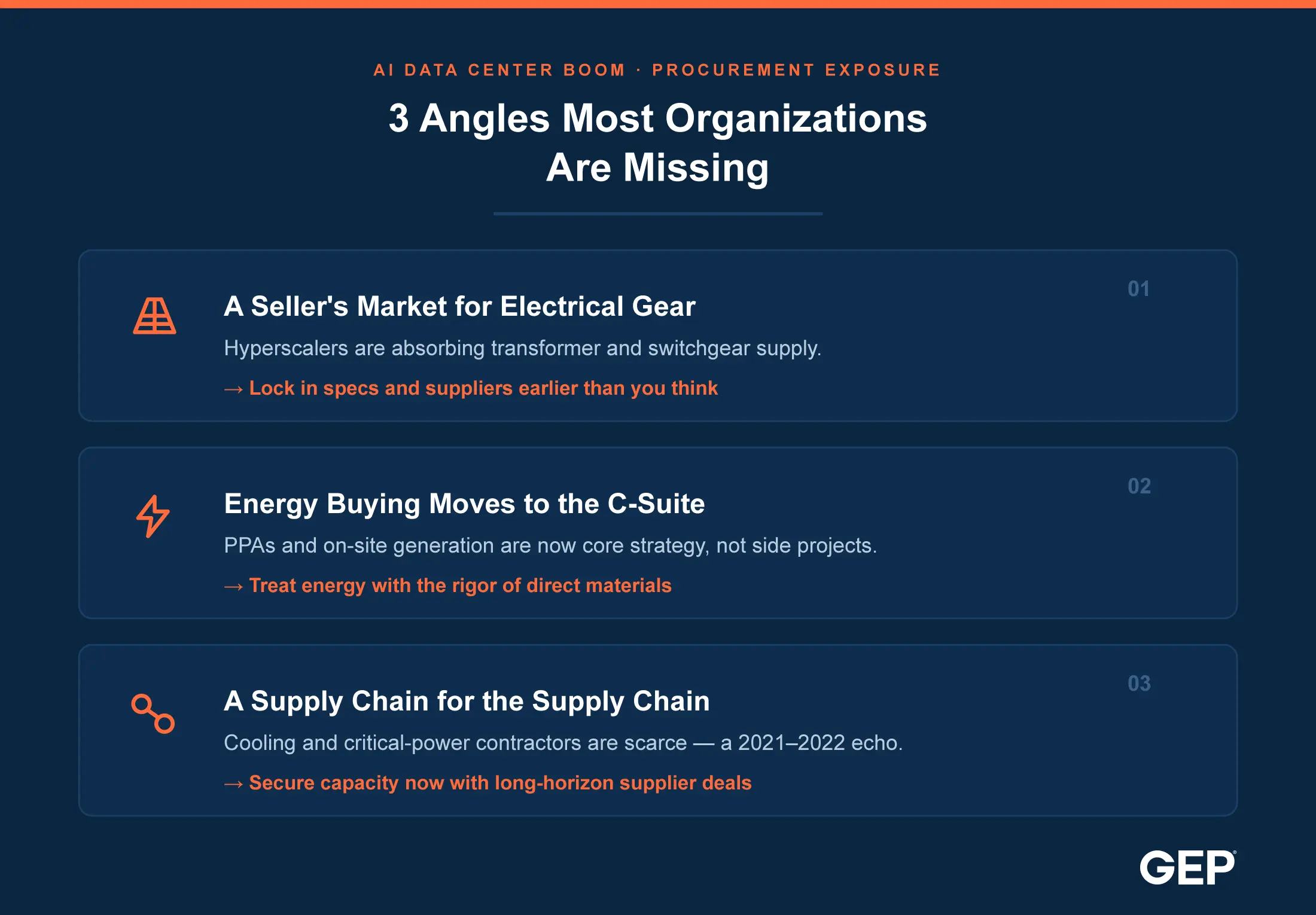
Hyperscalers competing for transformers and switchgear are compressing availability for utilities, manufacturers, and industrial buyers who need the same equipment for entirely unrelated reasons. If your capital projects include electrical infrastructure, such as data halls, EV charging installations, grid upgrades, manufacturing expansion, lead times and pricing are being distorted by AI infrastructure demand. Procurement teams need to be modeling this risk and moving sooner on specification and supplier engagement.
Energy Category Management is Becoming a C-Suite Discipline
Power purchase agreements, virtual PPAs, behind-the-meter generation, and on-site fuel cell partnerships are no longer niche instruments for sustainability teams. They are becoming primary procurement strategies for organizations with large, predictable energy loads. As AI workloads drive electricity demand, any organization with significant facilities exposure needs energy procurement strategy at the same level of rigor applied to direct materials.
Supply Chain for the Supply Chain
The construction boom itself creates procurement complexity: specialized contractors for high-density cooling systems, liquid cooling infrastructure, and critical power are in short supply. Procurement teams managing capital projects in this environment are dealing with subcontractor bottlenecks that look very similar to the component shortages of 2021–2022. Early engagement, long-horizon contracts, and preferred supplier agreements are the practical response.
Don't Wait for the Next Disruption
GEP can help you navigate the unpredictability and protect your margins with confidence
What Does This Mean for Non-Tech Procurement Leaders?
Even organizations with no AI buildout on their agenda are affected. When hyperscalers pull millions of tons of steel, copper, and specialized electrical components out of the market on an accelerated timeline, pricing and lead times shift for everyone competing for the same manufacturing capacity.
The smarter response is to treat this as an intelligence problem first. Which categories in your portfolio have material overlap with AI infrastructure demand? Copper wiring, power electronics, cooling systems, construction labor, and specialized contracting all qualify. Understanding where demand signals are being distorted (and positioning procurement strategy accordingly) is the difference between getting caught off guard and building resilience before the squeeze arrives.




FAQs
Even organizations not building data centers are exposed. Hyperscaler demand for transformers, switchgear, copper, and specialized construction services is compressing availability and driving up prices for all buyers of those inputs. Procurement teams managing capital projects, facilities, or energy-intensive operations should model this demand distortion and adjust lead time and supplier engagement timelines accordingly.
A PPA is a long-term contract between a buyer and an energy generator that locks in electricity supply at an agreed price, often from a renewable source. As energy costs and availability become more volatile, driven in part by AI data center demand, PPAs are increasingly managed as a core procurement instrument rather than a finance or sustainability side exercise, particularly for organizations with large or predictable electricity loads.
The highest-exposure categories include power transformers, switchgear, uninterruptible power supply systems, liquid and air-cooling equipment, copper wiring and cable, and specialized data center construction contracting. Procurement teams in any sector with capital investment plans touching these categories should be building longer sourcing runways and monitoring lead time trends actively.