


Buy-Hold-Sell: A New Way to Manage Inventory Without the Capital Trade-off
- Inventory doesn't have to sit on your balance sheet to stay available when you need it.
- A strategic partner can purchase, finance, and hold material on your behalf, so you pay only at the point of use.
- Running the model at scale depends on real-time visibility, a global operations team, and deep financing capacity working together.
July 29, 2026 | Inventory Management 4 minutes read
For years, procurement and finance teams have lived with the same hard trade-off. Carry enough inventory to survive disruption, or run lean to protect cash. Neither choice has aged well. A shortage exposes production lines and customer commitments to real financial damage. Excess stock, meanwhile, quietly erodes working capital long after the crisis that justified it has passed.
There's a third option that doesn't require picking a side. Under a Buy-Hold-Sell model, a strategic partner purchases material from your existing suppliers, finances it, and holds it until you need it. The partner carries ownership. You pay only at the point of use. Supply remains available. The balance sheet stays clear.
Why the Old Trade-off Keeps Failing
Traditional inventory planning was built for markets that moved in predictable cycles. Demand shifted gradually. Suppliers delivered reliably. Safety stock could be calculated with reasonable confidence, and most of the time, the calculation held up.
That world is gone. Disruption now shows up with little warning, whether it starts in tariff policy, freight capacity, or a single supplier's production line going dark. Finance leaders have grown wary of capital sitting idle in warehouses. Operations leaders are just as wary of a stockout that halts a production run overnight. They're reacting to the same root cause from opposite ends: inventory has been treated as a fixed asset, in a market that now needs something closer to a dial.
Understand the Full Buy-Hold-Sell Model
See what it takes to run inventory this way at enterprise scale
What Actually Changes
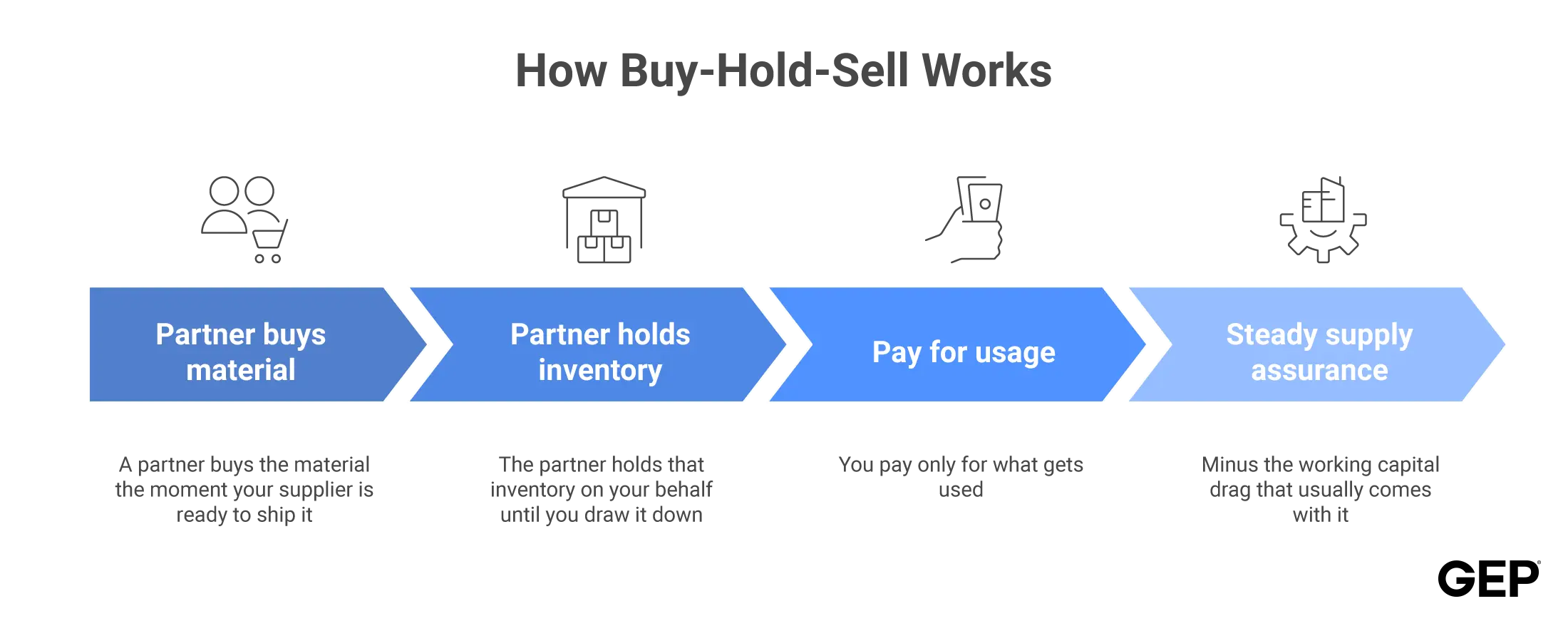
Buy-Hold-Sell doesn't ask an enterprise to switch suppliers or renegotiate existing contracts. Sourcing relationships stay exactly as they are today. What moves is the risk sitting between purchase and consumption, and who's responsible for carrying it.
Here's how it plays out. A partner buys the material the moment your supplier is ready to ship it, then holds that inventory on your behalf until you draw it down. You pay only for what gets used. Supply assurance holds steady, minus the working capital drag that usually comes attached to it.
Also Read: Inventory Control System Guide
Behind the Model
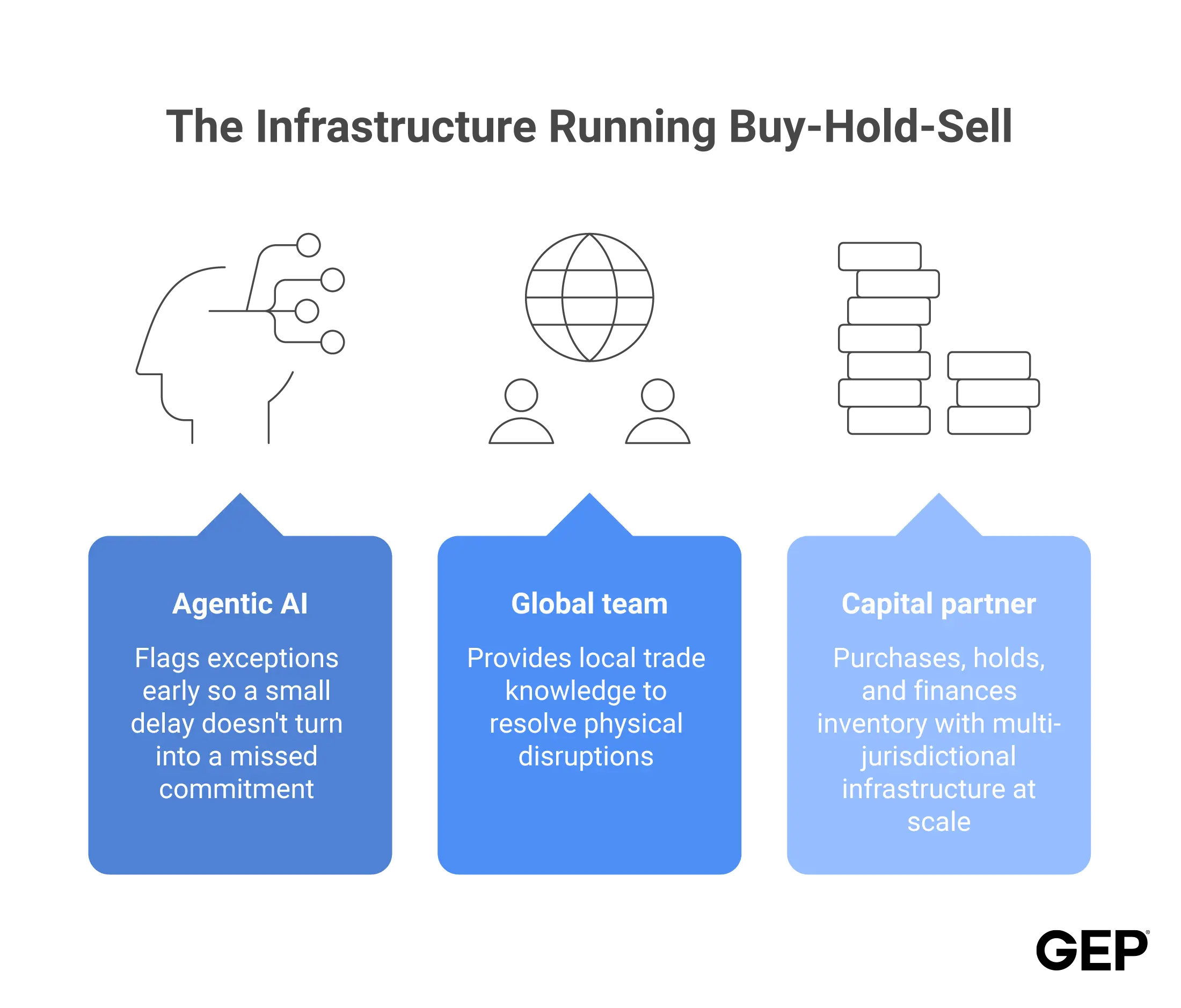
None of this works on financing alone.
Visibility must be constant, for one. Purchase orders and shipment status need to update in real time, matched continuously against demand that can shift by the week, so a shortage never becomes visible on the plant floor before someone's already acted on it. Agentic AI carries that coordinating load, flagging exceptions early enough that a team can respond before a small delay turns into a missed commitment.
Technology can't resolve every disruption by itself, though. A customs hold or a last-minute carrier swap, usually needs a person who can step in physically, not just a dashboard flagging the problem from a distance. That's where a global team with local trade knowledge earns its keep, turning an alert into an actual fix on the ground.
And behind both of those sits capital. Acting as buyer of record across dozens of countries takes more than good intentions. It takes a partner with the balance sheet and the multi-jurisdictional trade infrastructure to purchase, hold, and finance inventory at real enterprise scale.
Putting the Model to Work
Manufacturers lean on Buy-Hold-Sell to keep critical components on hand through volatile production schedules, without inflating carrying costs on the balance sheet. Enterprises operating across several regions use it differently: to standardize inventory strategy even where local regulations and supplier terms don't line up neatly from one market to the next.
The underlying shift is the same either way. Inventory stops behaving like a fixed cost that sits on the books no matter what demand looks like that month. It starts behaving like a capability, one that scales up or down with what the business needs.
Ready to Rethink Your Inventory Strategy?
Talk to our team about applying Buy-Hold-Sell to your own supply chain.
The Practical Takeaway
Inventory strategy has usually been treated as a decision made once a year and revisited only after something breaks. Buy-Hold-Sell turns it into something closer to a dial you can adjust continuously, in step with what's happening in the market that week.
The enterprises getting the most out of this shift haven't simply added stock or cut it. They've moved the risk of holding it onto a partner built to carry that risk well and kept the capital free for decisions that need it more.




FAQs
A partner purchases, finances, and stores inventory on your behalf, using your existing supplier relationships. Payment happens only when material is consumed, so supply stays available without the asset sitting on your own balance sheet.
Two things must work in tandem: real-time visibility technology built on agentic AI, paired with a global team able to resolve physical disruptions on the ground. Behind both of those sits a financing partner with the capital and trade infrastructure to act as buyer of record across markets.
Inventory held by the partner doesn't show up on your balance sheet. Capital that would otherwise sit in stock stays free for other priorities across the business.
No. It works with your current supplier base as-is. What changes is who holds the inventory between purchase and use, not who you buy from.