


Critical Minerals, Concentrated Risk: What Procurement Leaders Must Do Right Now
- China's 85% grip on rare earth refining is a live operational risk; its 2025 export controls directly forced automotive production halts across the U.S. and Europe.
- Rare earth dependency hides at tier 2 and tier 3; surfacing it requires bill-of-materials mapping, not contract reviews.
- Alternative supply is growing, but qualifying such suppliers and engaging bilateral frameworks must start now, not after the next restriction hits.
July 28, 2026 | Procurement Strategy 5 minutes read
The supply chain conversation around rare earth elements has shifted decisively since early 2025 — from a long-term strategic concern into an immediate operational challenge. In April 2025, China introduced export controls on seven heavy rare earth elements, causing export volumes to fall sharply and forcing several automakers in the U.S. and Europe to cut production or temporarily halt factory operations, according to a report by the International Energy Agency. The disruption was not theoretical. Vehicles were not built.
That episode set the tone for where things stand today.
The GEP Global Supply Chain Volatility Index
Get the latest intelligence on global supply chain volatility and anticipate risks before they impact your business
What’s the Supply Concentration Problem?
China currently controls approximately 85% of global rare earth refining capacity; a figure that has edged down from over 90% in 2023 as new projects come online in the U.S. and Malaysia, but which still represents extraordinary supply concentration for materials that sit at the heart of modern manufacturing, as reported by the International Energy Agency.
Rare earth elements — a group of 17 metals including dysprosium, terbium, neodymium, and yttrium — are essential to high-performance permanent magnets used in EV motors, wind turbines, defense systems, and precision electronics. The challenge, as the IEA notes, is that critical minerals are not like bulk commodities where a regional shortfall can be absorbed by drawing on global inventories. When export controls tightened in April 2025, European prices for dysprosium, terbium, and yttrium reached as much as six times their equivalent prices inside China, according to a report published in October 2025 by IEA.
Investment conditions are not helping. Despite strong demand forecasts, private investments in the critical minerals sector continue to slide.
Also Read: Building a China Plus One Supply Strategy for Rare Earth Elements
What Are Procurement Teams Getting Wrong?
The most common mistake is treating rare earth exposure as a tier 1 supplier problem. It rarely is. A procurement team buying electric motors or specialty alloys may have no direct rare earth purchases in their contracts, but their magnet suppliers do and their component suppliers' suppliers do. This dependency sits two or three tiers deep, invisible to most spend analytics and supplier risk systems.
The second mistake is waiting for price signals to trigger action. By the time spot prices for heavy rare earth elements spike (as they did in mid-2025 when European prices reached six-fold premiums over Chinese domestic prices), the window for building inventory, qualifying alternates, or renegotiating contracts has already closed.
How Can Enterprises Build a More Resilient Sourcing Position?
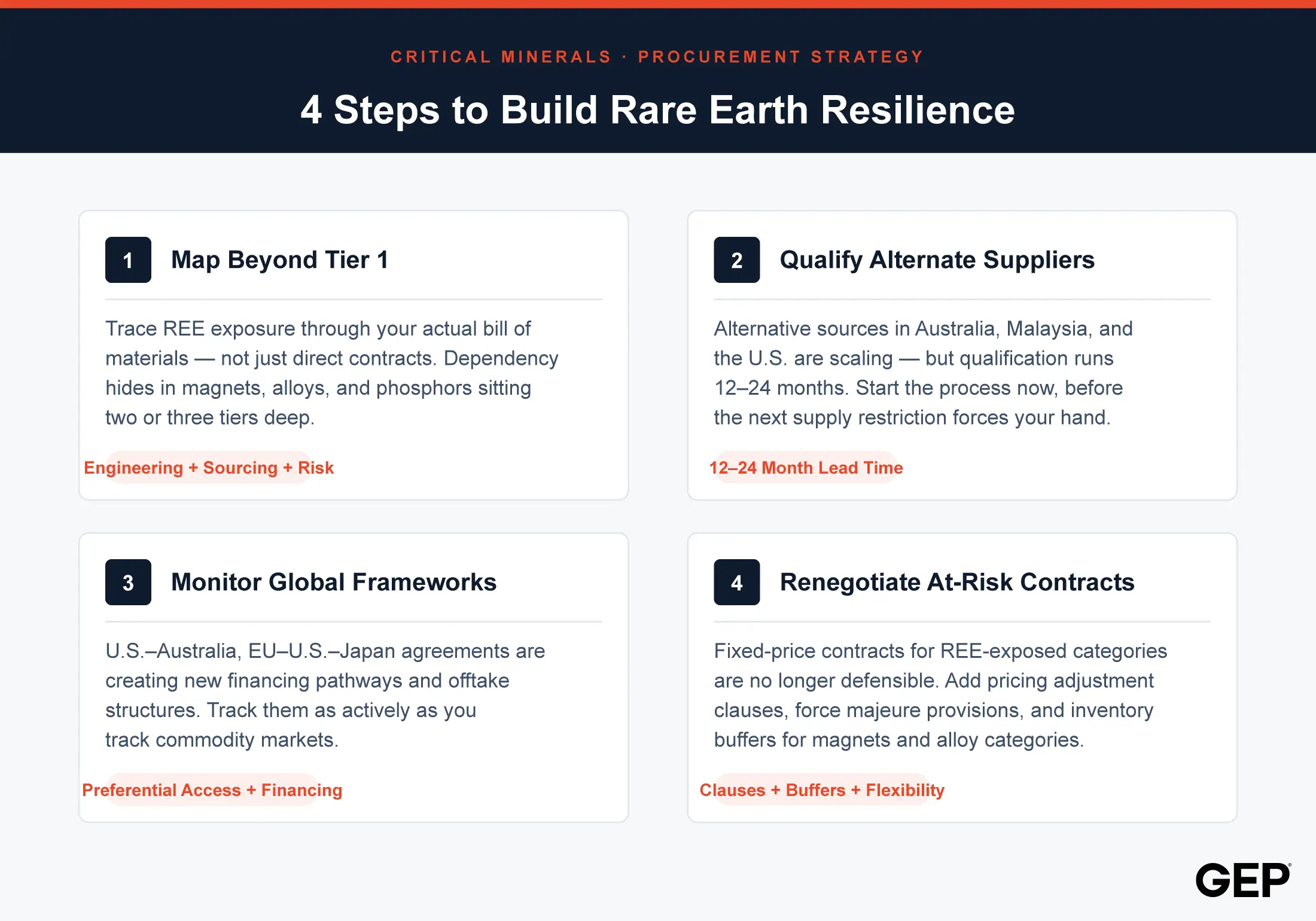
Knowing the risk is only half the battle. The harder question is what procurement teams should actually do differently, and how quickly. Here are four actions that can meaningfully reduce rare earth exposure without waiting for market conditions to force the issue.
Map Your Bill of Materials, Not Just Your Contracts
Rare earth exposure lives in components — permanent magnets, phosphors, specialty alloys — not in direct purchasing categories. Cross-functional engagement between engineering, category management, and supply chain risk is the only way to surface the full picture before a disruption arrives.
Engage the Growing Ecosystem of Alternatives
The IEA's 2026 outlook confirms that new rare earth refining projects in the United States and production increases in Malaysia have already reduced concentration modestly, and that concentration could fall to 70% by 2035 if planned projects come online as scheduled. Australia is now the world's fourth-largest rare earth producer, hosts 89 active rare earth exploration projects, and signed a bilateral framework with the U.S. in October 2025 committing at least $1 billion in joint financing to mining and processing projects, according to the Center for Strategic and International Studies.
In February 2026, the U.S., EU, and Japan issued a joint ministerial statement committing to a formal MOU covering supply chain diversification, stockpiling cooperation, and refining investment, according to the U.S. Department of State. Procurement teams at large enterprises should track these frameworks as actively as they track commodity markets; they are creating new financing pathways and offtake structures that can directly inform sourcing strategy.
Build Price Volatility Mechanisms into Contracts
Fixed-price contracts for categories with rare earth exposure are increasingly difficult to defend given current market dynamics. Procurement leaders should be reviewing pricing adjustment clauses, force majeure provisions, and inventory buffer policies across any category touching magnets, specialty alloys, or phosphors.
Treat Monitoring as a Category Intelligence Discipline
The minerals exposed to supply concentration risk extend beyond rare earths — gallium, germanium, graphite, and cobalt — have all seen export restrictions or supply shocks in the past 18 months, as per the IEA. Organizations that build ongoing monitoring of critical mineral market conditions into their category management process, rather than responding to individual disruptions, are consistently better positioned.
The organizations navigating this most effectively share a common trait: they treat critical mineral sourcing as a strategic function, not a tactical procurement task. Multi-year supplier development pipelines, board-level visibility into supply concentration risk, and proactive engagement with government frameworks. These are the operating standards that the current environment demands.
Looking for Ways to Protect Your Business from Disruptions
GEP can help you navigate the unpredictability and protect your margins with confidence
The Window to Act Is Now
The events of 2025 and 2026 have made one thing clear: critical mineral supply chains are a procurement problem, not just a policy one. The automakers that lost production weeks weren't caught off guard by a sudden discovery that rare earths existed. They were caught without a plan.
The infrastructure for a more resilient sourcing position is actively being built across the U.S., Australia, and through the EU–Japan–U.S. ministerial framework, but none of it benefits procurement teams that haven't done the upstream work. Map your exposure, qualify your alternates, and build contract flexibility before the next restriction lands. And not after.




FAQs
Rare earth elements (REEs) are a group of 17 metals, including neodymium, dysprosium, terbium, and yttrium, essential to high-performance permanent magnets used in EV motors, wind turbines, defense systems, and consumer electronics. While not geologically scarce, they are overwhelmingly refined in a single geography, making supply chain concentration the primary risk. As per IEA, refining concentration for rare earths remains around 85%, meaning any supply restriction has immediate global pricing and availability consequences.
Begin with a bill-of-materials (BOM) analysis rather than a supplier contract review. Rare earth dependency most commonly appears in components like permanent magnets, specialty alloys, and phosphors, which sit two or three tiers below direct procurement relationships. Cross-functional collaboration between engineering, sourcing, and supply chain risk teams is necessary to trace this dependency accurately. Once mapped, the priority is identifying which categories have no qualified alternative and which have long lead times for qualification, as these represent the highest-urgency risk positions.
The U.S.–EU–Japan Critical Minerals Ministerial in February 2026 established a formal cooperation framework covering diversification of refining, stockpiling, and research — creating new structures that procurement teams can reference when evaluating long-term supply partnerships, according to U.S. Department of State. These alternatives are scaling but require procurement engagement now; qualification timelines for new rare earth suppliers typically run 12–24 months, making last-minute pivots extremely difficult.