



Demand Planning vs. Supply Planning: Two Halves of One Forecast
- Demand planning tells you what customers will want. Supply planning tells you whether you can actually get it to them. Most planning breakdowns happen at the seam between the two.
- Businesses that connect demand and supply planning carry less dead inventory and lose fewer sales to stockouts, which shows up directly in working capital.
- AI-native forecasting has changed the cadence of planning, from a monthly reset to something closer to a live feed.
September 04, 2026 | Supply Chain Strategy 5 minutes read
Ask a demand planner and a supply planner at the same company what "the plan" is, and you'll often get two different answers. Not because either one is wrong, but because they're usually working from different data, on different timelines, updated at different points in the month.
That gap is where the damage happens. A regional demand spike has hit, but the supply team is still working off last month's numbers. Or a supplier lead time stretches, and nobody adjusts the demand-side commitments until it's too late to matter. The result is either an empty shelf or a warehouse full of stock nobody's buying, and neither is cheap.
This blog looks at what demand planning and supply planning each actually do, where the real differences are (and where they're overstated), and why more supply chain teams are trying to run them as one connected process instead of two.
See What's Breaking Your Forecast
Understand five common demand planning failures and how to fix them
Understanding Demand Planning and Supply Planning
Demand planning is the forecasting side: pulling together sales history, seasonal patterns, market signals, and promotional plans to estimate how much of a product customers will want, and roughly when. It's an educated guess, made as precise as the data allows.
Supply planning picks up from there. It's the "now what" step, deciding how much to produce, what materials to source, where inventory needs to sit, and how manufacturing and logistics get sequenced so the forecast can actually be met without tying up more cash or capacity than necessary.
One depends on the other. A demand forecast that never gets translated into a supply plan is just a spreadsheet. A supply plan built on a shaky demand number is just as unreliable, no matter how well the logistics are executed.
Key Objectives of Demand and Supply Planning
Both sides are chasing the same outcome, matching what's available to what's needed, without overspending on getting there. But they measure success differently.
Demand planning tends to focus on forecast accuracy, catching demand shifts early, and staying aligned with what sales and marketing are actually promising customers. Supply planning is judged more on whether materials and capacity are there when needed, whether inventory levels are sane, and whether production and supplier schedules hold up under pressure.
The problem isn't that these goals differ. It's that teams often chase them separately, each optimizing its own scorecard instead of the number the business actually needs to hit.
Also Listen - Why 2026 Demands a New Strategy for Chemical Procurement
Benefits of Effective Demand and Supply Planning
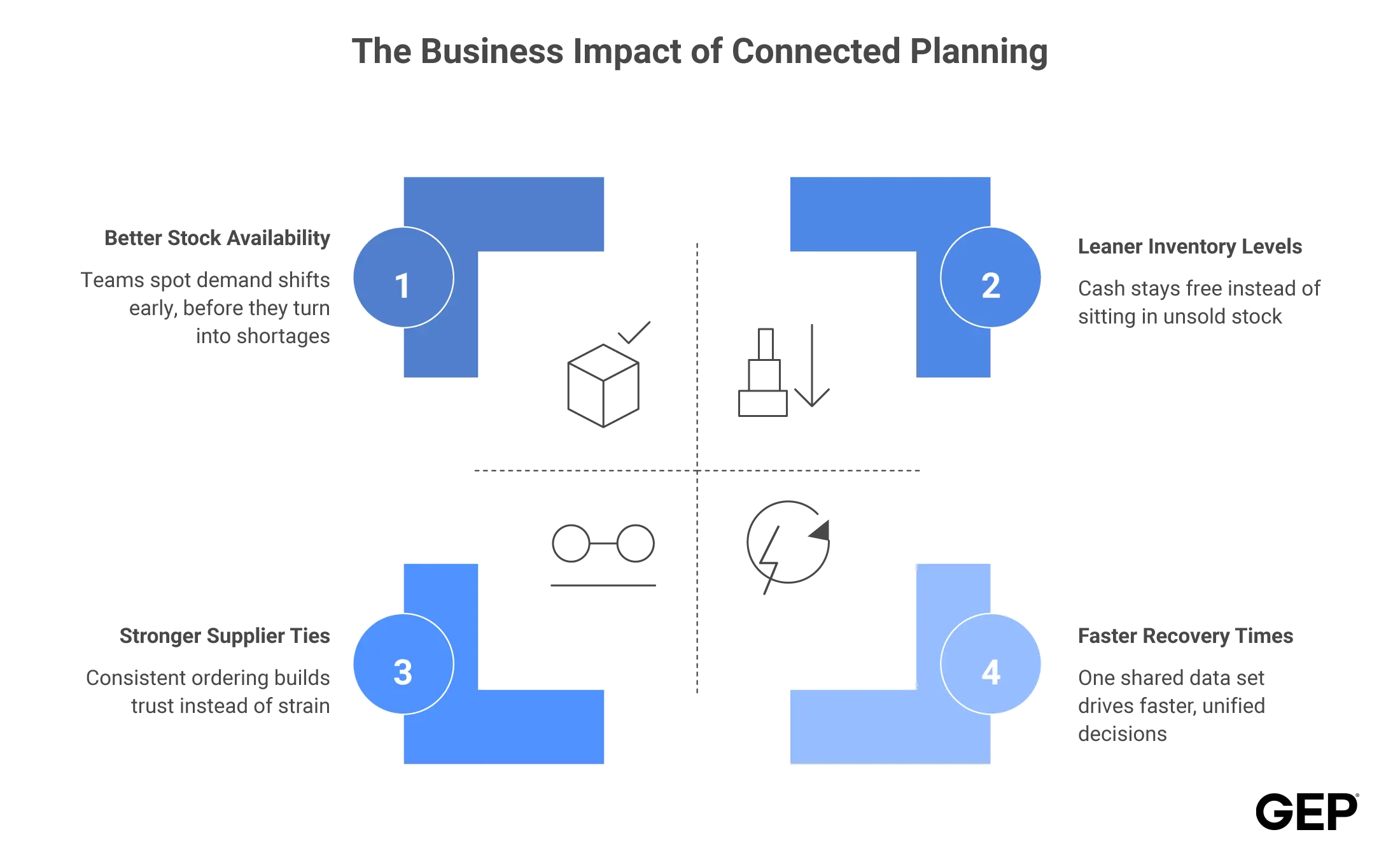
When demand and supply planning work in sync, the payoff isn't abstract. A few things tend to happen:
Stockouts and lost sales drop, because supply teams see demand shifts before they become a crisis
Excess and obsolete inventory shrinks, freeing up cash that would otherwise sit on a shelf
Supplier relationships get steadier, since order patterns stop swinging wildly month to month
Disruptions get absorbed faster, because everyone's reacting to the same data instead of arguing about whose number is right
None of this requires a bigger team. It usually just requires better visibility into the same numbers.
Demand Planning vs. Supply Planning: Key Differences Explained
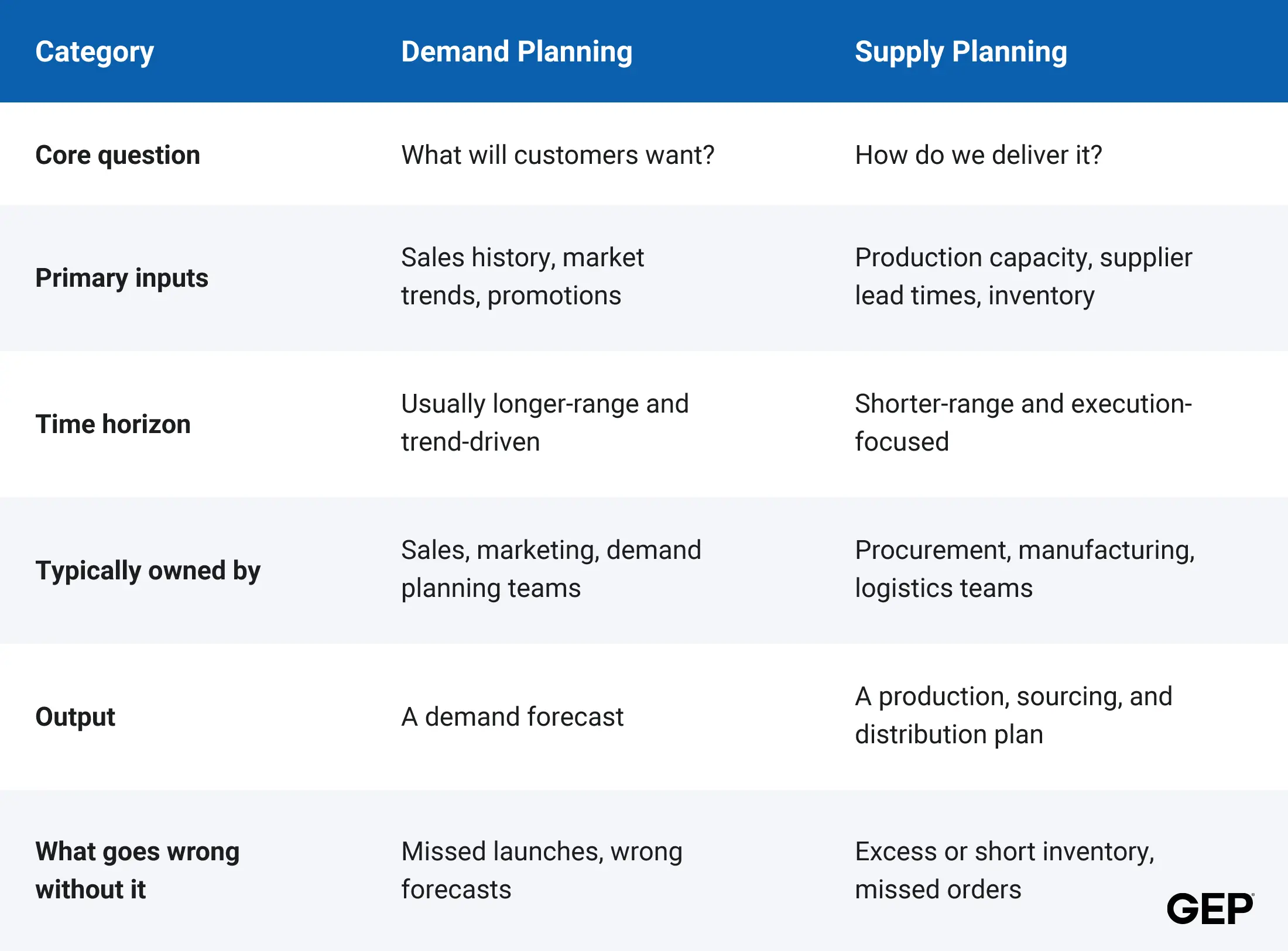
It's worth thinking of this less as a boundary between two departments and more as a handoff. Companies that struggle tend to manage that handoff once a month, in a meeting. Companies that don't struggle as much have found a way to make it continuous.
Benefits of Selecting the Right Demand and Supply Planning Software
Spreadsheets can hold a forecast. What they can't do is keep up with how fast conditions change now. The right planning software fixes a few specific things spreadsheets can't.
Forecasts stay current because they're pulling from live sales and inventory data, not last month's exports. Demand signals that manual models tend to miss, such as regional spikes and shifts between channels, are picked up by AI-native forecasting engines built to catch them. And planners on both sides of the demand-supply line work from the same platform, instead of reconciling two spreadsheets that never quite match.
The real win isn't a nicer dashboard. It's fewer hours lost to reconciliation and more time spent on decisions that actually change what gets ordered and shipped.
The Evolving Role of Demand and Supply Planning in Modern Supply Chain Management
For a long time, demand and supply planning was a backward-looking exercise. Look at last quarter, adjust, repeat next quarter. That cadence made sense when conditions changed slowly. It doesn't hold up well now.
What's replacing it is closer to continuous sensing. AI-native systems pick up demand shifts as they occur and model what they mean for supply, often before a planner would notice them manually. Plans stop being static documents and start behaving more like something that's always slightly in motion, adjusting as new data, a supplier delay, a cost spike, or a demand surge comes in.
That also changes what planners spend their day doing. Less time goes into building the forecast from scratch. More goes into deciding what to do about the trade-offs the software surfaces, like whether to pay more for speed or accept a longer lead time to protect margin.
Ready to Connect Your Planning Process?
Talk to a GEP expert about integrated demand and supply planning
Bringing Demand and Supply Planning Into One Conversation
Demand planning and supply planning were never really meant to be two separate jobs. One figures out what the business needs to deliver. The other makes delivery possible. Run them as a single connected process, backed by AI-native planning software, and the business gets something closer to real agility instead of just absorbing whatever volatility shows up.
The choice in front of most supply chain leaders isn't forecasting versus execution. It's whether those two things are finally talking to each other.




Frequently Asked Questions
Demand planning produces the forecast; supply planning turns that forecast into a plan for production, sourcing, and distribution. They're two steps in the same process, and when both run on the same real-time data, the business can react to demand changes without the usual lag.
Solid demand planning draws on sales history, seasonal and market trends, promotional calendars, and direct input from sales and marketing. Better demand plans also build in demand sensing, using near-real-time signals to catch a shift before it shows up in the next monthly forecast.
Supply planning turns a forecast into decisions: how much to produce, who to source from, where inventory should sit. Get it right, and you avoid both understocking, which costs you sales, and overstocking, which ties up cash that could be doing something else.
Manual planning and spreadsheets weren't built for how fast conditions shift now. AI-native software keeps forecasts current against live data, runs scenarios in minutes instead of days, and gives demand and supply teams one shared number to work from, cutting out the reconciliation delays that usually cause bad plans.