



How Should CXOs Evaluate an Intake and Orchestration Platform's Value?
- Employees need a single starting point for all procurement-related requests, regardless of type.
- The platform should guide users with contextual questions, dynamic forms, and conditional logic.
- Requests should be intelligently classified and routed by type, category, value, risk, geography, supplier status, and business unit.
June 29, 2026 | Procurement Strategy 4 minutes read
Most leaders focus on request capture and routing. The real differentiator is whether the platform improves procurement decisions and execution.
AI-native platforms compound value. Bolt-on AI compounds complexity and cost. The difference lies in whether your platform has built-in procurement intelligence, deploys AI agents across workflows, and coordinates work through unified data rather than isolated modules.
Learn how to identify the capabilities that matter and choose an orchestration platform built for long-term enterprise value.
Why Does Autonomous Intake and Orchestration Matter in Procurement?
Intake gives the business one front door: a place to start any procurement request.
Orchestration governs what happens next. It classifies the request, applies policy, routes work, engages the right stakeholders, and tracks progress through to execution.
Autonomous orchestration goes further. As an intelligent operating model, it can classify, coordinate, execute, monitor, and adapt within governed controls.
The platform reads each request, determines the next step, and connects systems that communicate with each other.
Why do Enterprises need Agentic AI Platforms with Procurement-Specific Domain Intelligence?
Agentic AI runs on context. Many procurement requests come from different sources, which may sound similar but can mean different things depending on the context for that specific category, supplier, contract, and the business need behind it.
Take a software renewal. It can be a routine transaction or your strongest leverage point in a vendor-consolidation strategy. A platform that can't tell the two apart will process the renewal cleanly and on time. What it won't do is flag the negotiation opening that a shift in the market has just handed you.
Domain intelligence is the procurement know-how built into the platform. It draws on your connected data, so its recommendations are specific and defensible.
When a request arrives, a platform with domain intelligence places it inside a web of relationships instead of a queue. It weighs the category against its cost drivers, the supplier against existing relationships and risk, the contract against its renewal and liability terms, and the spend against policy thresholds. Other factors apply depending on the request.
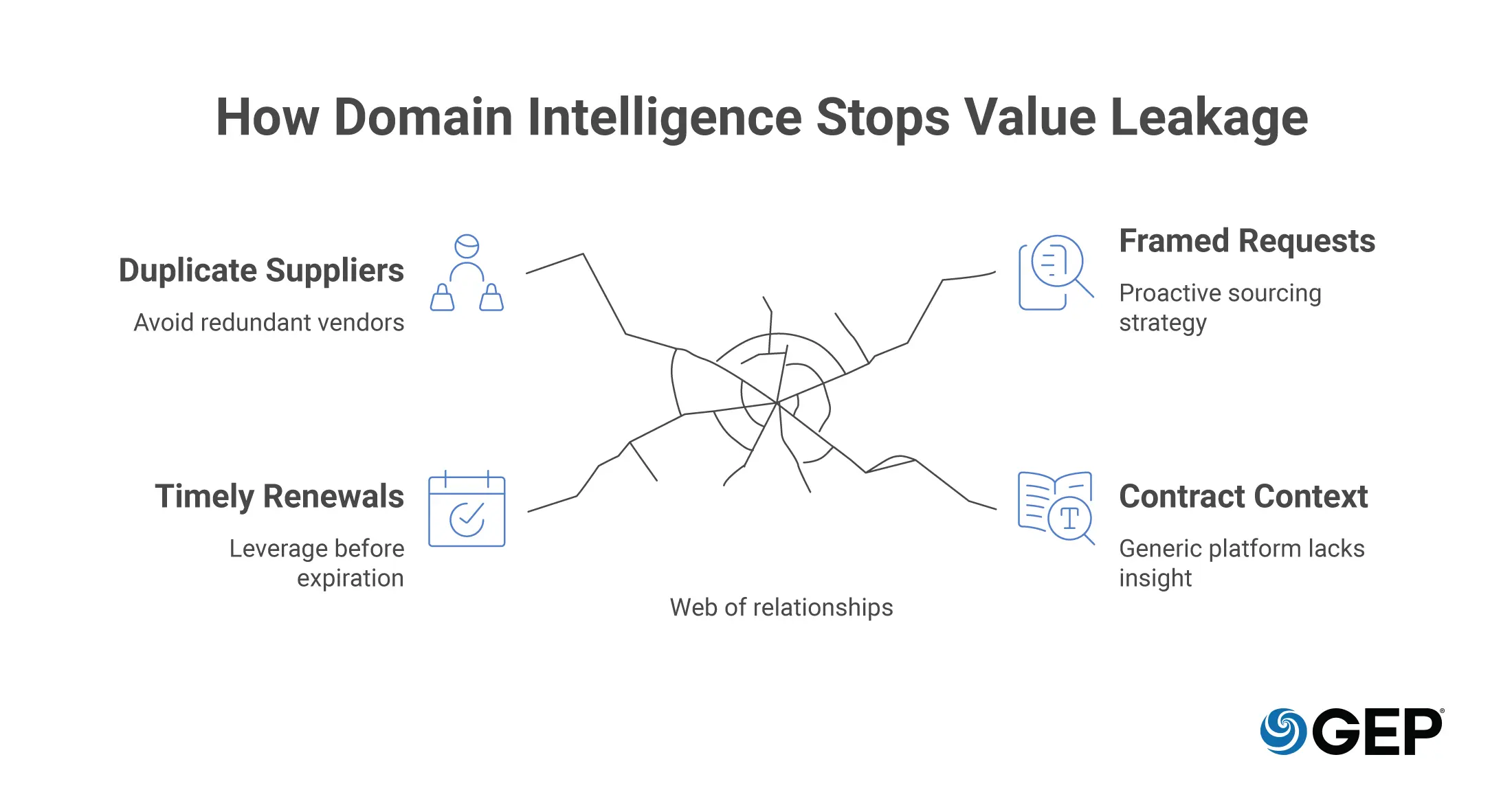
This is where teams stop value from leaking. The platform surfaces renewals while you still hold leverage, catches duplicate suppliers, frames sourcing requests before they turn into expensive events, and applies contract context that a generic platform never sees.
A Buyer’s Guide to Intake & Orchestration Platforms
Evaluate platforms that support policy, workflows, and stakeholder coordination
How Should You Assess Long-term Value In An Enterprise Intake and Orchestration Platform?
Every platform evaluation that can withstand today's procurement and supply chain volatility needs to excel in two areas: platform intelligence and platform architecture.
To test for procurement intelligence, ask:
- Does it interpret requests in natural language?
- Does it understand the full context of requests?
- Does it act on that understanding, or only recommend?
- Does it explain its reasoning, and is it traceable?
- Does it improve as rules and market conditions change?
To test whether value compounds or cost, ask:
- Does AI not execute a governed workflow?
- Does it have unified data?
- Is it easily integrable into your existing ecosystem?
- Would you require IT support for every workflow tweak or configuration change?
- Does it have a clear path from the first use case to broader enterprise orchestration?
What Do CXOs Look for in Orchestration Platforms?
Evaluate the capabilities that support procurement performance and enterprise value.
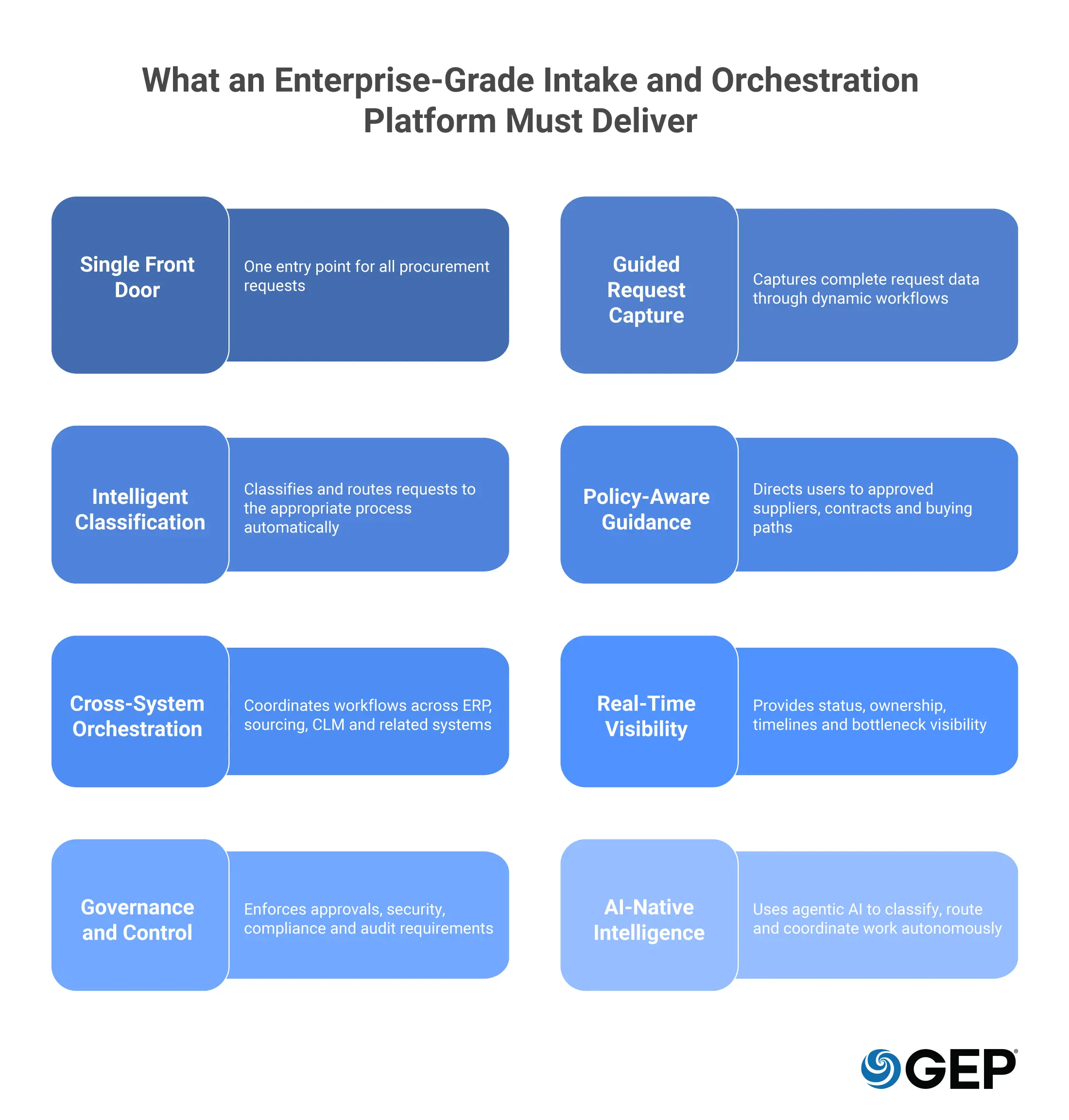
Present your vendor with the most complex scenarios you face, including exceptions and multi-system handoffs, and watch what happens when workflows need to deviate from the standard path.
For the complete evaluation framework, read GEP's 2026 Intake & Orchestration Buyer's Guide.
Unlock Long-Term Value in Agentic Intake and Orchestration
Agentic orchestration is becoming the knowledge and control layer for enterprise procurement. The real value lies not only in improving execution but also in improving the decisions and operations that drive it.
The platforms that deliver that value are AI-native: connected, intelligent, and autonomous enough to execute without human hand-holding. Every action carries the right data, follows the right policy, reaches the right stakeholders, and leaves a trail that is visible and auditable from start to finish.
To see what that looks like in practice, explore GEP Quantum Intelligence.




FAQ's
Value comes from what happens after a request enters the platform: increased managed spend, lower risk, faster cycle times, stronger compliance, and better business outcomes. Capturing requests is only the first step. The real value lies in improving decisions and guiding work through execution.
Start with a focused use case, prove results, then scale gradually. Choose a vendor with strong procurement expertise and a proven implementation approach. Prioritize process design, stakeholder alignment, and user adoption from day one.
Bolt-on AI adds capabilities to systems not designed for autonomous orchestration, often creating integration complexity and higher operating costs. AI-native platforms work from connected data and shared services, making it easier to scale capabilities while controlling costs.