What the Future Procurement Organization Looks Like in an Agentic AI Enabled Enterprise
- Agentic AI will automate procurement execution, allowing teams to focus on strategy, supplier ecosystems, and enterprise value creation.
- The future procurement organization will operate as an orchestrator of supplier networks rather than a manager of sourcing processes.
- Human expertise will shift toward judgment, collaboration, and risk leadership while autonomous agents handle operational complexity.
April 03, 2026 | Procurement Strategy 5 minutes read
Procurement leaders today often hear this: Artificial intelligence will transform procurement. Most people agree on that point. Where the conversation often becomes vague is in what that transformation actually looks like.
Many still imagine better dashboards, faster analytics, or automation that speeds up existing processes.
That view is already becoming outdated.
The next stage of transformation is Agentic AI.
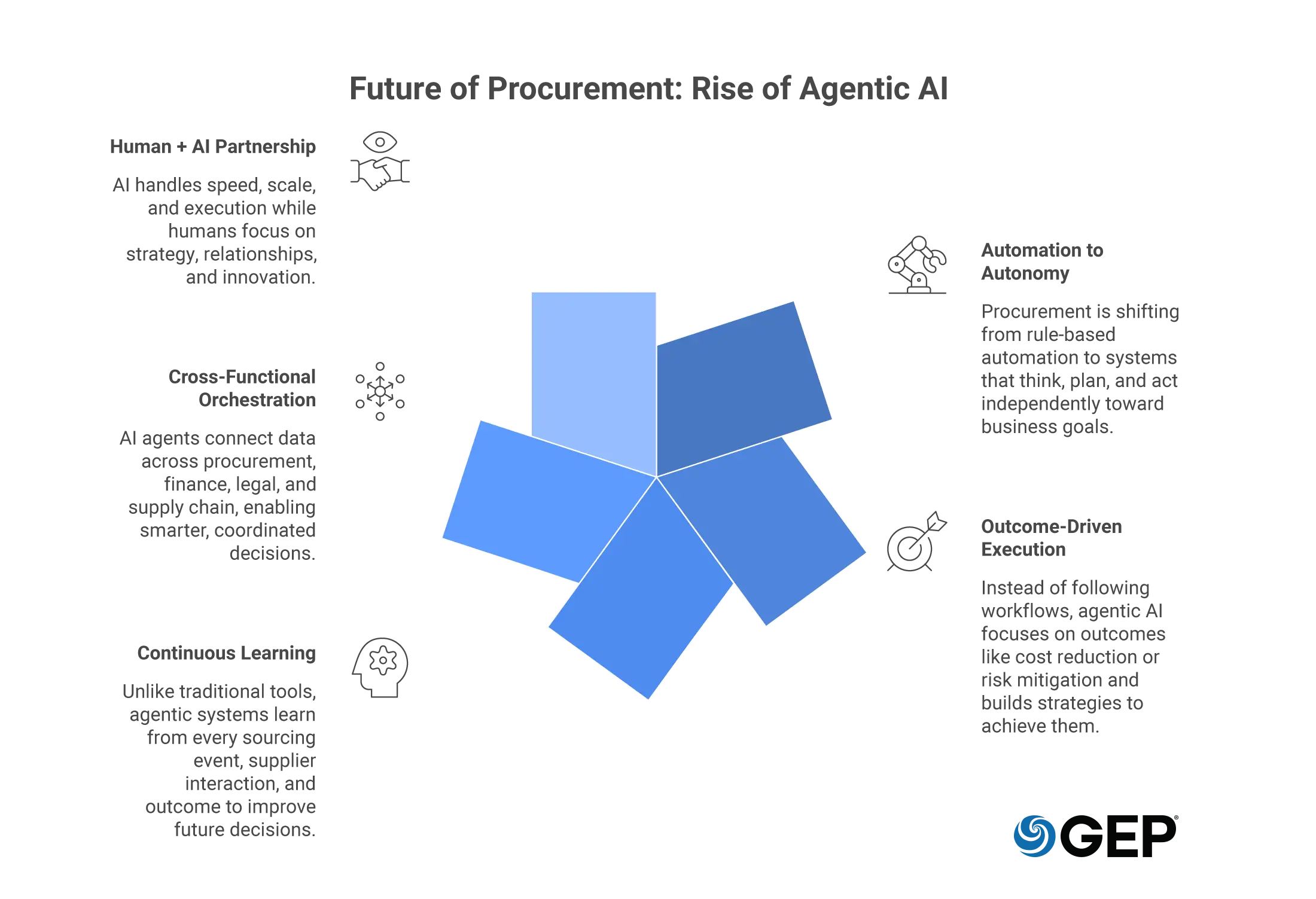
These are systems that can reason, plan, and act toward defined goals. Instead of simply responding to commands, they monitor environments, coordinate workflows across systems, and initiate actions on their own.
For procurement organizations, this changes something fundamental. The impact is not just better tools. It reshapes how procurement teams operate, how sourcing decisions are made, and where human expertise is applied across the source-to-pay lifecycle.
The procurement organization of the future will look very different from the one we know today.
Reimagine Procurement for the Agentic AI Era
See how Agentic AI turns procurement into a strategic value driver.
Procurement Shifts from Process Owner to Value Orchestrator
Autonomous agents power procurement operations.
In an Agentic AI enabled enterprise, procurement operations run on a network of specialized digital agents.
Each agent is responsible for a specific capability within the source-to-pay lifecycle. One monitors supplier markets and commodity signals. Another evaluates supplier risk using financial, operational, and geopolitical indicators. Another prepares sourcing scenarios based on spend data and demand forecasts. Others review contracts, analyze supplier proposals, and prepare negotiation positions.
These agents interact continuously with enterprise systems including ERP, sourcing platforms, contract management systems, and supplier networks.
When a sourcing opportunity appears, the process begins automatically. Market monitoring agents detect price volatility. Spend analysis agents identify categories with savings potential. Sourcing agents generate supplier shortlists and evaluate proposals. Risk agents flag compliance or sustainability concerns.
Human procurement professionals remain in control. They review recommendations, validate strategic choices, and intervene when judgment is required.
The key difference is that procurement workflows move from reactive execution to proactive orchestration.
Category management becomes market strategy
As operational sourcing becomes increasingly automated, the role of category managers evolves.
Today, many category managers spend significant time gathering market data, coordinating sourcing events, and managing documentation. Agentic AI removes much of that operational workload.
Category managers instead focus on understanding supply markets and designing long-term category strategies.
They evaluate supplier ecosystems, analyze regional supply dynamics, and identify opportunities for supplier innovation. Rather than asking which supplier should win the next contract, they consider broader questions about how a category should evolve over the next three to five years.
Agentic AI provides continuous market intelligence and scenario modeling. The category manager interprets those insights and defines the strategic direction.
Category management becomes less about running events and more about shaping supply markets.
Procurement organizations become leaner but more strategic
As autonomous agents handle routine tasks across sourcing, contract management, and supplier monitoring, procurement teams will likely become smaller in terms of operational roles.
However, the function becomes more strategically important.
Procurement professionals focus on areas where human expertise creates the most value. Supplier relationship management becomes more central. Cross functional collaboration with finance, engineering, and operations becomes more important. Risk governance across global supply networks becomes a leadership responsibility.
New roles will emerge within procurement organizations. Teams may include supplier innovation leaders, digital procurement architects, and ecosystem strategists who manage complex supplier networks.
Rather than acting primarily as buyers and process managers, procurement professionals become architects of the enterprise’s external value network.
Continuous sourcing replaces event-based sourcing
Traditional sourcing follows a cycle. A contract approaches expiration. Procurement launches a sourcing event. Suppliers submit bids. A decision is made.
Agentic AI changes that model.
Because AI agents continuously monitor supplier markets, cost drivers, and supplier performance, sourcing opportunities can be identified at any time. When market conditions shift or new suppliers enter the ecosystem, the system can automatically evaluate potential benefits.
Procurement leaders receive sourcing recommendations supported by real-time market intelligence and scenario analysis.
Instead of periodic sourcing events, procurement operates in a mode of continuous optimization.
This allows organizations to respond faster to supply disruptions, capture cost improvements earlier, and maintain stronger alignment between procurement strategy and market conditions.
Discover GEP’s - AI-orchestrated procurement platforms
The Human Role in an Agentic Procurement Organization
Supplier collaboration becomes the core differentiator
As operational tasks become automated, the human focus within procurement shifts toward supplier collaboration.
Strategic supplier relationships play a much larger role in enterprise competitiveness. Procurement leaders spend more time working with suppliers on innovation initiatives, sustainability goals, and long-term supply resilience.
Agentic AI strengthens these relationships by providing deeper insight into supplier capabilities, performance trends, and emerging risks.
However, trust and collaboration remain human driven. Technology can support decision-making, but long-term partnerships still depend on relationships.
The most successful procurement teams will combine advanced digital capabilities with strong supplier engagement.
Procurement leaders manage hybrid teams
The procurement leaders of the future will manage a hybrid organization that includes both human professionals and autonomous digital agents.
Technical knowledge of sourcing and contracting will remain important. At the same time, new capabilities become critical.
Procurement leaders will need strong data literacy to interpret insights generated by AI systems. They will need systems thinking to understand how procurement connects with supply chain, finance, and product development. They will need leadership skills that enable collaboration across complex supplier ecosystems.
Most importantly, they must learn how to guide teams where machines handle operational complexity and humans focus on strategic decision-making.
Stay ahead of shifting spend dynamics across key categories.
Explore the GEP Spend Category Outlook to inform data driven decisions.
Conclusion
It is easy to frame Agentic AI as a threat to procurement roles. That perspective misses the larger opportunity.
For many years, procurement leaders have argued that their function should play a more strategic role within the enterprise. In practice, operational workload often limited how much time teams could devote to strategy, innovation, and supplier collaboration.
Agentic AI changes that dynamic.
When autonomous systems manage repetitive sourcing tasks, monitor supplier markets, and analyze contracts at scale, procurement professionals gain the capacity to focus on what matters most.
Designing resilient supply networks. Building innovation partnerships with suppliers. Anticipating supply risks before they disrupt operations.
The procurement organization of the future will not simply be more automated.
It will be more strategic, more connected to enterprise decision-making, and far more influential in shaping how companies compete in an increasingly complex global supply landscape.