
How On-Demand Procurement Services Enable Agile Response to Supply Chain Shocks
- On-demand procurement services quickly expand sourcing capacity when supply shocks hit.
- Bring in category specialists and sourcing experts to navigate complex supplier markets.
- Identify alternative suppliers quickly and reduce dependence on single regions or vendors.
April 02, 2026 | Procurement Strategy 5 minutes read
If you have spent a few years in procurement, you know something about disruptions. They rarely arrive with a warning.
A supplier shuts down. A shipping lane slows unexpectedly. Commodity prices start climbing faster than anyone predicted. Suddenly, the pressure lands on procurement.
Most teams already know where the risks are. The harder part is responding fast enough when disruption actually hits.
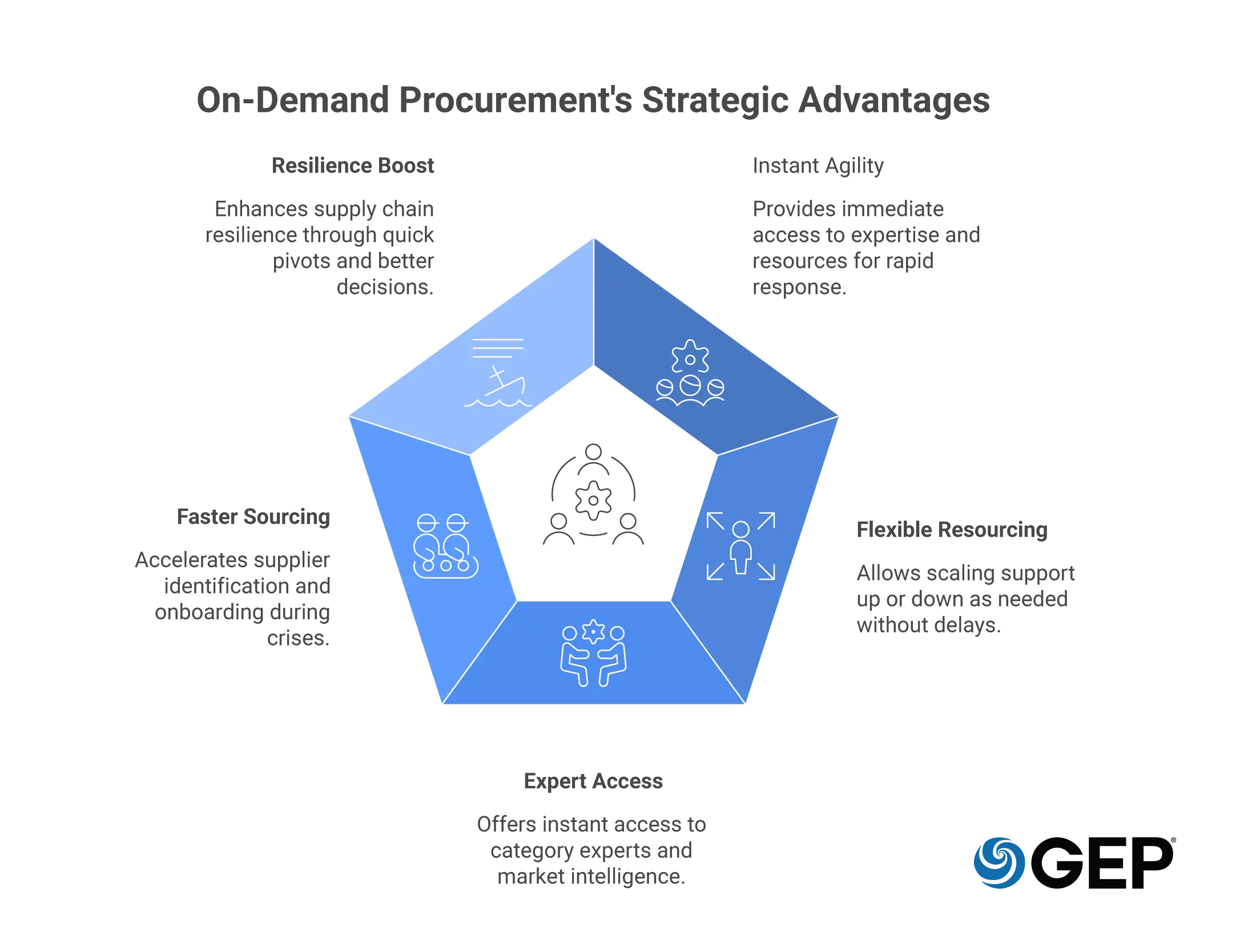
This is where on-demand procurement services are becoming useful. They allow you to quickly expand sourcing capability, access specialized expertise and move faster when supply markets change.
Build Procurement Agility Before the Next Disruption
See how on-demand procurement services help move faster when supply markets shift.
What Are On-Demand Procurement Services?
At its core, the idea is simple.
On-demand procurement services allow you to bring in procurement expertise exactly when you need it. Not as a permanent outsourcing program. Not as a full restructuring of your procurement team.
Instead, you activate targeted support when sourcing pressure rises or when expertise is needed for a specific category.
You can think of it as procurement capacity that becomes available when the situation demands it.
Traditional Procurement vs On-Demand Procurement
In most organizations, procurement work sits inside the company. Internal teams manage supplier relationships, run sourcing events and develop category strategies.
That model works well when demand patterns and supplier markets remain relatively stable.
But supply chains rarely stay predictable for long. When disruption appears, procurement teams may suddenly need to launch several sourcing initiatives at once. New suppliers must be identified and qualified quickly. Contracts may need renegotiation.
Hiring new staff takes time. Training them takes even longer.
On-demand procurement services allow organizations to temporarily expand sourcing capacity so these activities can move forward immediately.
Core Characteristics of On-Demand Procurement Services
Three characteristics make this model particularly useful.
First is flexibility. Procurement expertise can be deployed quickly for sourcing initiatives, supplier diversification efforts or cost optimization projects.
Second is access to specialized expertise. External procurement professionals often work across industries and supplier markets. That experience gives them a broader view of pricing trends and supplier capabilities.
Third is scalability. Organizations can increase procurement support when sourcing activity rises and reduce it once conditions stabilize.
For procurement leaders, this flexibility helps manage uncertainty in supply markets.
Stay ahead of shifting spend dynamics across key categories.
Explore the GEP Spend Category Outlook to inform data driven decisions.
Why Businesses Are Moving Toward Procurement Outsourcing Models
Many organizations are rethinking how procurement capabilities should be structured.
Maintaining a large internal team capable of handling every disruption scenario is expensive. Much of that extra capacity sits idle during stable periods.
Procurement outsourcing models offer a more flexible alternative. Internal teams maintain control over strategy and supplier relationships. External specialists support sourcing execution and market intelligence when additional capacity is required.
This approach allows procurement leaders to maintain strategic control while ensuring sourcing activity can scale when disruptions occur.
The Role of On-Demand Procurement in Agile Supply Chain Management
Agility in supply chains often comes down to speed.
When supplier markets shift, procurement teams must respond quickly. Delays in launching sourcing initiatives can quickly translate into production delays or rising costs.
On-demand procurement services shorten the response time. External sourcing specialists can immediately begin supplier searches, market analysis and negotiation support.
That faster response helps stabilize supply before disruption spreads through the organization.
Key Supply Chain Shocks and Their C Suite Impact
Supply chain disruptions are no longer just operational issues.
When supply is interrupted, the impact spreads across the organization. Operations slows down. Finance sees margin pressure. Customer commitments become harder to meet.
This is why supply chain resilience is now a C suite priority.
Geopolitical Disruptions and Trade Restrictions
Political events can quickly change global sourcing conditions.
Tariffs may increase. Export controls may appear. Certain sourcing regions may become difficult to access.
Procurement teams often need to identify new suppliers or sourcing locations quickly when these changes occur.
Logistics and Transportation Bottlenecks
Even when suppliers remain stable, logistics networks can create disruption.
Port congestion, container shortages or freight capacity limits can slow supply flows significantly. Procurement teams may need to adjust sourcing strategies or renegotiate delivery schedules.
Supplier Failures and Capacity Constraints
Supplier instability is another common challenge.
Financial stress, operational disruptions or unexpected demand spikes can reduce supplier capacity. Organizations that rely heavily on a limited number of suppliers often feel this impact the most.
When this happens, procurement teams must identify alternatives quickly.
Commodity Price Volatility
Commodity markets can shift rapidly.
Energy prices, metals and agricultural inputs may rise quickly due to global economic changes. Procurement teams must monitor these movements carefully and adjust sourcing strategies to protect margins.
Why These Disruptions Create Strategic Procurement Risk
Each disruption requires fast action from procurement.
New suppliers may need to be identified. Contracts may need renegotiation. Alternative sourcing regions may need evaluation.
If procurement teams lack the capacity to run these activities quickly, the business begins to feel the impact.
On-demand procurement services help close that gap.
Key Ways On-Demand Procurement Services Enable Agile Response to Shocks
When disruption appears, procurement teams must move quickly. On-demand procurement services provide capabilities that are difficult to maintain internally at all times.
Rapid Supplier Discovery and Qualification
When supply becomes constrained, the first task is finding alternatives.
External procurement specialists often maintain extensive supplier networks across industries and regions. They can quickly identify potential suppliers and support qualification processes.
This shortens one of the most time-consuming stages of sourcing.
Accelerated Sourcing and Negotiation Cycles
Sourcing initiatives normally require preparation. Supplier proposals must be evaluated and negotiations require market insight.
During disruption, these timelines must shrink.
On-demand procurement teams can quickly structure sourcing events and support negotiations so organizations secure supply faster.
Faster Category Expertise Deployment
Certain procurement categories require specialized knowledge.
Electronics components, logistics services and industrial materials each involve unique supplier dynamics. External category experts bring experience across multiple sourcing programs.
Deploying that expertise quickly improves sourcing outcomes.
Improved Supplier Diversification
Disruptions often expose supplier concentration risk.
If an organization relies heavily on one supplier or region, the supply chain becomes vulnerable. On-demand procurement services help identify new suppliers and expand sourcing options.
Over time, this diversification strengthens supply resilience.
Real-Time Market Intelligence for Procurement Decisions
External procurement professionals typically work across multiple supplier markets.
This exposure provides insight into pricing trends, supplier capacity changes and emerging risks. Procurement leaders can use this intelligence to make faster and better informed decisions.
Scalable Procurement Capacity During Demand Surges
Disruptions often create a sudden increase in procurement activity.
Multiple sourcing initiatives may need to run simultaneously while supplier negotiations intensify. On-demand procurement services allow organizations to expand sourcing capacity quickly so internal teams remain focused on strategic priorities.
Major Challenges in Transitioning to On-Demand Procurement Services
While the model is powerful, implementation requires planning.
External sourcing teams must integrate smoothly with internal procurement processes. Organizations must ensure access to procurement systems and supplier data. Stakeholders across procurement, finance and operations must align on governance and decision authority.
When implemented correctly, the model becomes a valuable extension of the internal procurement team.
How to Implement On-Demand Procurement Services
Organizations usually begin with a focused approach.
Start by identifying procurement categories where additional sourcing support will create the most value.
Define governance models that clarify responsibilities between internal teams and external specialists.
Ensure technology platforms allow both teams to collaborate effectively.
Finally, track performance metrics such as sourcing cycle time, supplier diversification and cost improvements.
Conclusion
Supply chain disruptions are now part of the operating environment.
On-demand procurement services give procurement leaders the ability to expand sourcing capacity quickly and access specialized expertise when disruption appears. That flexibility helps organizations respond faster and build stronger supply resilience.