



The Key Decisions That Prevent Agent Debt in Procurement
- Deploying multi-agent systems without central orchestration is an enterprise liability.
- Agent debt emerges when autonomous capabilities scale faster than the architecture and governance supporting them.
- A unified data layer ensures autonomous decisions align with enterprise goals.
August 19, 2026 | Procurement Strategy 5 minutes read
Procurement leaders chasing the promise of speed and independent judgment deploy agents faster than they can govern them. Left unchecked, that creates agent debt in procurement, a hidden liability that builds quietly with every new deployment. It rarely looks like a crisis at first, which is what makes it dangerous.
Most teams don’t measure success by how well different agents work together. That steers them toward buying more agents instead of building a better foundational architecture.
Learning how agent debt builds across procurement workflows will help you plan the foundations for reliable agentic AI that doesn’t degrade performance as you scale.
What Is Agent Debt, and Why Is It Procurement's Biggest Hidden Liability?
Agent debt builds when autonomous agents make independent decisions without shared context, as each one works perfectly well alone while slowly drifting apart from the rest.
As agentic AI scales across procurement, that drift compounds.
One agent might approve a supplier exception that another would reject, while others could miss it completely. These inconsistencies rarely show up in a single transaction but surface later as conflicting decisions and slower audits metamorphose into high costs that bleed entire supply chains.
Agent debt is not a technology problem as much as it is a governance problem wearing a technology disguise. Every unmanaged agent adds a small tax, which compounds until accountability becomes difficult to trace.
How Agent Debt Accumulates Across Procurement Workflows
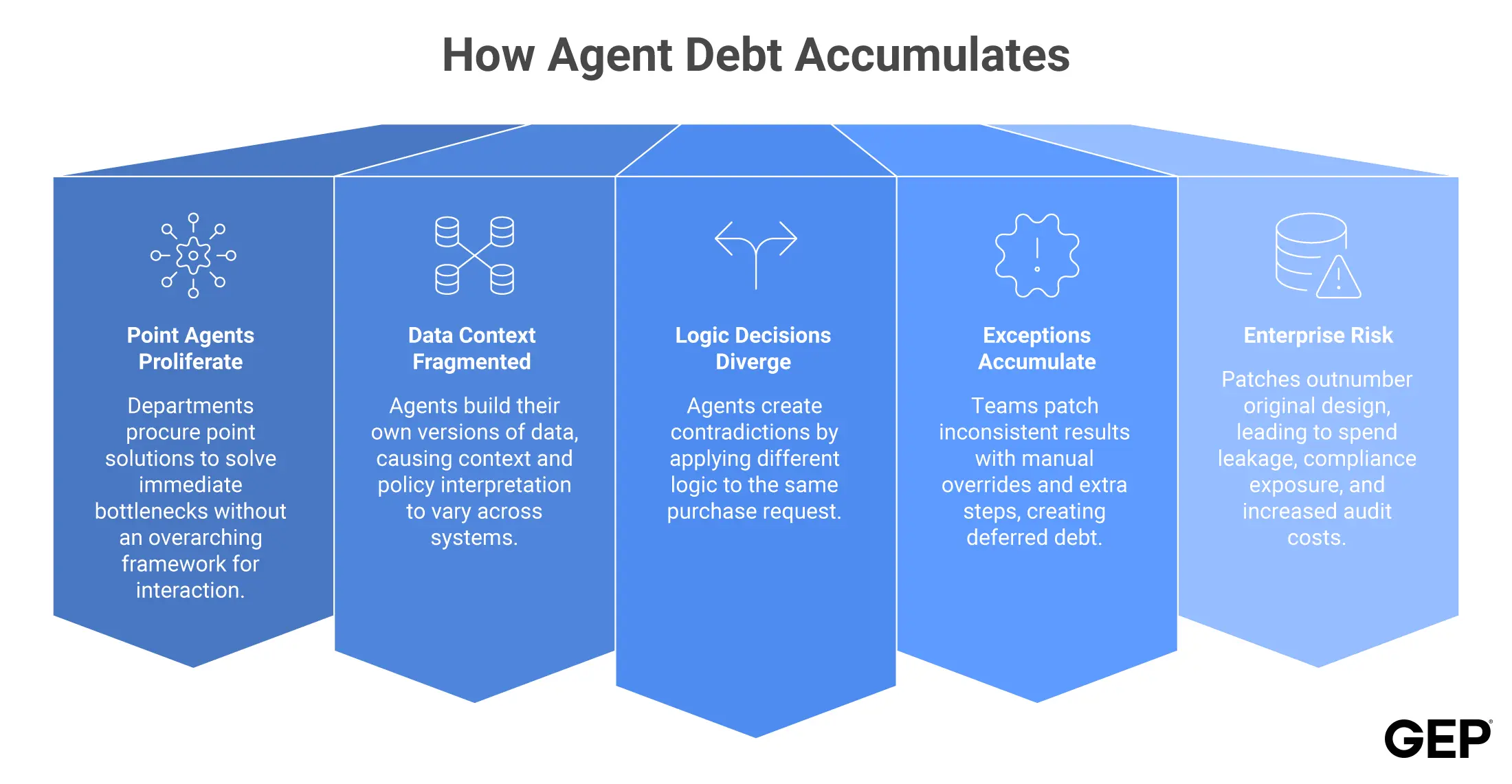
1. Point Agents Proliferate Across Procurement Functions
Different departments, like sourcing, contracts, finance, etc., procure point solutions to solve immediate bottlenecks. There is no overarching framework governing how these entities interact or share insights. Each team solves its own problem fast without planning ahead for how these agents will actually work together to solve broader business problems.
2. Data and Business Context Become Fragmented
Every agent needs data to make a decision, and without a shared source, each one builds its own version, so context can vary across systems. A preferred supplier can mean different things depending on which agent you ask, and policies get interpreted differently depending on where that agent gets its data from.
3. Agent Logic and Decisions Begin to Diverge
Two agents might see the same purchase request: one approves it under a lenient threshold, while the other flags it as high risk. Neither is wrong within its own logic, but together they create contradictions no one sees until later.
4. Exceptions and Workarounds Accumulate
When agents produce inconsistent results, teams patch around them: a manual override here, an extra approval step there. Those workarounds feel like control, but they're really just debt, deferred instead of resolved.
5. Agent Debt Becomes Enterprise Risk
Eventually, the patches outnumber the original design, and spend starts leaking through inconsistent enforcement while compliance exposure grows quietly across the organization. Audits take longer and cost more, and what started as a productivity win becomes real risk instead.
A Buyer’s Guide to Intake & Orchestration Platforms
Evaluate platforms that support policy, workflows, and stakeholder coordination
Three Decisions That Prevent Agent Debt from Compounding
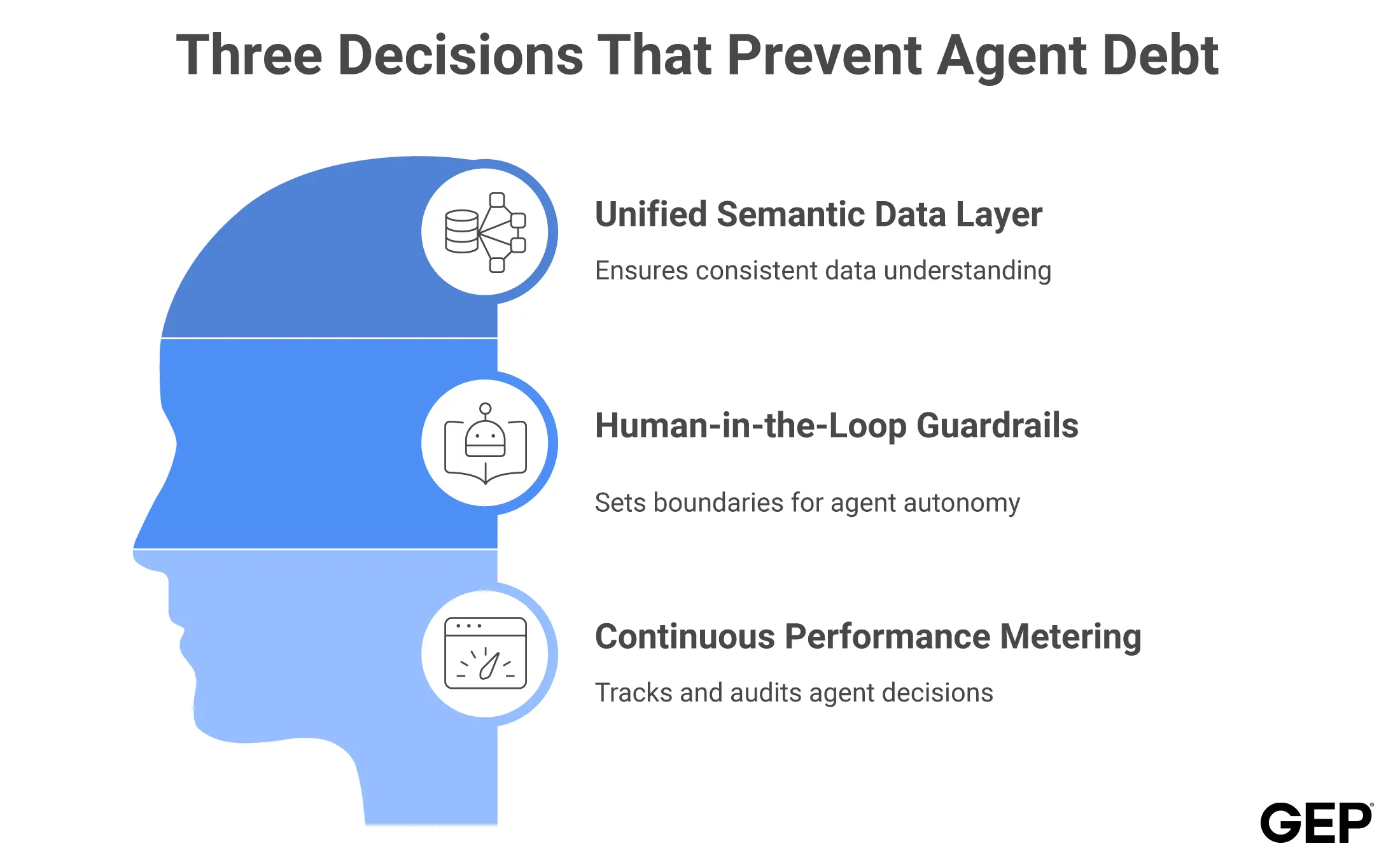
Decision 1: Establish a Unified Semantic Data Layer Before Scaling
Before you scale agentic AI, agree on what your data actually means, and build shared context across spend, supplier, contract, and procurement data so every agent draws from the same definitions. A framework without shared data isn't really a framework; it's a set of educated guesses running in parallel.
Decision 2: Hardcode Human-in-the-Loop Guardrails and Financial Thresholds
Autonomy needs boundaries: define what agents can decide alone and what always needs a human, then set financial thresholds before agents start acting on spend. Decisions above a certain value, along with anything high-risk or unusual, still need a person in the loop, and escalation paths should be clear rather than improvised.
Decision 3: Continuously Meter Performance and Audit Agent Logic
You can't manage what you don't measure, so track every agent decision, not just the outcome, and watch for logic drift as procurement context changes. Regular audits catch inconsistencies before they become expensive for the organization, and predictive monitoring flags problems before an agent repeats the same mistake.
Eradicating Agent Debt by Design
Agent debt isn't eliminated by adding more agents; it's eliminated by design. That means connecting unified data, shared intelligence, governance, and continuous oversight into one architecture, so agent capabilities stay connected as procurement scales agentic AI further. Done well, that architecture protects more than agent output: it protects supply chains from inconsistent decisions made upstream.
Multi-dimensional intelligence draws from spend, supplier, contract, and market data, keeping every agent working from the same picture, including tail spend, where inconsistent behavior often hides first. Built this way, an AI-native approach doesn't just automate procurement end-to-end; it builds real procurement orchestration, not automation stacked on more automation, with every agent accountable to the same source of truth.
Keep Agent Debt Out of Procurement
Build a foundation that supports scale, control, and visibility.
Build Agentic Procurement Without Building Agent Debt
Agent debt emerges when autonomous capabilities outpace the architecture and governance behind them; speed without structure feels like progress, but it's really just risk, deferred and compounding. Preventing it starts with treating architecture and governance as day-one priorities, not later additions.
Agentic AI adoption across procurement will only accelerate from here, and organizations that scale it as one connected system will move faster, with fewer surprises, than those running disconnected agents. Procurement leaders should start now: map where agents already operate and unify the data beneath them, then set guardrails before deploying the next one.
The future belongs to organizations that deploy intelligent systems with disciplined foresight. To secure your competitive advantage and modernize your supplier ecosystems today, explore advanced AI-Native Supplier Management Software.




FAQs
Before you deploy autonomous agents, make three decisions first: build a unified semantic data layer so every agent works from the same definitions across spend, supplier, contract, and procurement data, and set clear autonomy boundaries and financial thresholds so every agent knows when a decision needs a human. Put continuous monitoring in place to catch logic drift and inconsistent decisions before they compound, because skipping any of this early is what causes agent debt in procurement to build up later.
Governance prevents agent debt by keeping every agent accountable to the same rules, not just its own logic, with defined escalation paths and financial thresholds that keep autonomy inside clear limits. Policy interpretation needs to stay consistent across every workflow rather than varying agent by agent, and regular audits catch drift early, before inconsistent decisions turn into financial or compliance exposure. Without this oversight, agent debt accumulates quietly until it becomes an enterprise risk.
Technical debt comes from shortcuts in code, and you can usually fix it through refactoring. Agent debt in procurement comes from independent decisions made without shared context: agents can work perfectly in isolation and still drift apart in practice, and that drift shows up as inconsistent outcomes and slower audits, with maintenance costs climbing quietly as a result.