


Procurement Moves Closer to the CEO, but Execution Gaps Still Slow Results
- Procurement now shapes strategy, not just supplier negotiations.
- AI investment continues, though expectations have become more realistic.
- Execution gaps still prevent faster procurement and supply chain decisions.
June 02, 2026 | Procurement Strategy 5 minutes read
Procurement leaders spent years trying to earn a seat at the executive table. Now many finally have one. The harder part starts next.
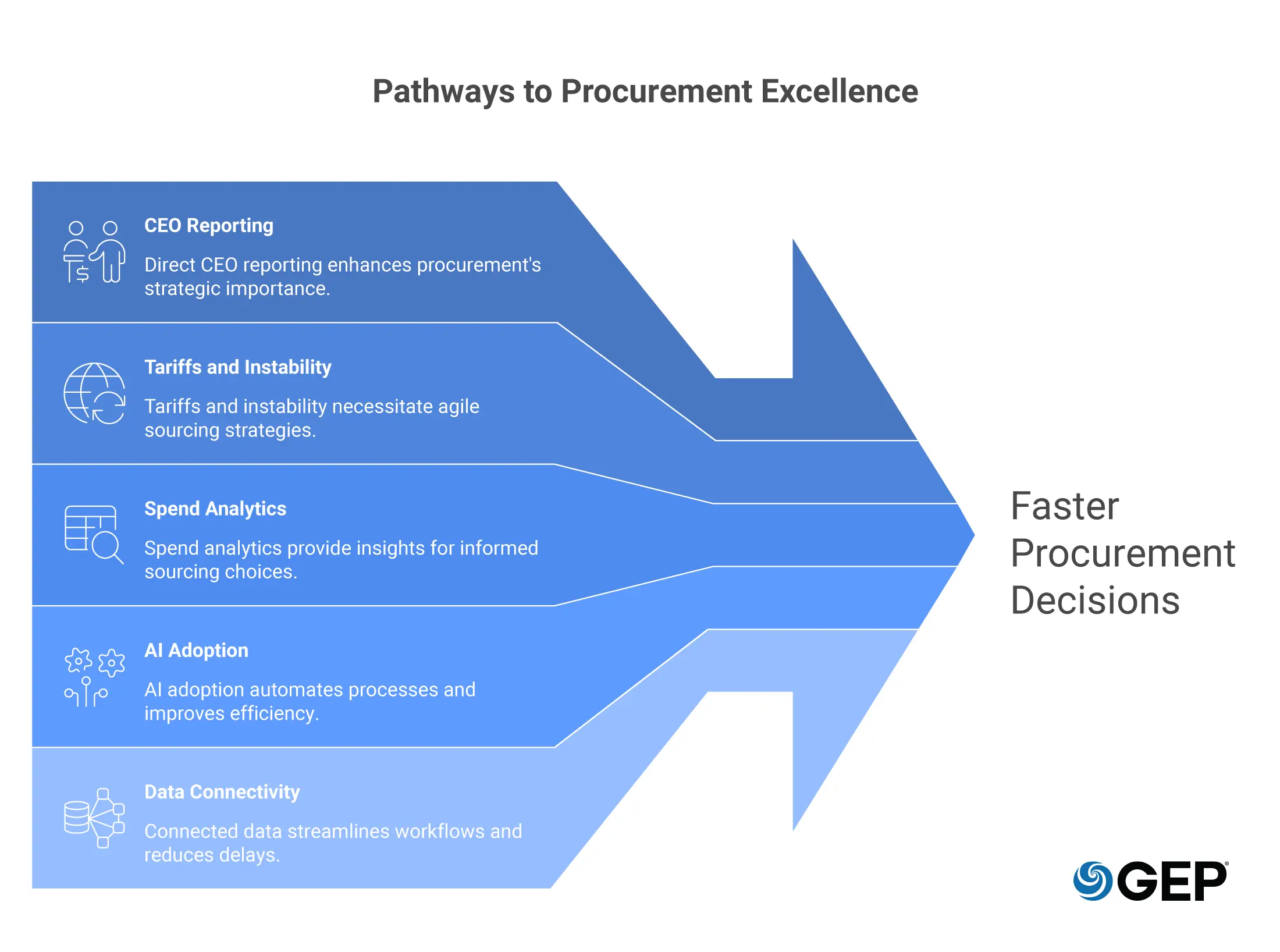
The latest Global State of Procurement & Supply 2026 report from CIPS and GEP shows procurement teams gaining direct access to CEOs and executive leadership at a much higher rate than before. One-third of procurement leaders now report directly to the CEO, managing director or owner, up from just 15% the previous year.
That shift matters because the world changed faster than most operating models could keep up with.
Tariffs move overnight. Supplier risk spreads across regions in hours. Cyber threats now sit inside procurement conversations alongside pricing and sourcing. Meanwhile, inflation pressure refuses to disappear completely. Procurement teams sit in the middle of all of it.
Companies know this. Boards know this too.
The old perception of procurement as a cost-control function no longer fits the reality inside global enterprises. Procurement teams increasingly shape resilience planning, supplier continuity, sustainability reporting and operational risk management. The report calls procurement “the connective tissue of all business activities.”
Still, the report reveals a contradiction.
Procurement has more visibility than ever before, but many organizations still struggle to turn insight into coordinated action.
That problem keeps surfacing across sourcing, supplier management, and supply chain execution.
How do best-in-class procurement teams navigate uncertainty?
The latest CIPS Global State of Procurement & Supply Report answers that question
Visibility Improved. Execution Still Lags
The data points tell the story clearly.
Fifty-two percent of procurement leaders say their influence over organizational spend is growing. Yet only 37% describe procurement as a “trusted business partner truly embedded in spend decisions.” In many organizations, procurement still gets pulled into decisions too late. Teams react instead of steering outcomes early.
The problem rarely comes from lack of information anymore.
Most enterprises already have dashboards, supplier reports, forecasting tools and spend analytics. What slows execution is fragmentation. Procurement systems remain disconnected from supply chain operations, finance workflows and supplier collaboration platforms.
The result feels familiar to many sourcing leaders. Teams identify risk early but fail to act quickly enough because approvals, data and workflows sit across different systems.
GEP’s foreword in the report addresses this directly. Organizations can already “see risks, understand trade-offs and identify opportunities in real time.” The challenge lies in translating that visibility into action consistently.
AI Expectations Have Become More Practical
That gap explains why AI conversations inside procurement are changing tone.
A year ago, discussions centered around dramatic automation and rapid workforce changes. This year’s findings look more measured. Procurement leaders still expect AI to improve operations, but expectations have cooled significantly in several areas.
The market appears to be moving from experimentation toward operational realism.
Only 7% of organizations describe themselves as highly automated today. Most remain partly automated or are still building toward broader adoption. Larger organizations continue to move faster because they have stronger data infrastructure and larger technology budgets. Smaller firms often struggle with fragmented systems and inconsistent supplier data.
That difference is becoming more visible across the market.
Research referenced in related GEP studies shows that 64% of organizations are very likely to invest in agentic AI. Yet more than half still lack unified procurement data systems.
That rarely holds up in production.
AI performs well only when supplier, spend, contract and sourcing data connect cleanly across the organization. Many companies still operate with procurement, supply chain and finance data spread across multiple environments. AI cannot coordinate decisions effectively if the underlying processes remain disconnected.
Procurement Orchestration Is Becoming More Important
This is where procurement orchestration and agentic AI start gaining attention.
Traditional automation handles isolated tasks. It routes approvals, processes invoices or flags supplier risks. Agentic AI works differently. It carries decisions across workflows and systems while adjusting actions in real time.
That matters in sourcing.
If a supplier disruption appears in one region, procurement teams cannot wait days for manual coordination between sourcing, logistics and operations. They need systems that identify exposure, model alternatives and trigger action immediately.
Several GEP studies attached to the broader procurement research point toward this shift. AI-powered orchestration now helps companies align sourcing, supplier management, logistics and risk decisions in real time.
Tariffs and Supply Chain Risk Are Changing Procurement Priorities
The timing makes sense.
Procurement leaders face pressure from every direction simultaneously. Tariff instability continues forcing companies to rethink direct material sourcing strategies. Manufacturers increasingly need real-time visibility into supplier exposure, forward pricing and regional sourcing alternatives. Manual sourcing processes move too slowly when market conditions change weekly.
Many companies are already restructuring supply chains because of this pressure.
Some are shifting production closer to regional markets. Others are decentralizing supply operations into smaller regional networks. The objective is straightforward: reduce dependence on single geographies and improve response speed during disruptions.
Procurement sits at the center of those decisions now.
Procurement’s Role Keeps Expanding
The profession also carries growing responsibility for sustainability programs. Ninety-three percent of procurement and supply leaders say ESG importance is either growing or remaining stable. More organizations now place ESG accountability directly inside procurement functions instead of separate sustainability teams.
That expansion changes the skills procurement leaders need.
Technology skills, risk management and negotiation now rank as the top development priorities globally. Procurement professionals increasingly need to interpret market signals, understand AI-enabled workflows and navigate geopolitical uncertainty alongside traditional sourcing responsibilities.
The role looks far broader than it did even five years ago.
Procurement teams now influence operational continuity, supplier resilience, cybersecurity
exposure and sustainability performance. Yet many organizations still run procurement processes through fragmented systems built for a slower business environment.
That mismatch becomes harder to sustain every year.
Lead with Agentic AI
Drive smarter procurement and resilient supply chains through enterprise-proven technology
The Next Phase Depends on Execution
Companies that modernize procurement around connected workflows, unified data and AI-driven execution will likely widen the gap over competitors still relying on disconnected tools and manual coordination. The report hints at this divide already emerging between mature procurement organizations and those still building foundations.
Procurement finally has leadership visibility. Now leadership expects results at speed.
The organizations that close the execution gap first will shape what procurement looks like over the next decade.




FAQs
Procurement now manages far more than supplier pricing. Teams influence resilience planning, ESG goals, risk mitigation, cybersecurity exposure and operational continuity. Global disruption pushed procurement closer to executive decision-making.
Many organizations discovered that AI depends heavily on clean, connected data. Fragmented procurement and supply chain systems limit automation effectiveness, which is slowing large-scale deployment.
Agentic AI refers to AI systems that can carry decisions across workflows with minimal human intervention. In procurement, it can coordinate sourcing, supplier management, risk monitoring and operational responses in real time.