


The Hidden Value Levers That Make Procurement Negotiations Deliver Enterprise Impact in 2026
- Enterprise value comes from four levers beyond price: cross-functional input, data intelligence, contract design, and supplier trust.
- Spend and market data turn a negotiation from a pricing exercise into a position of informed advantage.
- Contract structure and supplier trust determine whether savings survive past signature or quietly erode.
July 29, 2026 | Procurement Strategy 4 minutes read
Procurement teams in 2026 are negotiating in markets that shift week to week. Tariff changes and supplier consolidation move so quickly that a negotiated price can become outdated before the ink dries.
Many negotiations still end at a signed contract, treated as the finish line rather than the starting point. Savings get logged, and the deal gets filed, while the value that could have compounded across the enterprise never materializes.
This blog breaks down the value levers that turn a closed deal into lasting enterprise impact and shows how procurement teams can apply them starting with their next negotiation.
Why Closing a Negotiation Doesn't Guarantee Enterprise Value
A negotiation can close successfully and still produce weak results for the business. Category managers frequently focus on unit prices because it is the easiest number to measure and report.
Real cost shows up in delivery terms, payment cycles, quality thresholds, and switching costs, areas a single price comparison rarely captures.
When negotiations stop at price, procurement wins the transaction but loses the opportunity to influence total cost of ownership and working capital, along with the risk exposure attached to both.
Turn Every Negotiation Into a Position of Strength
Concrete strategies for tough supplier negotiations
Beyond Price: The Cross-Functional Levers Procurement Teams Overlook
Finance cares about payment terms and cash flow timing, and operations cares about lead time reliability, with legal weighing in on liability allocation before terms are even finalized. Each function holds a lever procurement that can pull during negotiation, provided the conversation happens before talks start rather than after a contract lands on their desk.
Bringing these functions into scoping sessions early changes what is asked for at the table. A small price reduction rarely matches the value of extended payment terms or a liability cap that removes downstream risk.
Negotiating in isolation tends to optimize for the number a team can defend in a savings report. Involving other functions early optimizes the outcomes the business feels.
Data as Negotiation Power: How Spend and Market Intelligence Build Advantage
A negotiator who walks in with supplier cost breakdowns and market pricing trends, backed by category benchmarks, holds a different conversation than one working from a quote and a target discount.
Spend analysis shows where volume can be consolidated, and market intelligence points to where supplier pricing power is weakening or strengthening. Combined, the two ground a negotiation in what the market supports rather than what a supplier is willing to offer.
This is where AI-native platforms change the negotiation prep cycle. Instead of category managers building spend cuts and market comparisons by hand, the analysis surfaces pricing anomalies and supplier risk signals, flagging benchmark deviations before the first call is even scheduled.
Explore GEP’s AI-Native Procurement Platform for Enterprise-Wide impact
How Contract Design Becomes a Value Driver
A negotiated price protects value for a single transaction, but contract structure is what protects it for the life of the relationship.
Terms covering volume tiers, renewal triggers, service-level penalties, and index-linked pricing determine whether savings hold for eighteen months or quietly erode, absorbed by scope creep or unmonitored escalation clauses.
Treating contract terms as an active negotiation lever, worked out alongside price rather than finalized afterward, builds protection that outlasts the person who signed them.
Ready to Build Value Into Every Negotiation?
Talk to a GEP expert about applying these levers to your next high-stakes supplier deal
Supplier Trust Outperforms Aggressive Tactics
Aggressive tactics can produce a strong number in a single negotiation cycle. They rarely produce a supplier willing to prioritize your business during a shortage or offer early access to new capacity, the kind of goodwill that also means hearing about a cost increase before it even hits your invoice.
Repeated, fair negotiations change supplier behavior in ways a hard bargaining stance cannot. Suppliers extend flexibility to buyers they view as consistent and reasonable, and that flexibility becomes valuable exactly when markets tighten.
That trust builds at no added cost and compounds with every renewal cycle.
Putting the Levers to Work: A Framework for 2026 Negotiations
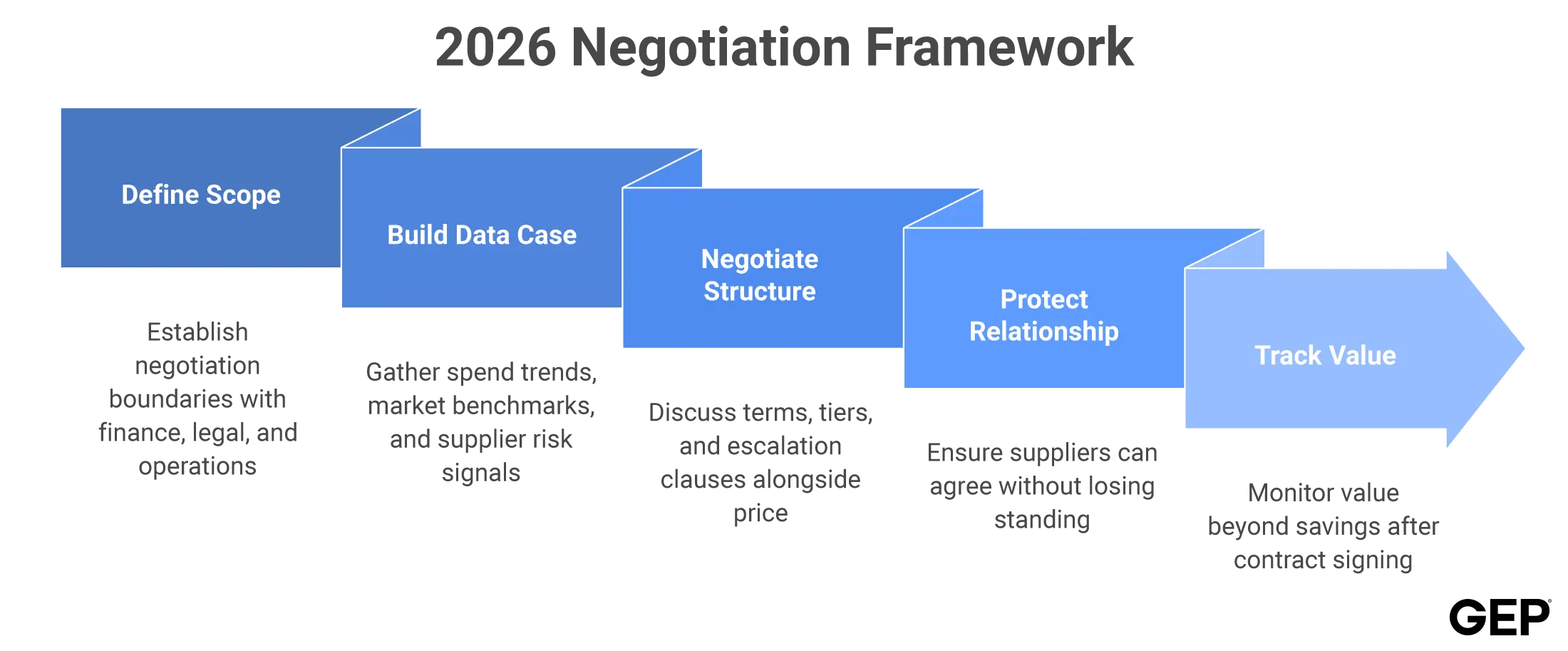
- Scope with finance, legal, and operations before talks begin.
- Build the data case: spend trends, market benchmarks, supplier risk signals.
- Negotiate structure alongside price, including terms, tiers, and escalation clauses.
- Protect the relationship: leave room for the supplier to say yes without losing standing.
- Track value after signature, not just savings at close.
If you want to see how these levers apply to your next high-value negotiation, talk to us.
Turning Negotiation Wins Into Lasting Enterprise Value
A closed contract confirms only that a negotiation ended, leaving open the separate question of whether the business gained anything durable from it.
Applying these levers together, rather than picking one for a single deal, is what moves procurement from closing transactions to building value the business keeps.
Applied consistently, the same negotiation skill starts producing a different outcome that a price-only approach could never reach on its own.




FAQs
A closed negotiation confirms that terms were agreed upon. Enterprise impact measures whether those terms produced measurable value across cost, cash flow, risk, and supplier reliability over time.
Finance can offer payment term flexibility, and operations can define delivery and quality priorities, with legal shaping liability and risk allocation behind the scenes. Involving these functions early expands what procurement can negotiate for.
Spend history and market benchmarks show what a fair price and fair terms look like before the negotiation starts. That shifts the conversation from asking for a discount to negotiating from an informed, defensible position.