
Procurement at a Turning Point: Your Function Was Built for a World That No Longer Exists
- Procurement’s biggest constraint is not capability, it is a fragmented operating architecture
- Speed, decision enablement, and user experience now matter more than savings alone
- Orchestration, not more tools, is what unlocks AI, automation, and real strategic impact
May 26, 2026 | Procurement Strategy 5 minutes read
The old playbook — drive savings, enforce compliance, standardize processes — delivered results for a generation. The environment changed faster than the playbook did. Now the gap is showing.
There is a moment in every function's evolution when incremental improvement stops working. Procurement has reached that moment.
CPOs today are managing a contradiction. On one side: supply volatility, geopolitical disruption, inflationary pressure, and a risk environment that never fully settles. On the other: a business that expects procurement to move faster, surface better intelligence, and operate with far less friction than before.Neither side is getting easier. And the model most procurement functions are running on was not designed for either.The business no longer measures procurement by savings alone. It measures it by how quickly it enables decisions and how much it gets in the way when it doesn't.
Modern Procurement Needs Modern Architecture
See how orchestration and agentic AI help procurement move faster and operate smarter
The Real Constraint is Not Capability, it is Architecture
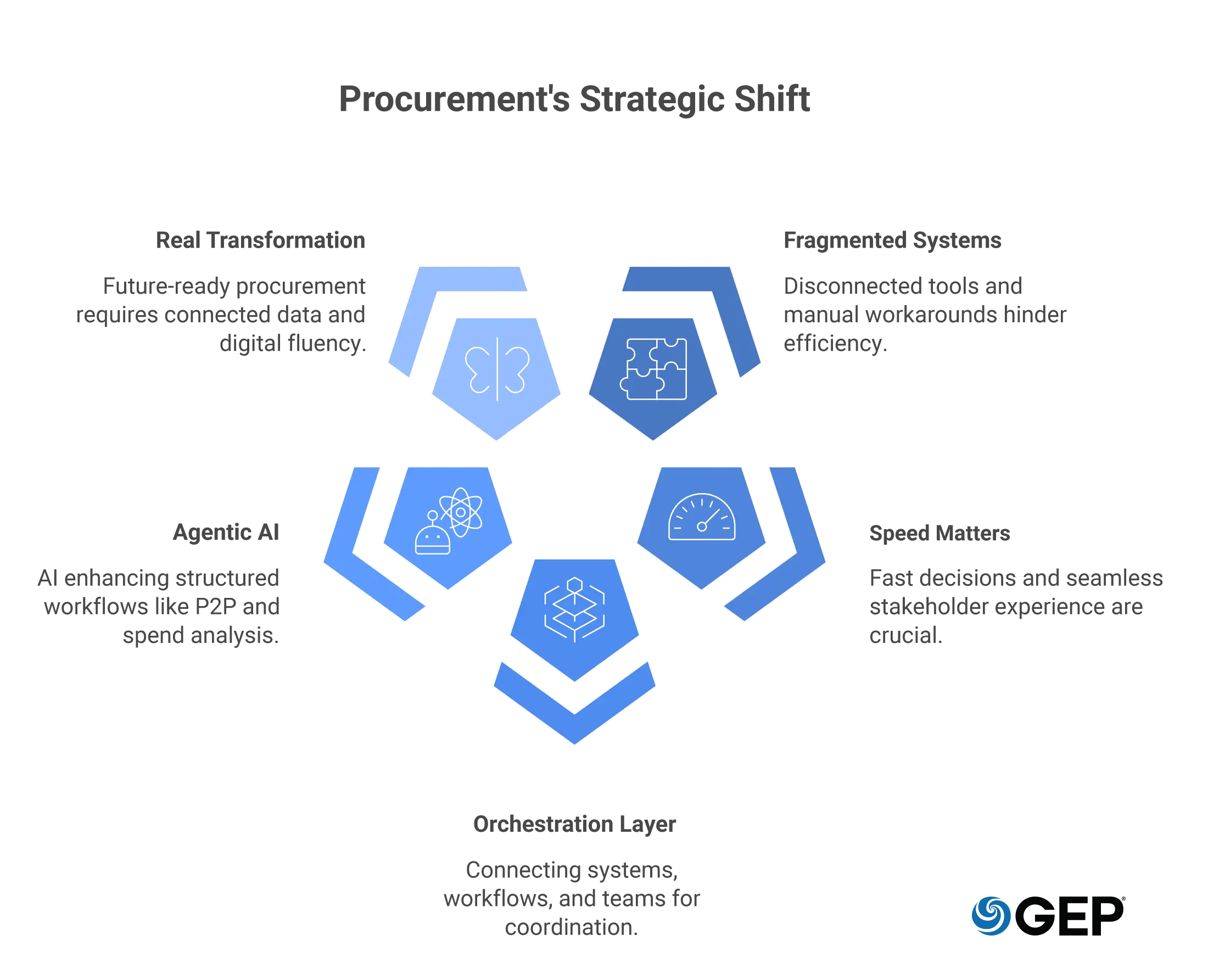
Most senior procurement leaders are not lacking ambition or talent. What they are lacking is a coherent operating architecture to work from.The typical enterprise procurement stack is a collection of point solutions accumulated over years of investment: source-to-pay platforms, contract management systems, supplier portals, spend analytics tools. Each was acquired to solve a specific problem. Together, they have created a new one.
Data is fragmented. Processes break at handoffs. Teams build manual workarounds to compensate and those workarounds quietly become the real process. The result is a function that looks digitized on paper but operates manually in practice. Advanced tools underdeliver not because they are inadequate, but because the foundation beneath them is not solid.
Until data is standardized, connected, and reliable, every investment in AI, automation, or analytics will return less than it should.
Speed is Now a Strategic Variable, Not an Operational Nicety
Procurement was historically optimized for control. Approval layers, structured governance, and tight workflows ensured compliance. That was the right design for a stable environment.
Stability is no longer the baseline.When a supply disruption hits or a category assumption shifts overnight, the business needs procurement to respond in hours, not procurement cycles. When a stakeholder needs to engage procurement, the experience needs to feel like a service not a bureaucratic obstacle.Slow cycle times, manual monitoring, and delayed insights are not signs of rigor. They are signs that the operating model is misaligned with what the business now requires.
Orchestration is the Layer Most Organizations are Missing
Orchestration is not another system to add to the stack. It is the connective tissue that makes the existing stack coherent. It creates a single, clear entry point for requests. It standardizes routing across teams and systems. It reduces the back and forth that consumes time and erodes stakeholder trust.
More importantly, orchestration creates the structure that automation and AI need to operate effectively at scale. Without it, even intelligent tools remain isolated, capable in theory, limited in practice.
The leaders who are furthest ahead are not necessarily those with the biggest technology budgets. They are the ones who dealt with the architecture problem first.
Agentic AI the Signal Beneath the Hype
Most organizations are still in evaluation or pilot stages with agentic AI. That is not a failure of ambition. It reflects appropriate caution about deploying systems that take action, not just analysis, within live processes.Where agentic AI is most mature is in structured, transactional workflows: procure-to-pay automation, spend analysis, supplier onboarding, contract management support. These are areas where data is well-defined, rules are clear, and the cost of error is contained.Strategic areas, such as category management, supplier negotiation, and make or buy decisions, still require human judgement. That is not a limitation to engineer around. It is the correct division of labor.AI handles repetition and scale. Humans own strategy, relationships, and decisions that carry real consequence. The organizations that understand this balance will outpace those chasing full automation too early.
Risk Management is Broken and Most Leaders Know it
On average, less than half of purchasing categories are proactively monitored for risk. That means a significant portion of enterprise spend sits in a blind spot, visible only when something has already gone wrong.
The traditional model was reactive: identify issues as they surface, respond, adjust. In a relatively stable environment, that was defensible. In today's environment, it is not.The shift now is toward continuous, real-time visibility: monitoring supplier performance and financial health, integrating external signals, building early warning into category strategies rather than treating risk as a separate function that gets called in after the fact.
Risk cannot be anticipated without visibility. It cannot be managed without coordination.
Stay ahead of shifting spend dynamics across key categories.
Explore the GEP Spend Category Outlook to inform data driven decisions
The Talent Question is Changing Quietly
The skills that defined strong procurement talent a decade ago — process rigor, contract execution, cost benchmarking — remain relevant. But they are no longer sufficient.CPOs are increasingly prioritizing analytical thinking, digital fluency, strategic category management, and the ability to work effectively across functions. Technology enables this shift but does not create it. In many cases, it amplifies the gap between those who can use it well and those who cannot.
What the Path Forward Actually Requires
The direction is clear. Procurement is moving toward faster execution, better intelligence, proactive risk management, and genuine strategic influence across the enterprise. Getting there requires coordinated effort across four things simultaneously:
Data: Standardize, connect, and govern it — everything else depends on this
Process: Simplify and orchestrate across the full source-to-pay cycle
Technology: Integrate what exists before adding more; ensure AI has a coherent foundation to operate from
People: Build for the skills the function needs now, not the ones it needed five years ago
None of these can be solved in isolation. Progress on one without the others creates a new imbalance.This is not a technology transformation. It is an operating model transformation, one that will determine which procurement functions become genuine strategic assets and which remain sophisticated back-office operations.
Conclusion
The question is not whether procurement will change. It already has. The question is whether your function is changing fast enough to stay ahead of what the business now expects from it.
The full data, leadership perspectives, and detailed findings behind every insight in this piece are in the 2026 Procurement Executive Insight Report. Download it here.