



Supplier ESG Assessments: From Questionnaire to Enforcement
- Segmenting ESG questionnaires by category and geography puts review effort where supplier risk is highest.
- A weighted scorecard turns fragmented ESG data into a single, actionable risk signal for sourcing decisions.
- Enforceable corrective action plans and hard-stop spend controls hold suppliers accountable instead of leaving low scores without consequence.
September 18, 2026 | Supplier Management Strategy 5 minutes read
Regulators don't treat supplier sustainability claims as optional disclosure anymore. The Corporate Sustainability Reporting Directive, the Corporate Sustainability Due Diligence Directive, and the Uyghur Forced Labor Prevention Act all put legal weight behind what a company can actually prove about its supply base. Not what a supplier writes in a glossy sustainability report. A once-a-year questionnaire doesn't cut it, and any procurement team still running one is sitting on exposure it hasn't priced.
This is a structural shift. It isn't going away. ESG due diligence used to live with sustainability teams, filed as a reporting exercise. Now it sits with procurement, because procurement holds the levers that actually change supplier behavior: contract terms, onboarding gates, spend decisions. A questionnaire without enforcement gets filed away. One tied to those levers actually shapes what happens next.
That shift plays out in four phases, from the first questionnaire a supplier sees to the contract terms that hold them to it.
Phase 1 (Questionnaires): Structuring Targeted ESG Evaluation Frameworks
Sending the same questionnaire to every supplier wastes reviewer time. Worse, it buries the suppliers who actually carry risk under a pile of low-stakes responses. Segmenting by category and geography fixes that: a raw materials supplier in a high-risk jurisdiction needs a deeper review than a regional logistics vendor does.
Most frameworks break the questionnaire into three domains:
- Environmental: emissions data, energy sourcing, waste handling, and water use
- Social: labor conditions, wage compliance, and health and safety records
- Governance: anti-corruption policies, board oversight, and supply chain transparency commitments
Doing this by hand doesn't scale. Manual distribution creates version control headaches once you're past a few dozen suppliers, let alone a few hundred. ESG tracking and reporting software handles the grunt work instead: automated intake, category-based routing, and flags on incomplete submissions before a reviewer ever sees them.
Phase 2 (Validation): Evidence Requirements and Verification Protocols
A questionnaire response is a claim, nothing more. Without verification, it stays that way. Supporting documentation, like carbon audit reports, safety permits, and signed codes of conduct, is what turns self-reported data into evidence a compliance team can actually defend during an audit.
Greenwashing rarely looks like an outright lie. It looks like selective disclosure, a supplier reporting renewable energy use at one facility and quietly leaving out the other three. Cross-checking disclosures against third-party risk databases is what catches that discrepancy before it becomes the company's problem. Centralizing verification inside supplier management software means every document, certification, and audit trail stays attached to the supplier record, not buried in someone's inbox.
Phase 3 (Scoring): Building a Weighted Supplier ESG Scorecard
Raw questionnaire data doesn't do much on its own. It needs to become a score procurement can actually act on. A weighted scorecard blends two things: commercial exposure, how much spend is riding on the category, and sustainability impact, how severe the environmental or social risk really is.
Red, yellow, and green thresholds give a buyer a fast read without making them dig through a full report. Real-time analytics keep those thresholds current as new audits, incidents, or certifications come in, rather than sitting frozen between review cycles. An annual refresh sounds thorough. In practice, it's already stale by the time a sourcing decision actually gets made.
Phase 4 (Follow-Through): Corrective Action Plans and Contract Governance
A low score with no consequence attached changes nothing. Corrective action plans need real timelines, ones that spell out the deficiency, the fix required, and the date it has to be closed by. Suppliers who blow past that deadline should hit a pre-agreed consequence, not an open-ended grace period.
None of that matters unless ESG scores connect directly to sourcing outcomes. Strong scores should open doors: preferred status, expanded business. Weak ones should close them, restricting onboarding or triggering a formal review before renewal. Procure-to-pay software can enforce this automatically, blocking purchase orders to suppliers below a compliance threshold with a hard stop, so it doesn't come down to a buyer remembering to check.
One Process, Not Four Separate Tools
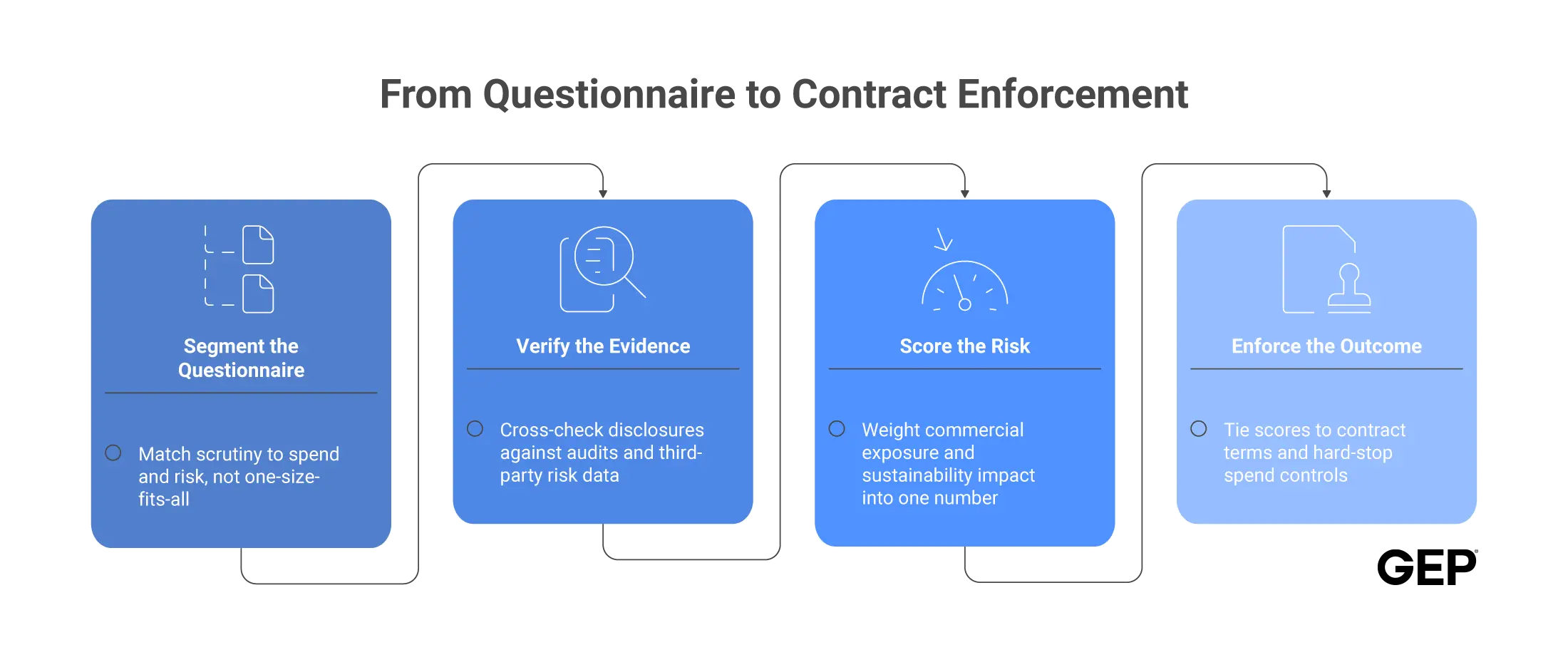
Keep questionnaires, verification, scoring, and enforcement in separate systems, and someone ends up manually cross-referencing spreadsheets across departments just to catch a single compliance failure. Source-to-pay orchestration links supplier onboarding, contract terms, and payment controls together, so a failure at one stage surfaces automatically at the next, no spreadsheet-hunting required.
What Changes When ESG Becomes Operational
Once questionnaires, verification, scoring, and enforcement work as a single process, supplier ESG assessment stops being a compliance checkbox. The supply base becomes something a company can actually defend under scrutiny: documented, current, tied to real decisions instead of filing away until next year's audit. That defensibility does two things at once. It protects against regulatory penalties, and it gives customers, investors, and auditors a supply base that holds up when they actually look closely.




FAQs
Two factors, mainly: how much spend sits in the category, and how severe the environmental or social risk actually is. A raw materials category sourced from a region with weak labor enforcement carries more weight than something like office supplies, where spend is low, and risk is minimal. Most procurement teams set these weightings with input from risk, legal, and sustainability, then revisit them as regulations shift or new supplier data comes in.
Self-assessments are exactly what they sound like: a supplier's own account of its emissions, labor practices, or governance policies. Third-party ESG telemetry comes from somewhere else entirely: satellite emissions monitoring, credit and litigation databases, certification bodies, none of it dependent on what the supplier chooses to disclose. That independence matters. A supplier has every incentive to paint a rosier picture than reality supports, and verified telemetry is what catches the difference.
Usually three input types, blended. Environmental data covers emissions, energy sourcing, and waste management, while social data tracks labor conditions, wage compliance, and safety records. Governance rounds it out: anti-corruption controls, board oversight, transparency commitments. Verification status and audit currency factor in too, since an unverified claim just doesn't carry the same weight as a documented one.
For one, it gives procurement documented evidence for regulatory audits, instead of leaning on informal supplier relationships and hoping for the best. It also surfaces risk earlier, before a violation turns into a disruption or a fine. There's an upside beyond risk mitigation, too: the data supports supplier development, helping capable suppliers fix what's broken instead of just losing the business.