



A Five-Phase Supplier Negotiation Planning Checklist for Category Managers
- Engage in market analysis and discussions with stakeholders to build internal alignment.
- Define negotiation targets and non-price levers such as payment terms and volume commitments.
- Lock in savings by moving agreed terms into enforceable contracts and SRM governance.
November 04, 2026 | Procurement Strategy 5 minutes read
A supplier emails a price increase on Monday, and by Wednesday your stakeholders want to know what you’re doing about it. Most category managers get a few days at best to prepare, and the deal usually deserves more.
Here’s the thing: the problem is rarely the negotiator. Plans go missing. Targets stay vague, and concessions get traded away with nothing coming back.
This blog walks through a five-phase checklist you can run before your next supplier negotiation.
Sharpen Your Supplier Negotiation Playbook
Learn how to plan, build the right team and communicate the right message
Why Category Managers Need a Structured Negotiation Planning Checklist
Most negotiations are won or lost well before anyone joins the call. Fuzzy targets and misaligned stakeholders do the damage early, and a written checklist is the cheapest way to catch both.
Mitigating Value Leakage and Commercial Risks in Supplier Negotiations
Value rarely disappears in one dramatic moment. It leaks out through loose service terms, rebates nobody tracked and escalation clauses that went unnoticed. Running the checklist before the call brings these gaps to the surface while you can still fix them.
Aligning Category Strategies with Sourcing Execution and Stakeholder Priorities
A strategy on paper means little if sourcing execution drifts away from it. The checklist links each concession back to category goals and to what Finance, Legal and operations actually need.
Moving Beyond Price: Multi-Variable Deal Structuring in Modern Procurement
Price is one lever among several. Payment terms, volume and lead times often carry as much value, and a deal built across all of them can beat a single headline discount.
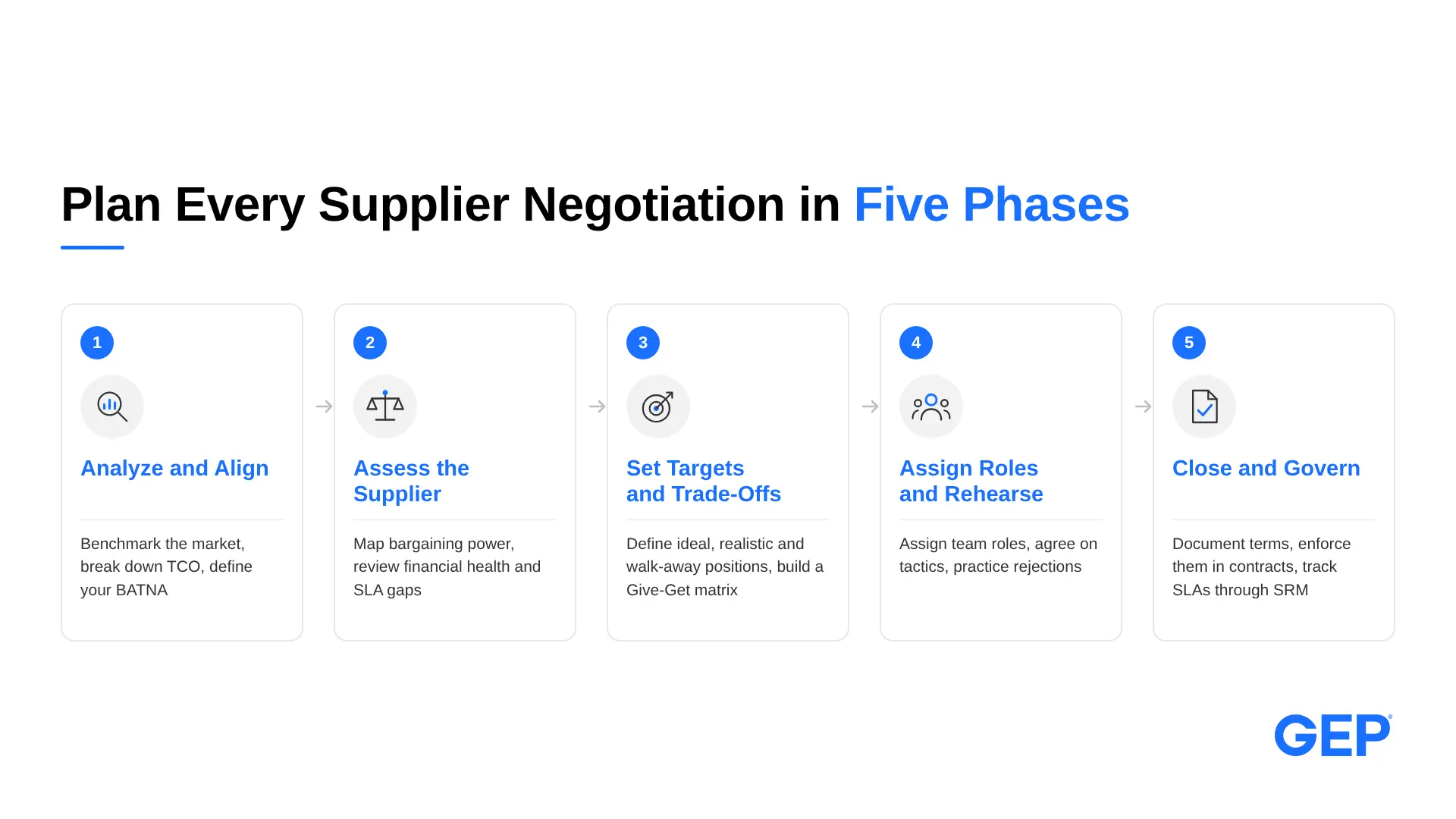
Phase 1: Pre-Negotiation Analysis and Internal Alignment
Good negotiators do their homework first. This is where you build the fact base and decide what you’ll do if talks stall.
Category Market Intelligence: Benchmarking Commodity Trends, Cost Drivers, and Supply Risks
Look at commodity trends, input cost drivers and capacity limits in the market. If supply is tight, the supplier holds more cards than you’d like, so know that going in.
Spend Data Analysis and Total Cost of Ownership (TCO) Breakdown
Pull spend by supplier, SKU and region to find price gaps between similar buys. Then layer in logistics, quality and payment costs, because unit price alone rarely tells the true story.
Defining Internal Requirements: Operational, Legal, SLA, and ESG Priorities
Sit down with stakeholders and sort every requirement into must-have or nice-to-have. The nice-to-haves become your trading material later.
Establishing the BATNA (Best Alternative to a Negotiated Agreement), and ZOPA (Zone Of Potential Agreement)
Your BATNA is what you’ll do if the talks fail. Your ZOPA is the range where both sides can still agree. Try to estimate the supplier’s BATNA as well, since it tells you how far they can really move.
Phase 2: Supplier Assessment and Power Dynamics
With your own position settled, look across the table. Who has the stronger hand, and what does this supplier actually want out of the deal?
Mapping Bargaining Power: Kraljic Matrix Positioning and Supplier Dependence
Place the category in one of four boxes: leverage, bottleneck, routine or strategic. Each calls for a different posture, and so does the level of dependence on both sides.
Analyzing Supplier Financial Health, Margin Pressures, and Strategic Motivations
A supplier under cost pressure may fight a price cut but welcome faster payment. Financial statements and recent strategic moves hint at what they’d be willing to trade.
Evaluating Past Supplier Performance Metrics, SLA Compliance, and Contractual Gaps
Collect delivery, quality and SLA records. Gaps, like penalties that were never written into the contract, go straight onto the agenda.
Phase 3: Defining Negotiation Targets and Multi-Variable Trade-Offs
Research now becomes numbers and choices, and the goal is to avoid making concessions on the fly.
Setting Clear Target (Ideal), Target (Realistic), and Walk-Away (Limit) Positions
Write down three positions: an ideal target, a realistic target and a walk-away limit. Share them with the team so nobody improvises under pressure.
Building a Give-Get Matrix: Trading Non-Price Levers (Payment Terms, Volume Commitments, Exclusivity)
List every lever you could offer and every one you’d like in return, then put a value on each beforehand. That way every give has a matching get.
Formulating Anchoring Strategies and Opening Offer Frameworks
Decide who opens and at what level. An opening offer grounded in benchmarks and TCO data pulls the outcome toward your side of the ZOPA.
Phase 4: Team Roles, Tactics, and Execution Strategy
A solid plan can still fall apart if the team isn’t in sync. Rehearsing roles and responses is what keeps everyone steady when the conversation takes a turn.
Assigning Negotiation Team Roles: Lead Negotiator, Commercial Lead, Technical Expert, and Scribe
Give each person one job. The lead negotiator talks, the commercial lead guards the numbers, the technical expert answers specifics, and the scribe keeps the record.
Selecting Negotiation Tactics and Communication Protocols
Pick tactics that suit the relationship, whether collaborative or competitive. Agree on who speaks, when to pause and how to handle information nobody expected.
Mock Negotiation Sessions and Scenario Planning for Supplier Rejections or Escalations
Ask a colleague to play the supplier and push back hard. Plan your answers to rejections and escalations so a flat no doesn’t stall the meeting.
Phase 5: Post-Negotiation Closure and Contract Execution
A signed deal isn’t the finish line. The value you negotiated only counts if it makes it into the contract and survives the months that follow.
Debriefing the Negotiation Team and Documenting Agreed Terms
Meet soon after, while details are fresh. Capture agreed terms, open points and lessons for next time.
Translating Negotiated Terms into Enforceable Contracts and SLAs
Brief Legal in precise language. Pricing, service levels and exit rights should read in the contract just as they were agreed at the table.
Establishing Supplier Relationship Management (SRM) Governance for Ongoing SLA Tracking
Set a review rhythm, scorecards and a named owner for each SLA. Without tracking, negotiated value fades quietly.
Bring Structure to Every Supplier Negotiation
See how an AI-native source-to-pay platform helps category teams plan, negotiate and track supplier outcomes in one place
Preparation Is the Real Negotiating Advantage
Most negotiation outcomes are settled before the first meeting. A five-phase checklist helps category managers protect value, use leverage well and walk into the room with confidence.
Try it on one live negotiation and note what was missing. If you want to explore how to operationalize this at scale, talk to us.
Explore GEP’s - AI-Native Category Management Software




Frequently Asked Questions
They widen the deal space. When payment terms, volume and exclusivity are on the table, both sides can gain, and you can protect margin without forcing a deeper price cut.
It sets your posture before you speak. Leverage items support competitive tactics, while strategic and bottleneck items call for partnership and risk mitigation.
It pairs every concession you offer with something you receive. Because values are agreed in advance, trades stay balanced instead of lopsided.