
The Strategic Role of Service-Level Agreements (SLAs) in High-Performance Procurement
- SLAs set a permanent quality baseline that suppliers are contractually required to meet.
- They function as financial protection, triggering restitution when performance declines.
- Precision transforms vague promises into measurable, executable, and legally binding obligations.
February 06, 2026 | Supplier Management Strategy 4 minutes read
In procurement, ambiguity is expensive. Precision is leverage. When you outsource any part of your operation, sourcing, logistics, manufacturing, IT, or shared services, you are handing over control to someone else. This is where SLAs come into play in procurement.
A Service-Level Agreement (SLA) forces clarity where assumptions usually hide. It defines what acceptable performance would look like, along with measurable outcomes like delivery windows, quality thresholds, response times, and escalation paths.
An effective SLA aligns procurement execution with business intent and translates expectations into numbers you can track, manage, and enforce.
SLAs also shape behavior. When responsibilities and outcomes are clearly outlined, teams on both sides work more effectively. This clarity prevents you from reacting to issues after they arise, turning procurement into a proactive rather than a reactive function.
What A Service-Level Agreement (SLA) Contains, and Why It Matters
Service Level Agreements (SLAs) are generally legally binding contracts.
At its core, a procurement SLA answers three questions:
- Who is responsible
- What must be delivered
- How success is measured
A well-structured SLA clearly identifies the parties involved and the scope of services or goods covered. It translates expectations into operational deliverables and assigns ownership to eliminate ambiguity.
Most importantly, it establishes performance metrics that can be verified.
Governance matters just as much. The SLA defines how performance is reported and how often reviews take place. It also outlines the consequences of missed standards, including service credits, penalties, remediation plans, or termination rights.
When the SLA is well-written, enforcement becomes straightforward, and numbers tell the story. That clarity protects both sides. Suppliers know what is expected, while procurement teams gain leverage to manage performance or renegotiate terms based on evidence.
Is Your SLA Framework Holding Up?
Get guidance on setting targets that support your procurement goals
Speak to an Expert
5 Strategic Phases of the SLA Lifecycle
A typical SLA life cycle includes five key stages:
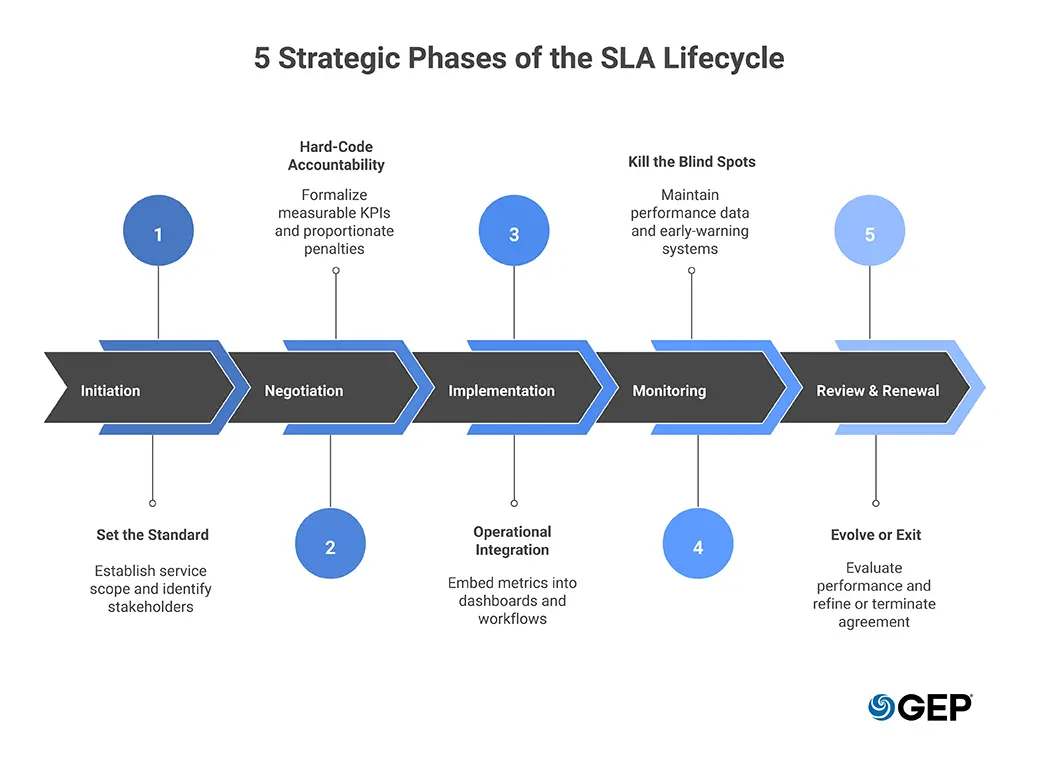
1. Initiation
You define what matters, which services are covered, and who owns outcomes internally and externally.
2. Negotiation
In this stage, you and the vendor hammer out the details. Be precise, and lock in specific KPIs and penalties. Ensure both sides agree that the targets are realistic.
3. Implementation
After signing, integrate the SLA into daily operations. Connect metrics to your dashboards and daily tools.
4. Monitoring
Once live, the SLA is continuously monitored. Use early-warning signals and regular data reviews to catch and fix issues before they become major problems.
5. Review and renewal
Periodically (often annually or at contract renewal), you review the results. Treat every renewal as a pivot point to decide whether to renew the SLA as is, adjust its terms, or terminate the agreement.
A well-managed SLA life cycle becomes a feedback loop for optimizing procurement and operations.
Core Components Every Procurement SLA Must Include
Every effective SLA shares a common structure:
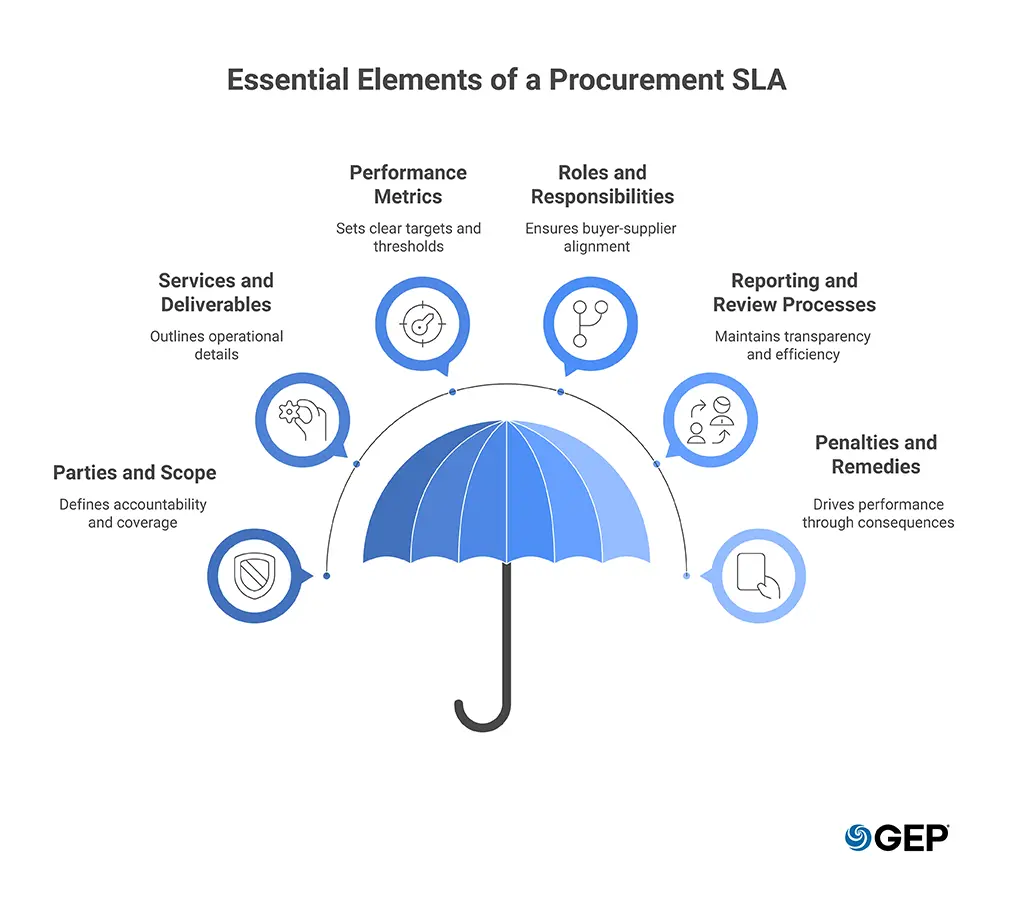
- Parties and scope so there is no confusion about who is accountable and what is covered.
- Services and deliverables described in operational detail to align expectations.
- Performance metrics with clear definitions and thresholds, such as delivery, compliance, and quality rates.
- Roles and responsibilities across both organizations to ensure daily operational alignment.
- Reporting and review processes that fit how work actually happens and ensure transparency.
- Penalties and remedies that are enforceable, proportionate, and drive performance.
Each component removes uncertainty. Together, they turn expectations into executable standards.
Advanced SLA Management for Procurement Leaders
To lead a mature procurement function, shift from viewing SLAs as "policing" tools to using them as strategic levers. Here is the shortened guide for procurement leaders:
1. Tier by Risk
Don't treat all vendors equally. Apply rigorous, custom SLAs to high-impact suppliers (those affecting revenue or safety) and use "light" templates for low-risk commodities.
2. Standardize Metrics
Create a KPI library with universal definitions. When everyone speaks the same language (e.g., how "On-Time Delivery" is calculated), negotiations are faster and benchmarking is more accurate.
3. Automate Tracking
Move away from manual spreadsheets. Use automated monitoring to get real-time alerts when metrics drift. This allows you to fix problems before they impact the business.
4. Foster Collaboration
Treat SLAs as performance guides, not traps. Share data transparently with suppliers so they can self-correct. High-performing partnerships are built on shared visibility, not surprises.
5. Drive Accountability
Integrate SLA data into executive dashboards. When performance is visible at the leadership level, it removes "opinion" from the room and keeps both sides accountable to the data.
At this level, SLAs become part of governance. They show up in dashboards, executive reviews, and supplier scorecards. Performance conversations automatically become data-driven.
What Will Shape Procurement in 2026?
See how policy shifts and new tech can change your operating reality
Download the Report
KPI Frameworks and Dashboards That Make SLAs Actionable
SLAs are only as strong as the KPIs behind them. Effective procurement teams track a focused set of indicators tied directly to business outcomes. Use “a risk-based approach” to understand how much damage could happen if a vendor fails.
Each metric must connect directly to a strategic outcome you care about faster lead times, tighter cost control, or stronger compliance. This usually means a digital dashboard that shows you performance as it happens.
You track signals that actually move the business, such as on-time delivery, order-to-fulfilment cycle time, invoice accuracy, defect rates, and cost or price variance. Below is a clean, executive-level list of important KPIs in a procurement SLA for different categories:
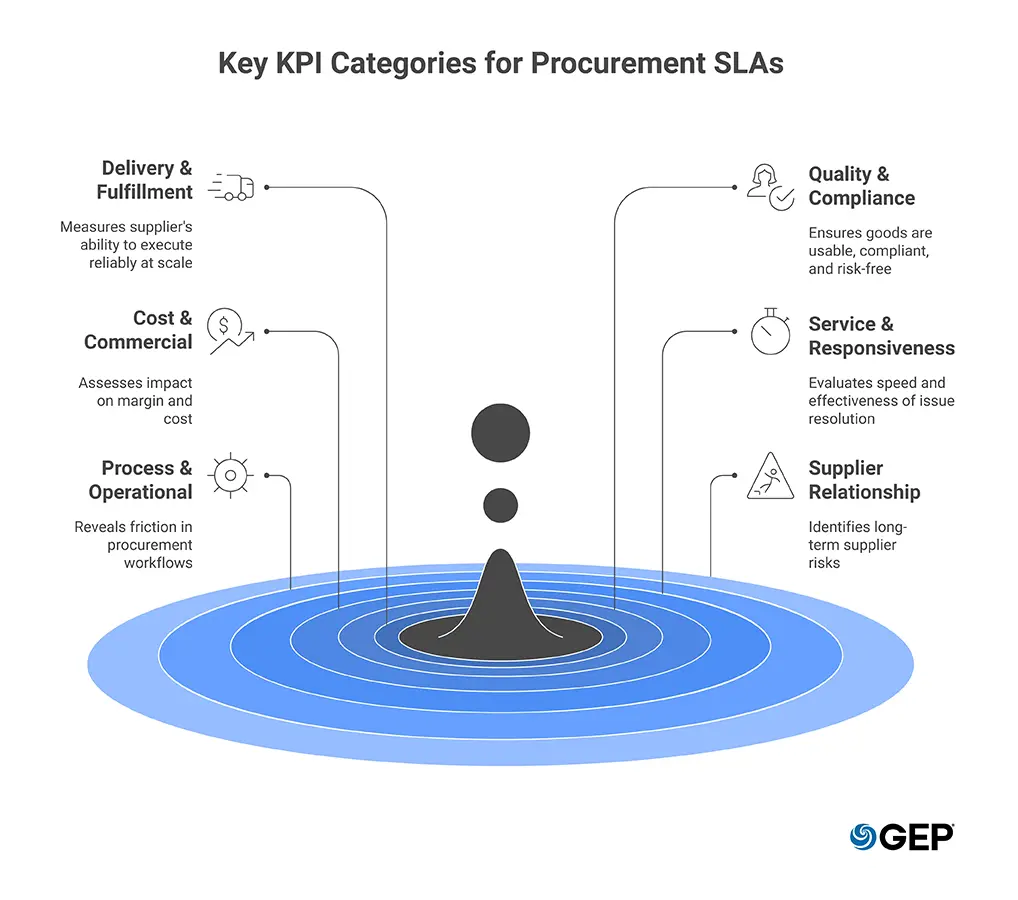
If a KPI does not influence a decision, it does not belong to the dashboard. Dashboards translate operations indicators into visualization where you can see overall performance at a glance. New trends and risks emerge early in the form of alerts. When a metric drifts, action follows.
The goal is faster decisions, fewer surprises, and tighter alignment between suppliers and operations.
Check Out GEP’s: AI Powered Procurement Software
Building Strategic Outcomes with SLAs
When written and managed well, Service Level Agreements (SLAs) translate expectations into measurable performance tied to operational data.
They impose accountability, eliminate ambiguity, and surface risks before they materialize.
The payoff is operational confidence. You gain predictability in volatile environments, ensuring every supplier relationship contributes to broader goals.
See how Supplier Management Software helps operationalize SLAs at scale.