Economic D-Day: What US Secondary Sanctions on Iran Mean for Multi-Tier Trade Compliance
- The U.S. Treasury has launched a sweeping new sanctions campaign against Iran, expanding secondary sanctions risk to any country or company doing business with Tehran across five key sectors.
- China has pushed back on the strategy and continues buying Iranian oil (though volumes are falling), while Iran's currency and inflation data show an economy under serious strain.
- Procurement and supply chain teams with any exposure to Iranian trade, Gulf shipping lanes, or the sanctioned sectors need to act now.
September 02, 2026 | Supply Chain News 5 minutes read
The U.S. has declared an economic war on Iran, and it's coming for anyone who does business with it.
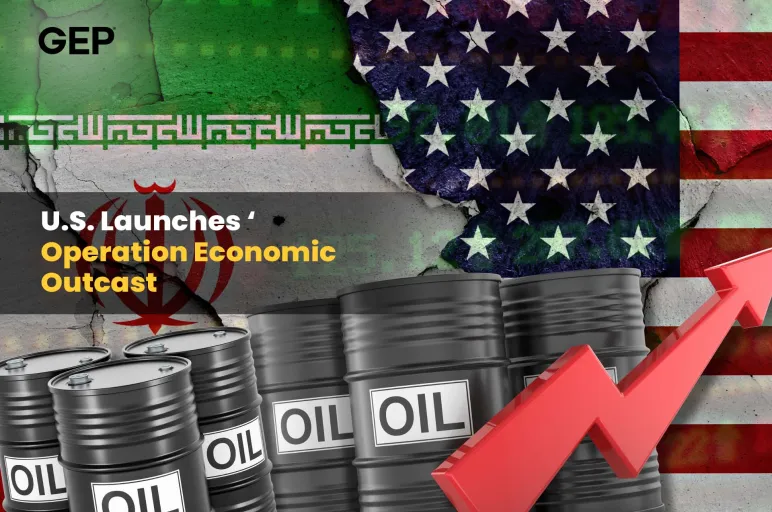
On August 24, 2026, U.S. Treasury Secretary Scott Bessent announced the launch of "Operation Economic Outcast," a sweeping campaign designed to cut off Iran from the global financial system entirely.
Bessent invoked the language of World War II to describe it, calling the campaign an "economic D-Day" and an "economic onslaught" against Iran's financial connections worldwide.
The new sectoral sanctions are believed to be the latest push to squeeze Iran economically after military strikes and diplomatic talks have failed to resolve the six-month conflict.
They target five of Iran's core revenue channels: digital assets, technology, gold, aviation, and shipping. Alongside the announcement, the U.S. Treasury's Office of Foreign Assets Control sanctioned nearly 60 entities, individuals, and vessels accused of helping Iran evade existing restrictions, procure sensitive technology, and generate oil revenue.
AI-Native vs. Bolt-On Procurement Platforms
What’s the Difference, and Why It Matters to You
A Warning, Not Yet a Full Crackdown
Washington hasn't yet named which countries will face secondary sanctions, and Bessent was candid about why: "Why would I want to blow up the global financial system?"
Instead, the administration is giving foreign governments and businesses a window to unwind their Iran dealings before tougher enforcement lands.
As Bessent put it, "We are level-setting with every country to tell them our expectations... So when the hammer of U.S. Treasury actions falls upon them, they will have no one to blame but themselves."
That ambiguity matters most for Iran's largest trading partners, including China, Turkey, and the U.A.E., since Washington has signaled it won't spare anyone.
Most observers, however, expect a cautious approach toward Beijing specifically, given how economically entangled the U.S. and China already are on separate trade matters.
China Pushes Back, Iran's Economy Buckles
The days since the announcement have surfaced two developments procurement teams should watch closely.
First, China, which buys more than 80% of Iran's shipped oil, has already rejected Washington's sanctions strategy, and Iranian crude has historically found its way to market through Chinese independent refiners, disguised cargo origins, and transactions settled outside the dollar system.
Notably, the U.S. initially spared major Chinese state banks from the toughest measures, reportedly to avoid disrupting the broader financial system ahead of a planned Trump-Xi meeting next month.
Iranian oil shipments to China have still fallen sharply, though, dropping to roughly 534,000 barrels a day in August from about 823,000 in July.
Second, Iran's domestic economy is deteriorating fast. The rial hit an all-time low against the dollar within hours of the threat of sanctions, and Iran's own statistical center has reported annual inflation near 88%, with food prices up over 125% year-on-year.
Experts are divided on whether this economic strain will trigger renewed mass protests or whether the regime's "resistance economy" posture means it can simply absorb the pain rather than change course.
Either reading points to the same practical takeaway for supply chains: instability in Iran and its neighboring shipping lanes is more likely to persist or escalate in the near term than resolve quickly.
What This Means for Procurement and Supply Chain Operations
For teams with no direct Iranian suppliers, it's tempting to read this as someone else's problem. But it isn't.
This GEP article on geopolitical risk in sourcing makes the underlying dynamic clear: sanctions can wipe out a supplier relationship overnight, tariffs can reset landed costs without warning, and export controls can make a critical input disappear.
The companies most exposed are often the ones who didn't think they had exposure at all, because the risk sits several tiers back in the supply chain rather than with a direct counterparty.
Two distinct risks are stacking on top of each other here. The first is compliance risk: any company transacting in the newly sanctioned sectors with counterparties that have any Iran-linked dealings could be swept into secondary sanctions exposure, even unintentionally, if their due diligence doesn't reach deep enough into their supplier and logistics networks.
The second is physical and cost risk tied to the Strait of Hormuz itself: continued disruption there has already driven up freight and insurance costs well beyond the Gulf region and forced rerouting that adds time and cost to shipments having nothing to do with Iran directly.
GEP's guidance on supplier risk management is direct about this pattern: political and geopolitical developments, such as trade policy shifts, sanctions, and export and import restrictions, can dramatically alter a supplier's risk profile with little warning, which is exactly why geopolitical monitoring can't be a once-a-year exercise anymore.
What Procurement Teams Should Do Now
- Run a sanctions exposure screen, including indirect exposure. Don't stop at your direct supplier list. Screen tier-two and tier-three relationships in shipping, aviation, gold, technology, and digital assets for any Iran-linked counterparties, since secondary sanctions risk attaches to facilitation, not just direct dealing.
- Reassess Gulf shipping routes and lead times now, not when disruption hits your shipment. If any part of your logistics network transits or depends on the Strait of Hormuz corridor, build in contingency routing and revised lead-time assumptions rather than assuming normal transit will resume soon.
- Diversify away from single-region dependency where geopolitical volatility is elevated. This GEP article on friendshoring frames this plainly: diversification used to be a long-term goal, but in an environment of shifting sanctions and export controls, it's now an urgent priority. Sourcing from partners in geopolitically stable, aligned regions reduces the odds that a sudden policy shift shuts down a critical input.
- Build scenario plans for multiple sanctions and shipping outcomes. With Washington deliberately leaving its secondary sanctions target list open, and Strait of Hormuz normalization still uncertain, procurement teams should have contingency plans ready for a range of outcomes rather than betting on one resolution timeline.
The overall impact of these new sanctions could shift quickly in the coming days, either toward de-escalation or a broader crackdown that touches major economies like China. Either way, waiting for clarity before acting is itself a risk procurement teams can't afford to take right now.