



What Are the Key Benefits of Sustainability Consulting Services for Businesses?
- Most organizations lack the capability to translate high-level sustainability commitments into measurable outcomes.
- Environmental responsibility must be woven into decision-making architecture at every level, from procurement to product design to partner selection.
May 15, 2026 | Strategy 8 minutes read
The rules of business have changed. Revenue growth, margin protection, and risk management built the last generation of great companies. The next one will be built on more. Environmental accountability and regulatory readiness are now part of the foundation. The shift is inevitable.
A well-defined sustainability strategy is now as foundational as financial planning or talent management. The risks of ignoring it are quantifiable and immediate. Investors want evidence. Regulators want compliance. Procurement leaders are expected to prove their supply chains are clean, not just say so.
But sustainability is not a problem you solve once and move on from. It requires continuous calibration across energy usage, supplier behavior, carbon accounting, and regulatory alignment, all while keeping operations running at full speed.
What matters is how well you are managing it right now, and how prepared you are for what comes next. Here are 10 ways the right sustainability consulting expertise makes both possible.
Make Your Sustainability Program Audit-Ready Today
Evaluate key sustainability frameworks and know where your business stands
10 Key Benefits of Sustainability Consulting Services for Businesses
The gap between sustainability as a commitment and sustainability as a competitive advantage comes down to one thing: execution. Here is what that looks like across 10 critical areas of your business:
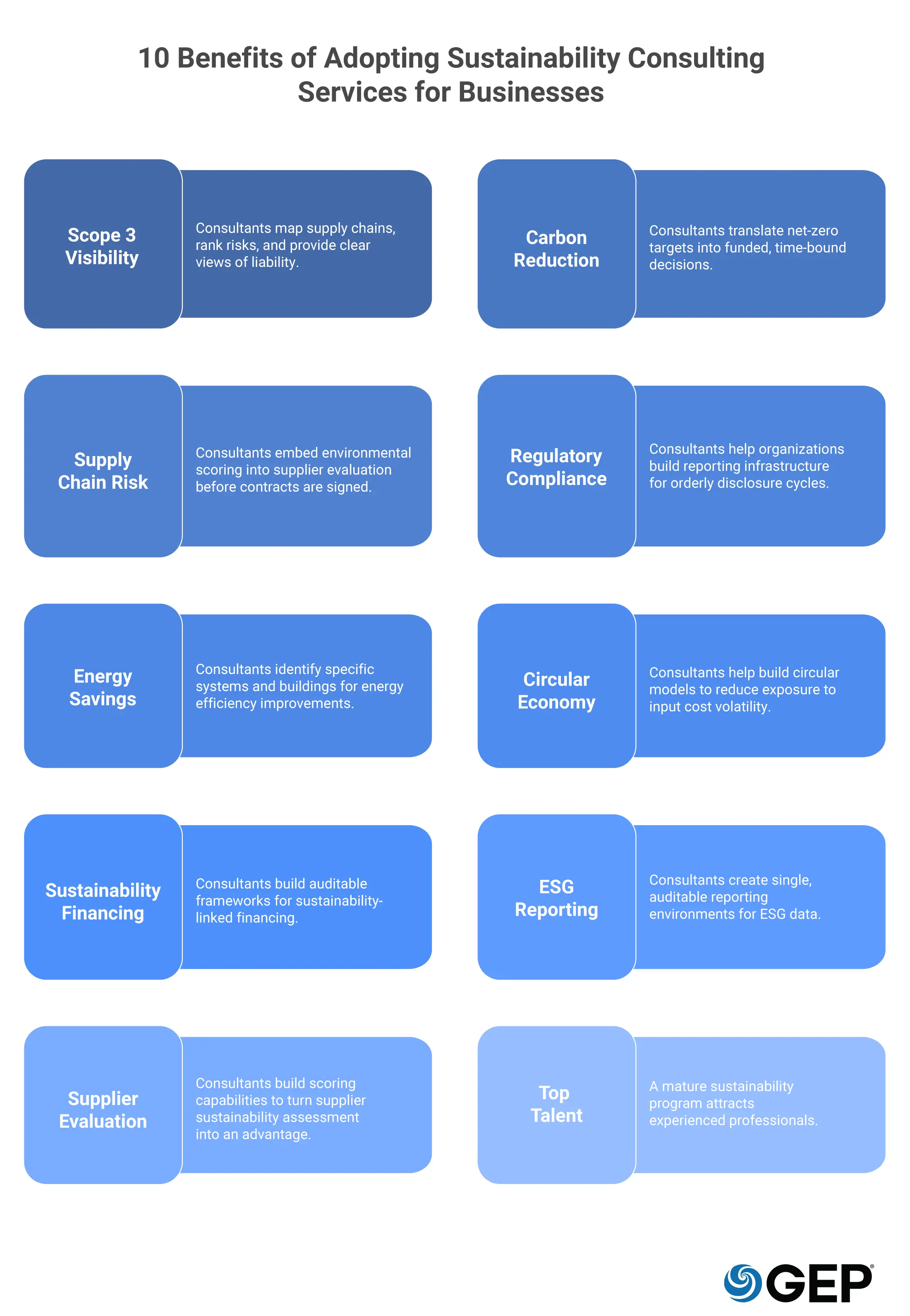
1. Scope 3 Visibility: Know What Your Supply Chain Actually Costs You
Your direct emissions are the smallest part of your exposure. What shows up in investor reviews, regulatory filings, and enterprise procurement audits is upstream, buried across supplier tiers you have likely never examined. Consultants map that chain, rank the risk by supplier, and give your procurement team a clear view of where the liability actually lives.
What you cannot see, you cannot manage.
2. Carbon Reduction: A Net-Zero Target That Holds Up Under Scrutiny
A net-zero target without a funded roadmap is not a strategy. It is a liability dressed up as ambition. The question your board and your institutional investors are asking is not whether you are committed. It is whether that commitment has been translated into specific, time-bound, funded decisions. Consultants do that translation, and without it, your sustainability program is a communications asset with no operational backing.
3. Supply Chain Risk: Nib Risks in the Bud
Environmental risk does not arrive with a warning. It surfaces as a key supplier losing certification overnight or a carbon border charge landing on inputs your sourcing team chose purely on cost. By the time it reaches your operations, the decision that caused it is already months behind you.
Consultants embed environmental scoring into supplier evaluation before contracts are signed, because the only useful point of intervention is before the disruption, not after.
4. Regulatory Compliance: Mandates No Longer Catch You Off-Guard
The Corporate Sustainability Reporting Directive, the Securities and Exchange Commission's climate disclosure rules, and supply chain due diligence mandates are not emerging risks. They are active obligations with enforcement timelines already in motion.
Organizations building reporting infrastructure now will have an orderly first disclosure cycle. The ones waiting will have an expensive remediation project. The lead time still exists, but it is narrowing.
5. Energy Savings: Less Waste, Better Margins
Most organizations have never run a granular energy audit. When they do, what surfaces is always specific: a compressor running beyond need, heating, ventilation, and air conditioning systems sized for a headcount that no longer exists, equipment drawing power through idle hours.
6. Circular Economy: Independence from Input Cost Volatility
Every price spike, supply constraint, and carbon charge on primary inputs lands directly on your margins. Circular models, built through redesigned material specs and supplier take-back provisions, reduce that exposure progressively. The organizations doing this well are not chasing environmental credit. They are building a cost structure that is harder to disrupt.
7. Sustainability-Linked Financing: Lower Your Cost of Capital
Sustainability-linked financing, where borrowing margins improve against verified environmental performance, is standard across institutional lenders today. The qualification threshold is not ambition. It is measurability. Without an auditable framework proving you are hitting agreed indicators, the instrument is simply not available. Consultants build that framework, and your sustainability program starts paying for itself in financing terms.
8. ESG Reporting: A Sustainability Initiative That Pays for Itself
When an institutional investor requests your ESG data, how fast and cleanly you respond communicates as much as the numbers themselves. A last-minute scramble across disconnected systems, followed by figures with caveats, tells a sophisticated investor or an auditor exactly what they need to know about your program's maturity. A single, auditable reporting environment changes that dynamic entirely.
9. Supplier Evaluation: Separate the Credible from the Convenient
When a supplier reports a 30% reduction in carbon intensity, that number means nothing without the baseline, the methodology, and independent verification. Most procurement teams do not have a consistent framework to assess that, so sustainability responses get filed rather than evaluated. Consultants build the scoring capability that closes that gap, turning supplier sustainability assessment into a genuine procurement advantage rather than a compliance formality.
10. Talent: Have The Best People Wanting to Join You
Experienced sustainability professionals evaluate a program's maturity before joining it. They can tell immediately whether sustainability has operational standing within an organization or exists solely for external messaging or a PR initiative. A program that is fully integrated into procurement and capital decisions signals something a mission statement cannot. In a market where this expertise is scarce, that signal matters.
Build Credible ESG At Enterprise Scale
Explore intelligent ESG tracking and reporting aligned to regulatory expectations
The Role of Sustainability Consultants in Implementation
Implementation is where most sustainability efforts stall, and it is precisely where external expertise delivers the most leverage.
Sustainability consultants bring a combination of technical capability, regulatory knowledge, and organizational change management that most enterprises do not maintain in-house. They don’t just diagnose problems but design systems.
This includes building data-collection infrastructure for emissions tracking, constructing supplier-evaluation frameworks, developing science-based target methodologies, and engineering internal workflows that make sustainability reporting accurate rather than aspirational.
Sustainability consultants also serve as a critical interface with external stakeholders such as auditors, certification bodies, regulators, and industry consortia, helping navigate requirements that are otherwise too complex to interpret and comply with.
What differentiates the best consultants from the rest is their ability to integrate sustainability into your existing operational and financial decision-making rather than layering it on top as a parallel workstream. Your sustainability strategy should inform procurement decisions, capital allocation, product development cycles, and partner selection.
Sustainability Indicators for Artificial Intelligence Systems
One of the most significant and underappreciated dimensions of enterprise sustainability strategy today is the role artificial intelligence plays, both as a subject of scrutiny and as a mechanism for transformation.
As AI systems become embedded in procurement, logistics, operations, and decision-making, the sustainability profile of those systems themselves is coming under increasing examination from regulators, investors, and society.
Most organizations think about AI in terms of what it can do. Fewer are asking what it costs the planet to run it.
Large-scale AI infrastructure, including data centers, cooling systems, and the hardware behind it, carries a significant energy and carbon footprint.
For enterprises deploying AI at scale, that footprint is now a material part of your total environmental exposure. Ignoring it is not a neutral position. It is a gap your investors and regulators will eventually find.
The more interesting opportunity, however, is on the other side of that equation.
AI agents, when deployed with the right objectives, are among the most powerful tools available for driving sustainability performance. They can monitor energy consumption across facilities in real time, reroute logistics to reduce fuel consumption, flag supplier behavior that creates environmental risk, and model the carbon impact of a procurement decision before it is made.
The same technology that adds to your footprint, when properly directed, can dramatically reduce it.
The determining factor is how you govern it. Sustainability criteria need to be built into AI systems from the start, not retrofitted after deployment. That means evaluating energy efficiency, carbon-aware scheduling, data provenance, and the environmental outcomes the system is actually designed to optimize for.
What your AI is built to achieve is a leadership decision, and in today's regulatory environment, it carries real accountability.
Autonomous AI systems can continuously monitor energy consumption across facilities, optimize logistics routing in real time to reduce fuel and emissions, identify supplier anomalies that create sustainability risk, and model the downstream environmental impact of procurement decisions before they are made.
Key sustainability criteria indicators must be embedded directly into system architecture.
Evaluating AI through a sustainability lens requires leaders to consider computational efficiency, training and inference energy consumption, carbon-aware scheduling, data provenance, ethical sourcing practices, and the measurable environmental outcomes the system is designed to drive.
As agentic AI takes on greater autonomy across enterprise operations, what those systems are optimized for matters as much as what they are capable of. Sustainability must become a governance decision before it is treated as a technical problem.
The Agentic AI Playbook for Procurement Pros
Your roadmap to moving from pilots to production, with AI that adapts, learns, and delivers.
The Path Forward Belongs to Organizations That Act Now
Organizations will treat environmental and social performance as a core business competency, which is rigorously measured and strategically managed.
For procurement and supply chain leaders, the mandate is direct: build sustainability criteria into every consequential decision. Be it supplier selection, contract terms, material specifications, logistics partners, or technology investments, all of it needs to be sustainable.
Leaders must ensure that business direction, capital, regulation, and customer expectations move in unison. Understanding which sustainability frameworks apply to your organization, based on geography, industry, size, and customer requirements, is a core deliverable of a rigorous sustainability plan.
The future will reward organizations that make the right systemic investments now.
If you are ready to turn sustainability commitments into measurable, operational outcomes, reach out to know what GEP’s sustainability consulting services can do for your organization.



BLOG CATEGORIES
FAQs
Sustainability consulting reduces costs by identifying inefficiencies with enough precision to act on. Consultants run detailed energy audits, resource utilization analyses, and supply chain mapping that surface waste and redundancy at a granular level. When you optimize energy consumption, reduce material waste, rationalize transportation networks, and restructure supplier relationships around sustainability criteria, the cost reductions are direct and measurable.
The most immediate gains come from reduced energy and resource expenditure. The more significant returns, however, come from what you avoid: regulatory penalties, supply chain disruptions, and reputational damage that a well-constructed sustainability strategy prevents before they materialize. Layer in improved access to financing, stronger positioning, the compounding effect on stakeholder trust, and the return profile is considerably broader than most organizations initially expect.
Several frameworks have become foundational for enterprise procurement and supply chain sustainability. The Science-Based Targets initiative provides the methodology for setting credible, emissions-reduction targets aligned with climate science. The Global Reporting Initiative and the Task Force on Climate-related Financial Disclosures govern how organizations disclose environmental performance to investors and stakeholders. The Corporate Sustainability Reporting Directive mandates detailed sustainability disclosure for large enterprises operating in or supplying into the European Union. International Organization for Standardization (ISO 14001) provides the framework for environmental management systems. In procurement specifically, the United Nations Sustainable Development Goals and sector-specific standards govern supplier evaluation and responsible sourcing practices.