



Which Procure-to-Pay Software Features Should a Mid-Sized Company Look for Streamlining Payments?
- Strong P2P software embeds policy, approvals, and invoice matching into the flow, so payment errors are prevented early.
- Real-time spend visibility aligns procurement and finance, improving cash forecasting and decision-making.
- True value comes when P2P integrates seamlessly with ERP systems, eliminating silos and accelerating payments.
March 24, 2026 | Procurement Strategy 4 minutes read
As companies grow into the mid-market range, payment processes often become harder to manage.
Approvals move through email. Invoices sit in shared inboxes. Procurement and finance work from slightly different numbers. Nothing is broken enough to cause panic, but nothing is smooth either.
That is where procure-to-pay software starts to matter. Not as a shiny new tool, but as infrastructure. It connects the entire procure-to-pay process from requisition to payment, so money moves with control and visibility.
If you are evaluating procure-to-pay software solutions, the question is not what P2P is. You already understand the basics. The real question is simple: which features actually help a mid-sized company streamline payments without adding complexity.
Let’s look at what truly makes a difference.
Streamline Payments with Smarter P2P
Gain clarity, control, and cash visibility with an integrated P2P platform
Why Procure-to-Pay (P2P) Matters for Mid-Sized Firms
Mid-sized businesses operate in a demanding space.
You are too large to rely on spreadsheets and manual approvals. At the same time, you likely do not have unlimited resources to build layered control systems.
That is why the procure-to-pay process becomes so critical. It connects purchasing decisions to financial outcomes. When that connection is tight, you get predictability. When it is loose, you get surprises.
Common pain points usually look like this:
- Manual approvals that slow down buying
- Limited real-time visibility into spends
- Invoice mismatches that delay payments
- Missed cost saving opportunities
- Supplier frustration due to unclear payment timelines
Strong P2P platforms bring structure without making the process rigid. They align procurement and finance around one version of the truth, so payments move faster and with fewer errors.
Core Procure-to-Pay Software Features for Mid-Sized Company to Streamline Payments
Not every feature is equally important. For mid-sized businesses, the priority should be speed, accuracy, and visibility.
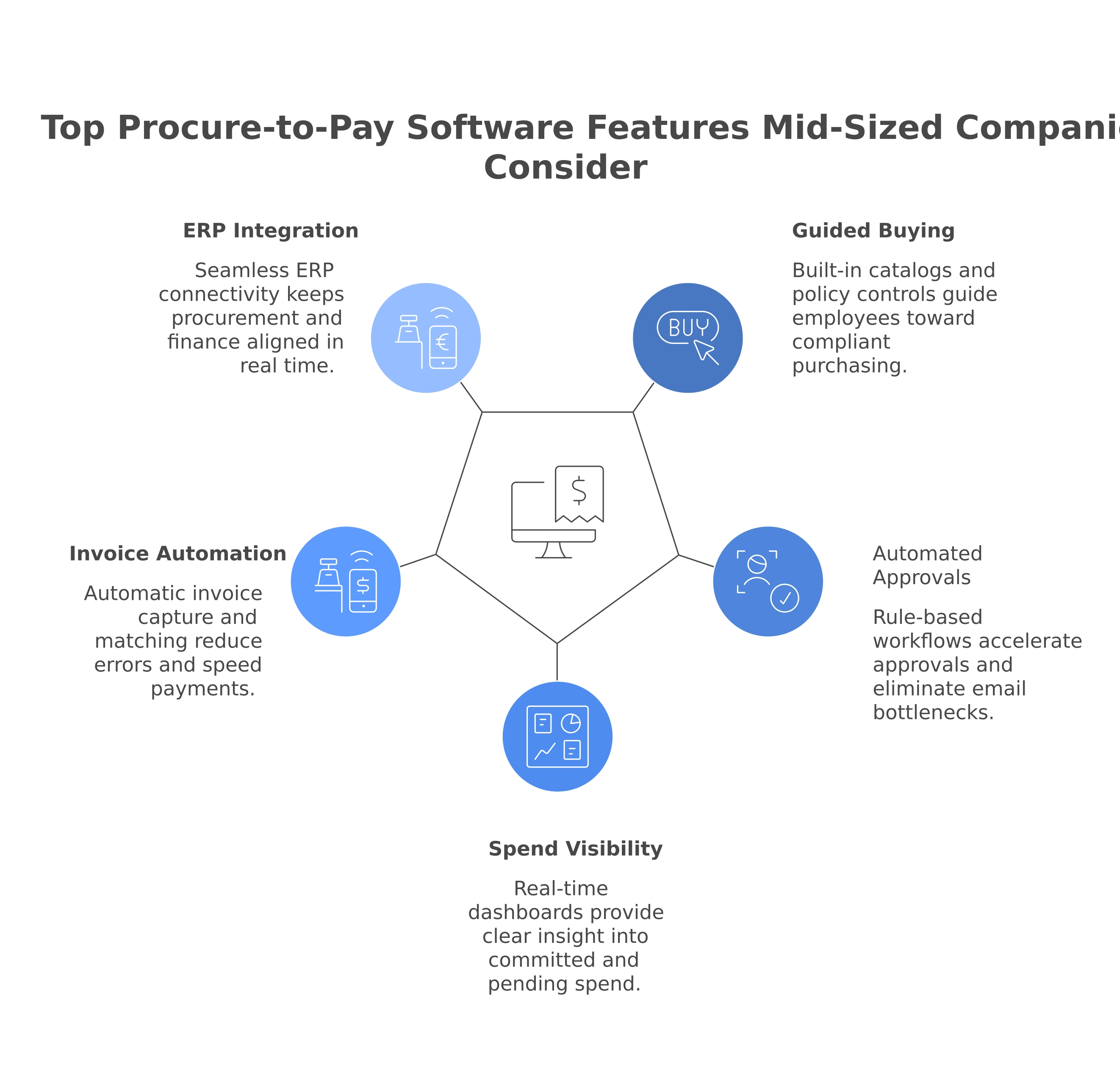
1. Guided Buying and Smart Requisitioning
Most employees are not procurement experts. They just want to buy what they need quickly.
Modern procure-to-pay software should provide a clean interface, approved catalogs, and built-in policy controls. Users should be guided toward compliant purchasing decisions without needing constant oversight.
When requisitions are clean and policy aligned from the start, downstream invoice issues reduce significantly. That is how P2P automation prevents problems before they begin.
2. Automated Approval Workflows
Approvals are often where payments slow down.
Configurable workflows allow you to route requests based on value, department, or risk level. Escalations happen automatically. Audit trails are built in.
This removes dependency on manual follow-ups and email chains. The result is a shorter approval cycle and clearer accountability.
Over time, this is one of the biggest ways how P2P software streamlines payment processes.
3. Real-Time Visibility into Spends
Visibility is power.
Real-time visibility into spends allows you to see committed spend, approved budgets, supplier exposure, and pending liabilities in one place. You are not waiting for month end reports to understand your position.
For mid-sized businesses, this level of transparency improves forecasting and working capital planning. It also strengthens conversations between procurement and finance because both teams are looking at the same data.
4. Invoice Automation and Matching
Invoices are where friction often shows up.
Strong procure-to-pay software solutions include intelligent invoice capture, automated matching against purchase orders and receipts, and exception-based workflows.
Instead of manually reviewing every invoice, your team focuses only on discrepancies. This reduces errors and delivers procure-to-pay capabilities to reduce errors at scale.
Cleaner invoices lead to faster payments. Faster payments improve supplier trust.
5. ERP and Platform Integration
No P2P platform should operate in isolation.
Platform integration with your ERP ensures master data stays aligned, general ledger codes are accurate, and payment status is visible in real time.
Without integration, you simply shift the bottleneck from one system to another. With proper integration, procurement and finance operate as one connected function.
For mid-sized businesses, this connection is often the turning point between incremental improvement and real transformation.
6. Payment Scheduling and Cash Optimization
Streamlining payments is not only about speed. It is also about timing.
Advanced P2P platforms allow you to manage early payment discounts, automate payment runs, and forecast cash outflows more accurately.
This is where the conversation moves from efficiency to strategy. You begin to identify cost saving opportunities that were previously hidden in fragmented data.
Better payment control improves liquidity and strengthens supplier negotiations.
7. Supplier Self Service
Supplier communication can consume more time than expected.
A supplier portal allows vendors to submit invoices digitally, track payment status, and update information without constant back and forth emails.
This reduces pressure on accounts payable and creates transparency. Suppliers feel informed rather than ignored.
In competitive markets, that matters.
Stay ahead of shifting spend dynamics across key categories
Explore the GEP Spend Category Outlook to inform data driven decisions
Benefits of Streamlined Payments Through Procure-to-Pay Software
When implemented correctly, procure-to-pay software delivers practical and measurable results.
- Faster approval and invoice cycles
- Reduced manual intervention
- Fewer payment errors
- Improved compliance with internal policies
- Stronger collaboration between procurement and finance
- Better cash flow visibility
These benefits are not theoretical. They directly influence working capital, supplier relationships, and operational stability.
For mid-sized businesses, this stability supports sustainable growth.
Choosing the Right Procure-to-Pay Software to Streamline Payments
As complexity increases, manual processes become fragile.
The right procure-to-pay software creates structure across the entire procure-to-pay process. It aligns teams, improves visibility, and supports smarter payment decisions.
When evaluating procure-to-pay software solutions, focus on features that:
- Automate approvals and invoices
- Provide real-time visibility into spends
- Integrate seamlessly with ERP systems
- Support cash optimization
- Enhance supplier collaboration
If you are exploring modern P2P automation, review GEP’s Procure to Pay solution to see how integrated P2P platforms can connect sourcing, procurement, and payments in one unified environment.
The goal is not simply digitization. The goal is clarity, control, and confidence in how money flows through your organization.




FAQs
P2P software streamlines payment processes by automating requisitions, approvals, invoice matching, and payment scheduling. It reduces errors, increases visibility, and shortens cycle times across the entire procure-to-pay process.
Yes. Modern procure-to-pay software solutions are designed for strong platform integration with ERP systems. This ensures synchronized financial data, accurate reporting, and consistent payment execution across procurement and finance.