


Achieving Procurement Agility Through Composable Source-To-Pay Software
- Composable source-to-pay software helps procurement teams respond faster to disruptions by allowing changes without full system overhauls.
- Modular architecture improves visibility and coordination across procurement, supply chain, and finance functions.
- Real-time data and automation reduce cycle times, manual errors, and delays in sourcing and supplier management.
March 24, 2026 | Source to Pay 4 minutes read
Procurement teams are under pressure to move faster, yet most systems still slow them down. Market shifts hit without warning. Tariffs change cost structures overnight. Suppliers fail. Internal approvals drag.
Many organizations have already aligned procurement and supply chain goals. Execution still falls apart. Siloed systems block visibility. Teams work off different datasets. Decision cycles stretch longer than the disruption itself.
Agility sounds simple on paper. In practice, it requires systems that can adjust without breaking. That is where traditional source-to-pay platforms struggle. They were built for control, not speed.
Procurement leaders now face a hard reality. Stability in systems often comes at the cost of responsiveness.
Step Into the Future of Procurement
Empower your CPO strategy with agentic AI–orchestrated source-to-pay transformation
Why Composable Source-to-Pay Software is a Game Changer for Procurement Agility
Monolithic S2P platforms lock processes into fixed workflows. Any change requires IT effort, testing cycles, as well as time (which teams rarely have). That delay matters when supply risk unfolds in days.
Composable S2P changes the structure. Instead of one large system, it breaks procurement into smaller functional blocks. Intake, sourcing, contracts, supplier management, and payments operate as connected modules. Each piece can evolve without disrupting the rest.
That flexibility changes how teams react. A new supplier onboarding workflow can go live without waiting for a full system upgrade. Risk signals can plug into sourcing decisions instantly.
It sounds ideal. But it only works if the data underneath is consistent. Many organizations are still struggling here. Over half report that procurement data is not fully integrated across systems.
Composable architecture does not fix bad data. It exposes it faster. That friction is useful. It forces cleanup where it matters most.
Core Components of Composable S2P Software
Composable S2P does not mean fragmented tools. The structure still needs coordination.
Intake management acts as the front door. It captures demand clearly and routes it based on rules. Poor intake creates confusion later. Clean intake removes rework early.
Sourcing modules handle supplier selection, RFx events, and negotiations. These modules adapt faster when market conditions shift. A tariff spike or supply shortage can trigger alternate sourcing flows without redesigning the system.
Contract lifecycle management stores terms, obligations, and pricing structures. It connects directly to sourcing and purchasing. That link matters when contracts need quick adjustments under pressure.
Supplier management tracks performance, risk, and compliance. Real-time updates help teams act before issues escalate.
Payments and invoicing close the loop. Integration here ensures that procurement decisions reflect actual spend and financial outcomes.
The real strength lies in how these components connect. Data flows across modules without manual intervention. Decisions reflect current conditions, not outdated reports.
The Path to Autonomous Procurement
Explore how AI-native S2P platforms enable orchestration and agentic execution for 1.5–2.5x higher ROI over time
Key Ways Composable S2P Drives Procurement Agility
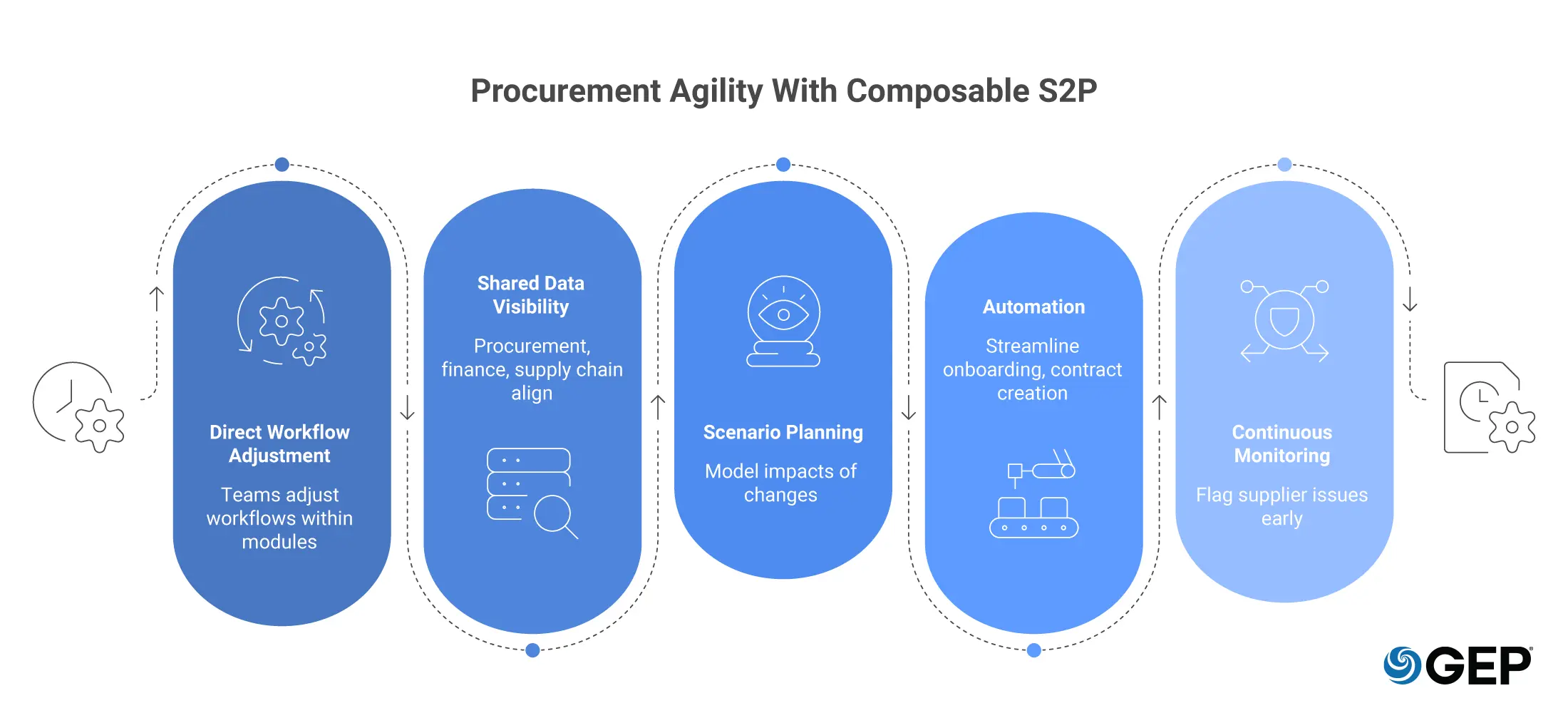
Faster decision cycles stand out first. Teams no longer wait for system changes to act. They adjust workflows directly within modules.
Visibility improves across functions. Procurement, finance, and supply chain operate on shared data. That alignment reduces delays caused by conflicting information.
Scenario planning becomes practical. Teams can model supplier changes, tariff impacts, or demand shifts using real-time data. That capability helps avoid reactive decisions.
Automation reduces manual effort. Supplier onboarding, contract creation, and approvals move faster. Errors drop because validation happens earlier in the process.
Risk management improves. Continuous monitoring flags supplier issues before they disrupt operations. Teams can switch suppliers or renegotiate terms with less delay.
There is a catch. Agility increases complexity. More moving parts mean more dependencies. Without governance, systems can drift into inconsistency. That trade-off needs attention from the start.
How to Implement Composable S2P Software for Agility
Start with data readiness. Fragmented data will limit every benefit. Focus on key datasets first. Spend, supplier, and contract data should be accurate and accessible.
Define clear use cases. Avoid trying to redesign everything at once. Pick areas where agility matters most. Direct material sourcing or supplier risk management often delivers quick results.
Adopt a phased rollout. Test modules in controlled environments before scaling. Early success builds confidence across teams.
Set governance rules early. Define how modules interact. Establish ownership for each component. Without this, flexibility turns into confusion.
Train teams alongside deployment. Technology alone does not change behavior. Procurement professionals need to trust and understand the system.
Work with vendors who understand procurement workflows, not just software architecture. Technical capability without domain knowledge often leads to misaligned implementations.
Expect resistance. Teams used to stable systems may hesitate. Address concerns with clear outcomes. Faster cycle times and fewer disruptions make a stronger case than technical features.
Final Thoughts
Procurement agility is no longer optional. Disruptions are constant, not occasional. Systems built for stability cannot keep up with that pace.
Composable S2P offers a different path. It allows procurement teams to adjust processes without waiting for system overhauls. That speed changes how organizations respond to risk, cost shifts, and supplier challenges.
The transition is not simple. Data gaps, governance issues, and change resistance will slow progress. That rarely shows up in vendor presentations. It shows up during implementation.
Still, the direction is clear. Procurement teams that move toward modular, connected systems will respond faster and operate with fewer delays.
Agility comes from structure, not chaos. Composable S2P provides that structure, if implemented with discipline.




FAQs
Composable S2P reduces manual work by automating workflows such as sourcing, approvals, and invoicing. Faster cycle times lower administrative overhead and reduce delays in supplier engagement. Better visibility into spend and supplier data helps teams negotiate effectively and avoid unnecessary costs.
Many organizations overlook data quality, which limits system performance from the start. Some attempt large-scale transformations instead of phased rollouts, leading to delays and confusion. Weak governance also creates inconsistencies across modules, reducing the benefits of a composable approach.