


Leveraging AI for Supply Chain Risk Intelligence
- Supply chain risk intelligence is evolving rapidly: AI-powered platforms now process signals from hundreds of data sources to surface threats before they become crises.
- Through predictive analytics and machine learning, AI shifts risk management from reactive to anticipatory, giving teams time to act rather than just respond.
- Organizations that embed AI into supply chain risk management gain a measurable competitive edge by protecting margins and maintaining operational continuity under pressure.
May 13, 2026 | Procurement Software 5 minutes read
The Role of AI for Supply Chain Risk Intelligence
Supply chains have never faced more variables at once. Geopolitical tensions, extreme weather events, port congestion and supplier financial stress can converge within a matter of weeks to create disruptions that cost large enterprises millions per day in lost output and expedited logistics.
Traditional risk management was built for a slower world. Analysts reviewed supplier scorecards quarterly, monitored a handful of key indicators and relied on relationships to flag early warning signs. That approach can’t keep pace with the volume and velocity of signals that determine supply chain health today.
AI changes the equation entirely. By continuously analyzing news feeds, shipping data, financial filings, weather patterns and geopolitical developments, AI-native supply chain risk intelligence platforms give procurement and supply chain leaders a real-time picture of their exposure. The result is a shift in how organizations perceive and respond to risk.
What Is AI for Supply Chain Risk Intelligence and How Does It Work?
Supply chain risk intelligence refers to the practice of collecting, analyzing and acting on data that signals potential disruptions to the flow of goods, services or information across a supply network. AI amplifies this practice by automating analysis at a scale no human team could replicate.
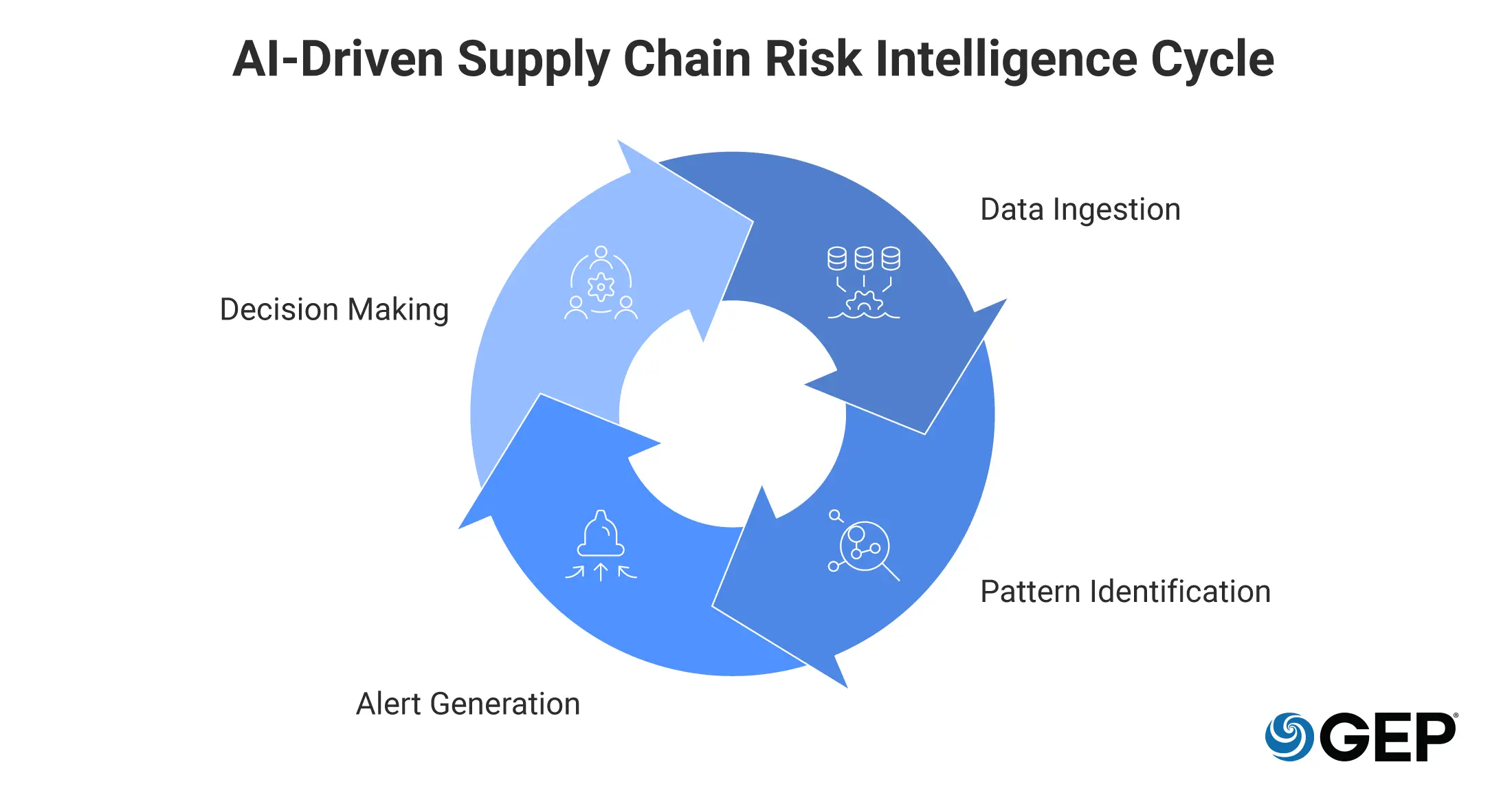
At its core, an AI-native risk intelligence system works in three stages. First, the perception layer ingests data continuously from structured sources like ERP systems and financial databases, as well as unstructured sources like news articles, regulatory announcements and social media signals.
Second, a machine learning engine identifies patterns within that data, correlating events across geographies and supply tiers to calculate disruption probability.
Third, the system surfaces prioritized alerts with context, giving teams the information they need to make decisions quickly.
What makes AI genuinely powerful here is its ability to connect dots across tiers. A political protest near a port in Southeast Asia, combined with a spike in container rates on a specific trade lane, may not trigger concern individually. Together, and matched against a company's specific supplier footprint, they become an actionable warning. AI in supply chain management makes those connections continuously and at scale.
Key Benefits of Leveraging AI for Supply Chain Risk Intelligence
The most immediate benefit is speed. When a risk event occurs, the window for effective response is often measured in hours. AI-powered platforms compress the time between a signal appearing and a decision-maker receiving a briefing from days to minutes.
Beyond speed, the strategic benefits are equally compelling. Risk intelligence in supply chain management enables organizations to move from reactive crisis management to proactive portfolio management. Instead of scrambling after a disruption, teams can evaluate exposure across their full supplier base, model alternative sourcing scenarios and make adjustments before a situation escalates.
There is also a significant financial case. Research from industry analysts consistently shows that supply chain disruptions cost organizations a measurable percentage of annual revenue. Companies with mature risk intelligence capabilities recover faster and with lower cost impact because they have already identified fallback options and pre-negotiated contingency arrangements. AI-native supply chain planning software embeds this capability directly into planning workflows, connecting risk signals to operational decisions in a single environment.
How AI for Supply Chain Risk Intelligence Improves Risk Management Strategies
AI transforms risk management strategies by making them continuous rather than periodic. A quarterly supplier review captures a snapshot in time. An AI system monitoring the same suppliers around the clock captures the full motion picture, including early indicators that would not appear on a traditional scorecard.
Predictive analytics in supply chain management is particularly valuable for multi-tier visibility. Most disruptions originate not with Tier 1 suppliers but with Tier 2 and Tier 3 nodes that organizations have limited direct visibility into. AI platforms can map these relationships and monitor sub-tier suppliers using publicly available signals, flagging concentration risks and single points of failure that would otherwise remain invisible.
AI also strengthens risk management by enabling scenario modeling. When a known risk materializes, or when a new threat emerges on the horizon, procurement teams can use AI to rapidly model the downstream impact on supply continuity, cost and customer service levels. That capability converts risk intelligence from a reporting function into a genuine decision-support tool.
Is Your Supply Chain Built for Disruption?
Explore scenario-based strategies for regional and global resilience
Best Practices for Effectively Leveraging AI for Supply Chain Risk Intelligence
Deploying AI for supply chain risk intelligence is only as effective as the data underpinning it. Organizations should begin by auditing their supplier master data to ensure it is complete, accurate and structured in a way that supports automated matching against external data sources. Gaps in supplier taxonomy or geography data will limit the system's ability to surface relevant alerts.
Cross-functional alignment is equally critical. Risk intelligence has value only if it reaches the people who can act on it. That means establishing clear workflows connecting the risk function to sourcing, logistics and finance, so that when a significant alert is generated, the right stakeholders receive it with sufficient context to make a rapid decision.
Organizations should also resist the temptation to treat AI as a black box. The most effective implementations use AI to augment human judgment rather than replace it. Practitioners should understand the data inputs driving high-priority alerts and apply domain knowledge to validate findings before escalating or acting. This human-in-the-loop approach builds confidence in the system and improves decision quality over time.
Finally, measure outcomes. Track how quickly alerts are actioned, how often predicted disruptions materialize and what the cost avoidance value is from early interventions. Those metrics make the business case for continued investment and help teams continuously improve how they interpret and act on AI-generated risk intelligence.


FAQ
AI continuously monitors structured and unstructured data sources across the supply network, using machine learning to detect patterns that signal elevated disruption risk at Tier 1 through Tier 3 supplier levels. This converts risk management from a reactive function into an anticipatory one, giving teams the lead time to act before disruptions reach operations.