
How to Sharpen Your Category Strategy with Signed Contracts
- Value is won at negotiation but lost after signature.
- Contract-to-category strategy feeds contract data back into category planning.
- Agentic AI reads contracts and tracks obligations across every category.
August 05, 2026 | Procurement Strategy 4 minutes read
You negotiate hard, win favorable terms, and then the intelligence stops flowing. The value you fought for at the table quietly erodes because the signed contract never travels back into how you plan the category.
A disciplined contract-to-category strategy closes that loop and turns every executed agreement into a live input for the next sourcing decision.
Most teams treat signatures as the finish line. They measure savings at award and never check whether those terms survive contact with real buying behavior. They chase the wrong capabilities, too, investing in faster drafting and cleaner repositories when the real leverage lies in the feedback loop between contract performance and category planning.
Let’s learn how to build that loop, what capabilities actually power it, and where agentic AI takes it next.
What Contract-to-Category Strategy Actually Means
Contract-to-category strategy is the practice of feeding executed contract data back into category planning so each sourcing cycle starts smarter than the last. That data includes negotiated pricing, obligations, contract utilization, supplier performance, and renewal timing.
A signed contract in a PDF file is a record in which all terms are tracked, monitored, and fed back into the strategy, forming a control system. The difference decides whether your negotiated value holds or slips away.
At enterprise scale, that difference is enormous. Top-performing organizations hold contract value leakage near 3%. Low performers bleed 15 to 20% of the value they thought they secured.
When you operate hundreds or thousands of active agreements, closing even part of that gap protects more margin than another aggressive negotiation round ever could.
How A Contract-to-Category Strategy Works
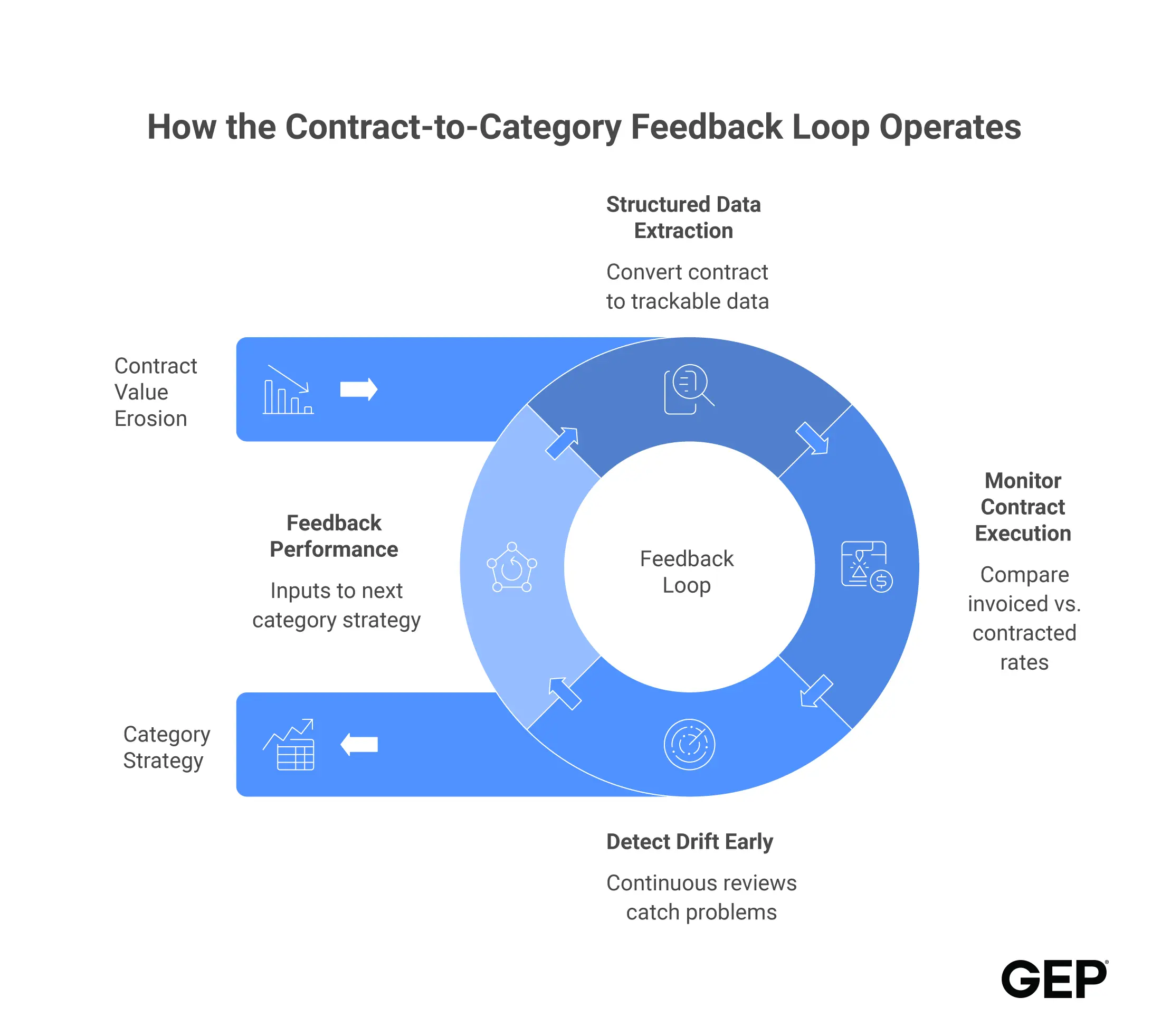
Start at Signature
The moment a contract closes, its terms should become structured, trackable data rather than a filed document. You extract obligations, entitlements, price tiers, rebate schedules, and service levels so the system knows exactly what the supplier committed to and what you are owed.
Watch the Execution
This is where value disappears. You compare invoiced prices against contracted rates, contract utilization against addressable spend, and actual buying against approved channels.
A category team can negotiate real savings, but those gains vanish if users buy elsewhere, if the supplier bills off-schedule, or if no one tracks the entitlement clauses. Roughly 9 to 11% of contract value erodes this way, almost all of it after the deal is signed. The culprit is usually the handoff.
Detect Drift Early
Annual audits arrive too late to fix anything. Continuous commercial assurance reviews pricing, volume tiers, service levels, and rebates on a steady cadence, catching problems before they compound across a full contract term.
Feed It Back
Performance signals, supplier reliability, and utilization patterns become direct inputs to the next category strategy. Weak categories get flagged for intervention. Reliable suppliers become consolidation candidates. Renewals get planned instead of missed. Then the cycle repeats, and each pass sharpens the strategy that follows.
Four Capabilities to Look for in a Contract Intelligence Platform
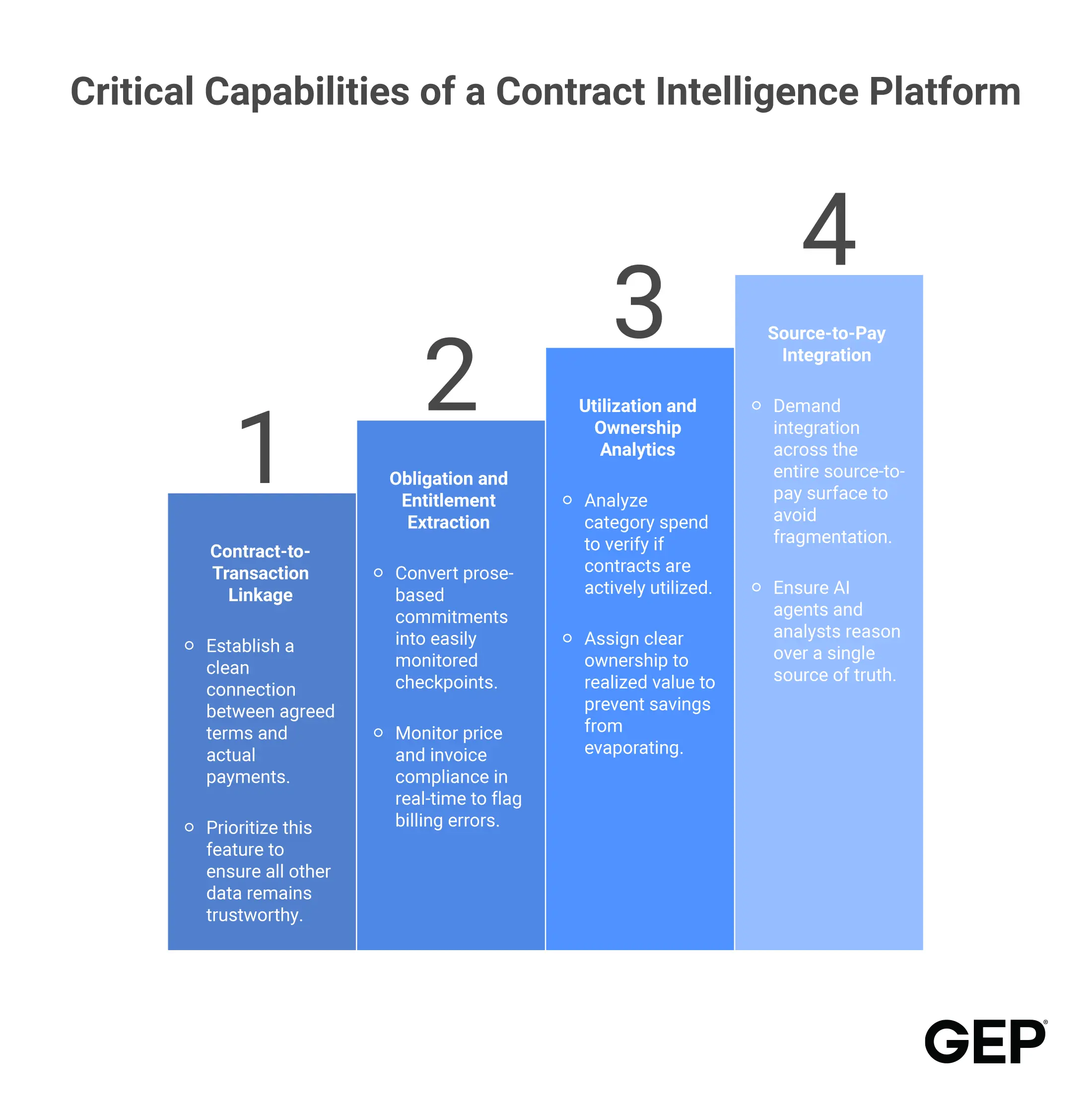
Contract-To-Transaction Linkage
It’s the single most important capability. Without a clean connection between what you agreed and what you actually paid, every other feature produces confident-looking numbers you cannot trust. Insist on it first.
Structured Obligation and Entitlement Extraction
Terms buried in prose cannot be tracked, so you need the ability to convert commitments into monitored checkpoints. Pair that with real-time price and invoice compliance monitoring, which flags the moment a supplier bills outside agreed terms rather than surfacing it in a year-end review.
Utilization Analytics Tied to Category Spend
This tells you whether contracts are actually being used or quietly bypassed. Clear ownership of post-award value matters just as much, and it is organizational, not technical. Assign a name to realized value, or it evaporates, because nameless savings always do.
Demand Integration Across Source-To-Pay
Fragmented systems produce fragmented answers. When your analysts and AI agents reason from a single source of truth spanning sourcing, contracts, suppliers, and spend, the loop actually closes. When they stitch together disconnected tools, it never does.
Not All AI Platforms Are Built Alike
Learn what separates AI-native procurement platforms from bolt-on solutions.
The Payoff? Three Returns Worth the Effort
The first return is margin protection. Recovering leakage on a large portfolio delivers savings that rival a fresh sourcing initiative, without the cost and disruption of running one. You keep the value you already earned.
The second return is better strategy. Category planning built on evidence beats planning built on memory and last year's assumptions. You see which suppliers perform, which categories drift, and which renewals to move on before the window closes.
Organizations with integrated contract systems report meaningfully fewer disputes and portfolio savings in the range of 7 to 12%, because visibility translates into leverage.
The third return is positioning. A function that closes the contract-to-category loop stops storing documents and starts creating commercial value. This changes how the business views procurement and the conversations you're invited to.
Turn Contract Data into Category Intelligence
See how AI keeps contract value active across every sourcing cycle
Where Agentic AI Takes This Next
Agentic AI moves you beyond once-a-year category strategy toward a nimble, continually refreshed capability.
AI agents read and monitor contracts across regions and categories, track obligations, flag deviations before value leaks, and aggregate spend, demand, and market data to recommend sourcing levers.
The loop runs continuously, refreshing itself while your team sleeps.
Leaders must treat contract implementation with the same seriousness as they give to negotiation and assign explicit ownership to realize value afterward. The technology will keep improving.
Ready to close the loop? Explore agentic AI-powered category intelligence.