



The Illusion of Control: Why Fragmented Procurement Systems Undermine Board Confidence
- Fragmented procurement platforms destroy operational value: duplicated vendors, missed contract renewals and shadow spend compound silently until they show up as missed targets.
- Lost negotiating leverage, missed early-payment discounts and supplier blind spots are direct consequences of disconnected platforms.
- Fragmented systems decrease boards’ confidence in procurement systems, leading to compliance risk exposure and decreased credibility.
April 24, 2026 | Procurement Software 5 minutes read
The dashboard is green. Spend reports went out on Friday. Everything looks fine, except the dashboard is pulling from a system that hasn't synced with the ERP in 36 hours, and the spend report was assembled manually from three sources that don't quite agree with each other.
This is what fragmented procurement systems look like from the inside: not chaos, but the convincing appearance of control. Genuine chaos demands attention. The illusion of control just quietly distorts data, eroding the confidence of every executive who has to rely on the numbers.
When More Tools Create Less Clarity
Most enterprise procurement environments become fragmented by iteration. A legacy ERP for purchase orders. A contract management tool added after a compliance audit. A supplier onboarding platform following a vendor risk incident. Tail spend still living in spreadsheets. Each decision made sense in isolation, but together, they've created a landscape where every system reflects a slice of the truth and no system reflects all of it.
The result is data distortion. When systems don't exchange information cleanly, spend categorization becomes inconsistent, approval records don't map to transaction records, and the same supplier appears under three different names depending on where you look. If the CFO needs a total spend figure for the board and the ERP, the contract system and the category trackers all return different numbers, that's not a data quality problem. It's a governance failure.
The Hidden Cost of System Sprawl
Start with negotiating leverage. In a fragmented environment, the same supplier frequently appears under multiple records across different systems. A business unit spending $2 million with a vendor and another spending $3 million in separate systems are both negotiating from a position of weakness. The leverage is there. The visibility to use it isn't.
Contract renewals and early-payment discounts tell the same story. When expiry dates live in a disconnected tool, auto-renewals trigger on unfavorable terms and volume commitments lapse unnoticed. Without real-time syncing between AP and procurement data, early-payment discount windows close before invoices clear approval.
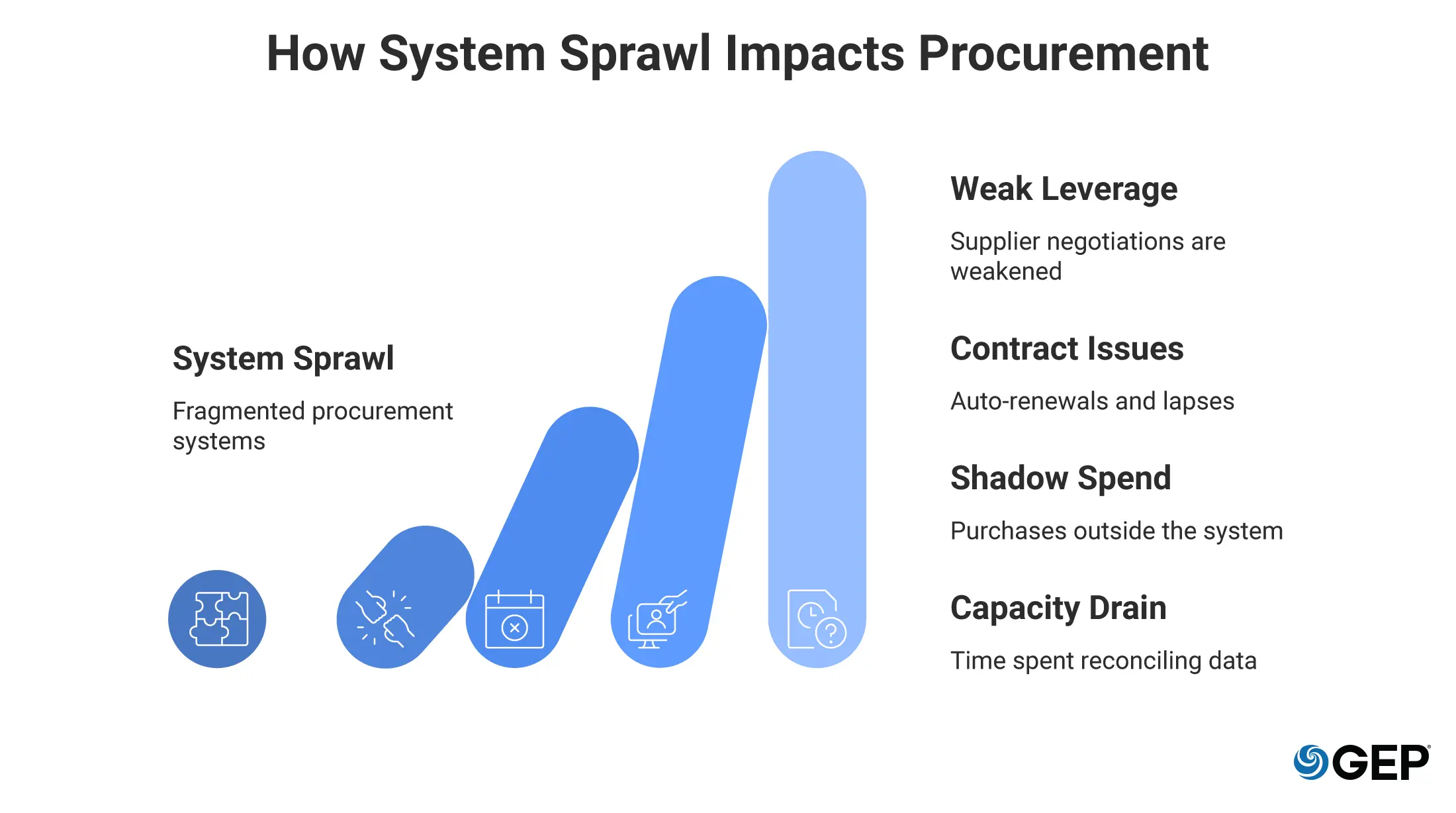
Shadow spend compounds all of it. Cumbersome systems incentivize employees to route purchases outside it, and those purchases are invisible to category managers, excluded from negotiations and untracked for compliance. Every hour spent reconciling data between platforms is an hour not spent on supplier strategy or risk modeling. Fragmentation doesn't just cost money directly; it consumes the organizational capacity that would otherwise generate competitive advantage.
Stop Managing Procurement Across Disconnected Systems
Talk to our experts about building unified procurement visibility across your organization
What Boards Actually See, And Why It Worries Them
Boards evaluate procurement through the lens of risk, performance and predictability. They notice when procurement leaders can't answer straightforward questions about total spend exposure, supplier concentrations, or savings performance authoritatively. And they draw conclusions not about the systems, but about the leadership.
When write-downs occur or savings targets are missed, the root cause is often a structural data problem: information that existed somewhere in the system landscape but was never synthesized into a decision-ready picture. Fragmented systems set procurement leaders up to absorb blame for structural failures they didn't design and can't easily fix.
The Compliance Gap You Can't See
Operational and strategic exposure are the primary costs of fragmentation. Compliance risk is their downstream consequence, and it's one organizations often don't discover until a regulator or auditor creates the occasion to look.
When an approver signs off in one system, the transaction posts in another and the required supplier certification lives in a third, no single record proves the process was followed correctly. Supply chain due diligence legislation in the EU and equivalent US frameworks are tightening those requirements, not relaxing them. The risk isn't only regulatory fines, it's telling a board or auditor that the business cannot reconstruct a procurement decision.
From Fragmentation to a Single Source of Truth
The solution to fragmentation isn't more technology. It's fewer systems, governed more rigorously. Unified procurement visibility means one environment where spend data, contract status, supplier risk profiles and approval records are visible together, updated in real time and accessible to finance and audit without manual compilation.
The capabilities required are integrated source-to-pay workflows, a unified data layer across categories and business units, automated policy checks embedded in the transaction process and reporting that speaks the language boards actually use. The short-term cost of migration is almost always lower than the long-term cost of managing fragmentation through workarounds, missed savings and reports that can't be fully trusted.
Is Your Procurement Stack Costing You Board Confidence?
See how AI-native source-to-pay platforms change the conversation at the top.
What Leadership Teams Need to Do Now
Start with a system landscape audit: map every tool in use across procurement and identify every point where data handoffs fail or require manual intervention. From there, establish clear data governance to define which system is authoritative for spend actuals, contract terms and the vendor master, and enforce that organizationally, not just technically.
Rebuild procurement reporting around the questions boards and CFOs are actually asking, on risk-adjusted spend exposure, savings realization and supplier concentration. The answers should be deliverable on demand, not assembled quarterly. And evaluate consolidation honestly; a unified platform requires an adjustment period, but it costs less than the compounding price of fragmentation.
Procurement leaders who want to command genuine board confidence need to close the gap between systems. That starts with acknowledging that more tools don't equal more visibility, and ends with the discipline to consolidate around a single authoritative source of truth.




FAQs
Without a single complete audit trail, organizations cannot demonstrate that procurement decisions followed policy — a problem that stays invisible day-to-day and becomes critical the moment an auditor asks for documentation.
When data is compiled manually from multiple systems, procurement leaders are forced to present numbers with caveats rather than confidence. Boards can interpret that as a leadership issue, not a technology one.
Shadow spend is purchasing that happens outside the managed system because the official platform creates too much friction; it's invisible to category managers, excluded from supplier negotiations and untracked for compliance.
It requires a single authoritative data layer, not just integrations between existing tools, where spend, contracts, supplier risk and approvals are consistent and current, supported by clear organizational governance over which system owns each data type.