


The Procurement Data Problem Agentic AI Will Expose
- Agentic AI delivers its greatest value when it can reason across clean, connected procurement data. The quality of your data determines the quality of its outcomes.
- Most enterprises have data quality gaps they have worked around for years. Agentic AI deployment is the moment to close them.
- You do not need perfect data to start. But a clear data readiness strategy is what separates organizations that capture AI’s full value from those that capture a fraction of it.
May 22, 2026 | Procurement Software 5 minutes read
Agentic AI is maybe the most powerful capability procurement has ever had access to. Intelligent agents can reason through context, orchestrate decisions across the source-to-pay process and act autonomously on behalf of your team. The efficiency gains are real. So is the competitive advantage for organizations that deploy it effectively.
That, however, starts with an honest look at your data. Agentic AI is not like a dashboard or a reporting tool that presents information for a human to interpret. It connects across your ERP, sourcing platform, contract repository and supplier portal simultaneously, using that data to reason and act. The richer and more reliable that data foundation, the more your AI agents can do.
For many organizations, this is the moment to get serious about procurement data quality. Not as a blocker to AI adoption, but as the investment that determines how much value AI actually delivers.
Ready to Build an AI-Ready Procurement Foundation?
Talk to our experts about the data strategy your agentic AI initiative requires
What Agentic AI Actually Needs From Your Data
To understand the data requirements, it helps to understand how agentic AI works differently from the tools that came before it.
Traditional procurement automation follows predetermined rules against structured inputs. Agentic AI is more sophisticated: it perceives context, reasons across multiple data sources and takes multi-step actions to achieve a defined outcome.
A 2025 MIT Sloan analysis found that 80% of the work involved in deploying AI agents effectively was spent on data engineering, governance and workflow integration. The investment in data infrastructure is not a tax on AI adoption. It is the foundation that makes everything the AI does more accurate, more autonomous and more valuable. and more valuable.
This is why Gartner’s 2025 Hype Cycle for Artificial Intelligence positioned “AI agents” and “AI-ready data” as the two fastest-advancing and most inseparable technologies of the year. One without the other delivers a fraction of the potential. positioned “AI agents” and “AI-ready data” as the two fastest-advancing and most inseparable technologies of the year. One without the other delivers a fraction of the potential.
The Four Data Foundations That Unlock AI Performance
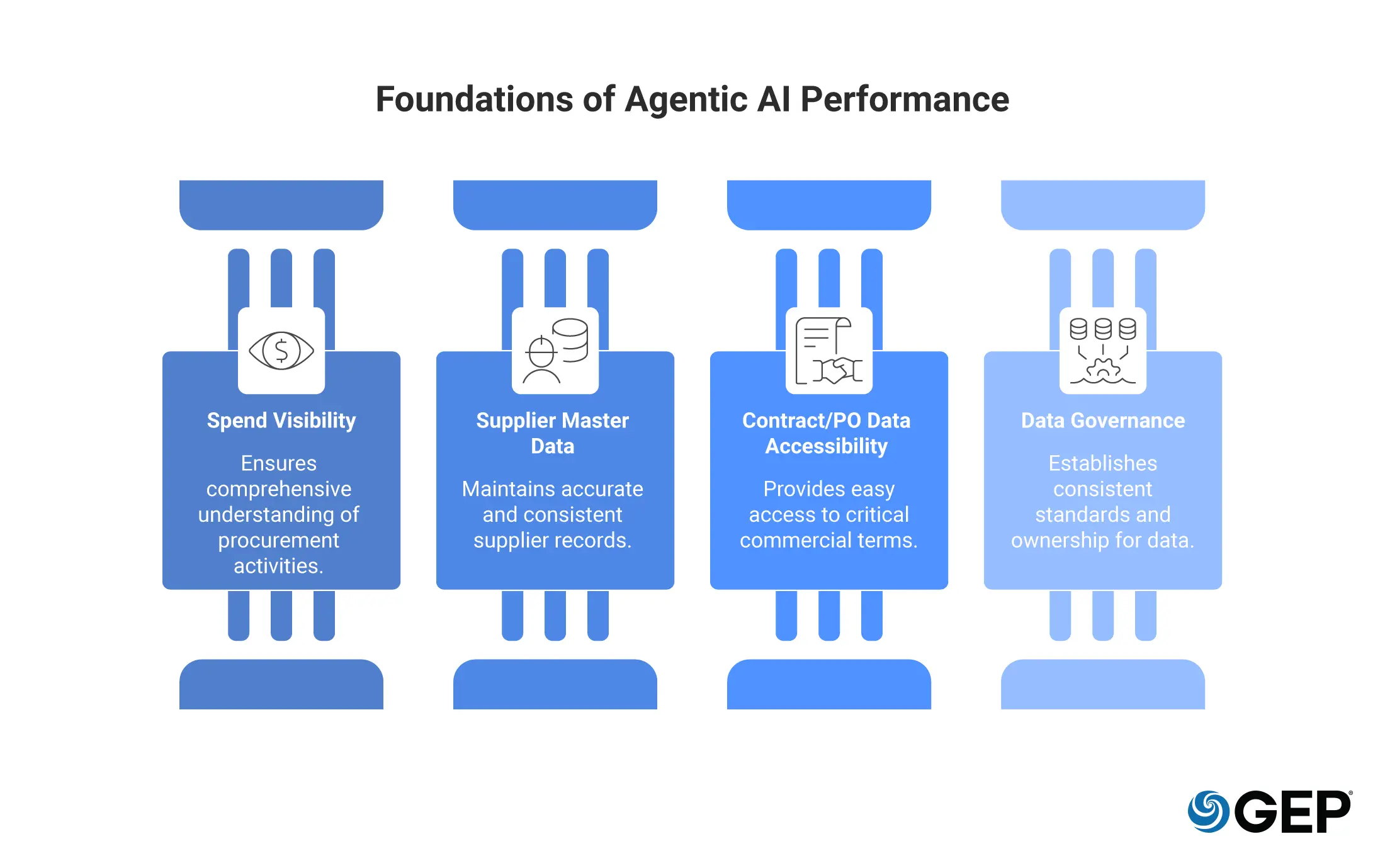
Agentic AI performs best when it can reason across a complete, consistent and connected data environment. There are four specific areas where data quality directly determines what your agents can accomplish.
Spend Visibility
Agentic AI optimizes sourcing, identifies savings opportunities and models risk across your supply base. To do that well, it needs to see your full spend picture. Many procurement organizations, however, lack full visibility into spend, with data siloed across ERPs, P-card systems and sourcing tools. Closing that visibility gap is what allows AI agents to optimize across categories rather than within them.
Supplier Master Data
AI agents cross-reference supplier records for sourcing, risk assessment and payment. Those records need to be clean and consistent. Duplicate entries and inconsistent naming conventions limit an agent's ability to build an accurate picture of any given supplier relationship. The more reliable your vendor master, the more confidently your agents can act.
Contract and PO Data Accessibility
Critical commercial terms often live in PDF contracts and purchase order attachments rather than structured ERP fields. When agents can access and read that information, they can validate compliance, flag discrepancies and act on the full context of a commercial relationship.
Data Governance
AI agents operate across functions and systems simultaneously. When spend is categorized consistently, ownership is clear and standards are shared across finance and procurement, agents can reason and act with confidence. Strong governance is what allows AI to scale beyond a single use case or category.
Data Readiness Is a Multiplier, Not a Prerequisite
Data readiness isn’t a gate you must pass through before AI deployment. It’s a multiplier that compounds the value of everything your agents do.
The practical approach is to first deploy AI where your data is strongest and use that deployment to build both confidence and momentum. APQC research cited by Art of Procurement found that 8 in 10 organizations implementing AI in procurement saw improved data quality as a result.
Agents running in well-defined domains actively help remediate the data they use, through deduplication, categorization and gap-filling. Data improvement and AI deployment are most effective when they run in parallel.
Focus initial efforts on the 20% of data that drives 80% of procurement decisions: supplier names, spend categories and contract references. Establish clear ownership for each. Define what agents can act on autonomously and what requires human sign-off. That framework is not a constraint on AI capability; it’s the governance structure that allows you to expand AI’s scope with confidence over time.
Deploying Agentic AI? Avoid These Top 3 Pitfalls
Learn what leaders must address before agentic AI can operate at scale
Where to Start: A 90-Day Data Readiness Diagnostic
A practical starting point is a rapid diagnostic across three dimensions:
Visibility: Can you see 80% or more of your spend across all systems?
Accuracy: How many duplicate or inconsistent records exist in your supplier master?
Accessibility: Is contract and PO data structured and machine-readable, or locked in documents your systems have never parsed?
Those three answers will tell you which AI use cases are ready to deploy now and where foundational data work will expand what becomes possible. The organizations capturing the most value are the ones treating data readiness as a strategic investment alongside their AI initiative, not as an afterthought that follows it.
Agentic AI is a genuine step change for procurement, but organizations need to move with a clear-eyed view of what their AI needs to perform, and the commitment to build that foundation alongside it.




FAQs
Agentic AI performs best with structured and consistent data across the source-to-pay process, including clean supplier records, accurately categorized spend and accessible contract metadata. The more connected and reliable that foundation, the more autonomously and accurately agents can act.
Assess three dimensions: spend visibility across all systems, accuracy of your supplier master data and accessibility of contract and PO data. Those answers tell you where to start and which use cases to prioritize.
Yes. APQC research found 8 in 10 organizations saw improved data quality after AI implementation, as agents perform deduplication, categorization and gap-filling during normal operation.
No. Deploy in domains where your data is strongest first and use those results to build momentum. Data improvement and AI deployment are most effective when they run in parallel, not in sequence.