



Why Context-Aware Procurement Orchestration Needs Enterprise Knowledge Structures
- Your AI is only as capable as the knowledge architecture beneath it.
- A knowledge layer where procurement data is not just stored but organized around the relationships that drive procurement judgment.
- Effective orchestration applies specialized reasoning to each procurement domain, coordinated through a common orchestration layer.
July 08, 2026 | Procurement Strategy 5 minutes read
Preventing hallucinations is the hardest part of deploying agentic AI at scale in procurement. The risk is confidence without context: a response that sounds right but is too generic to drive a real decision. Enterprise knowledge structures are how procurement teams close that gap.
Agentic AI does not run on data alone. It runs on knowledge, and that knowledge has to be structured, contextualized, governed, and continuously evolved. Most teams judge orchestration platforms by interface and routing speed, and overlook the knowledge layer, which is most important for making sound decisions.
This article explains what enterprise knowledge structures are, why context-aware orchestration depends on them, and what procurement leaders must build toward.
How Do Enterprise Knowledge Structures Enable Context-Aware Orchestration
Enterprise knowledge structures organize procurement information into meaningful relationships. They connect suppliers, contracts, categories, transactions, and policies by how those records relate to one another, rather than holding each one in isolation.
This lets a platform identify relevant connections and bring the right context into the decision-making process. A knowledge structure holds those relationships so the platform can retrieve and reason across them when a request arrives.
Context decides what a request means. This matters because a language model, when left alone, answers from patterns in words.
Ask it to source a supplier, and it can produce something that reads well but knows nothing about your approved vendors, your contract terms, or your category rules. That is the confidence-without-context problem.
The value comes not just from knowing that a contract exists or that a supplier is approved, but from understanding how those facts connect to category strategy, historical activity, commercial obligations, and business objectives.
How Does Intake and Orchestration Guide Better Choices?
See how intelligent orchestration supports procurement judgment
How Do Enterprise Knowledge Structures Work in Agentic Procurement Orchestration?
A knowledge structure gives the AI a real map to check through before it acts. So, its reasoning stays anchored to your actual commitments, not generic plausibility. The map only helps if the platform knows how to read it.
The common challenge is that critical procurement information rarely resides in a single place. Enterprise knowledge structures overcome this by connecting those records. Once these relationships are structured, the platform can retrieve and reason across them, which is exactly what context-aware orchestration requires.
The mechanism works in 4 stages.
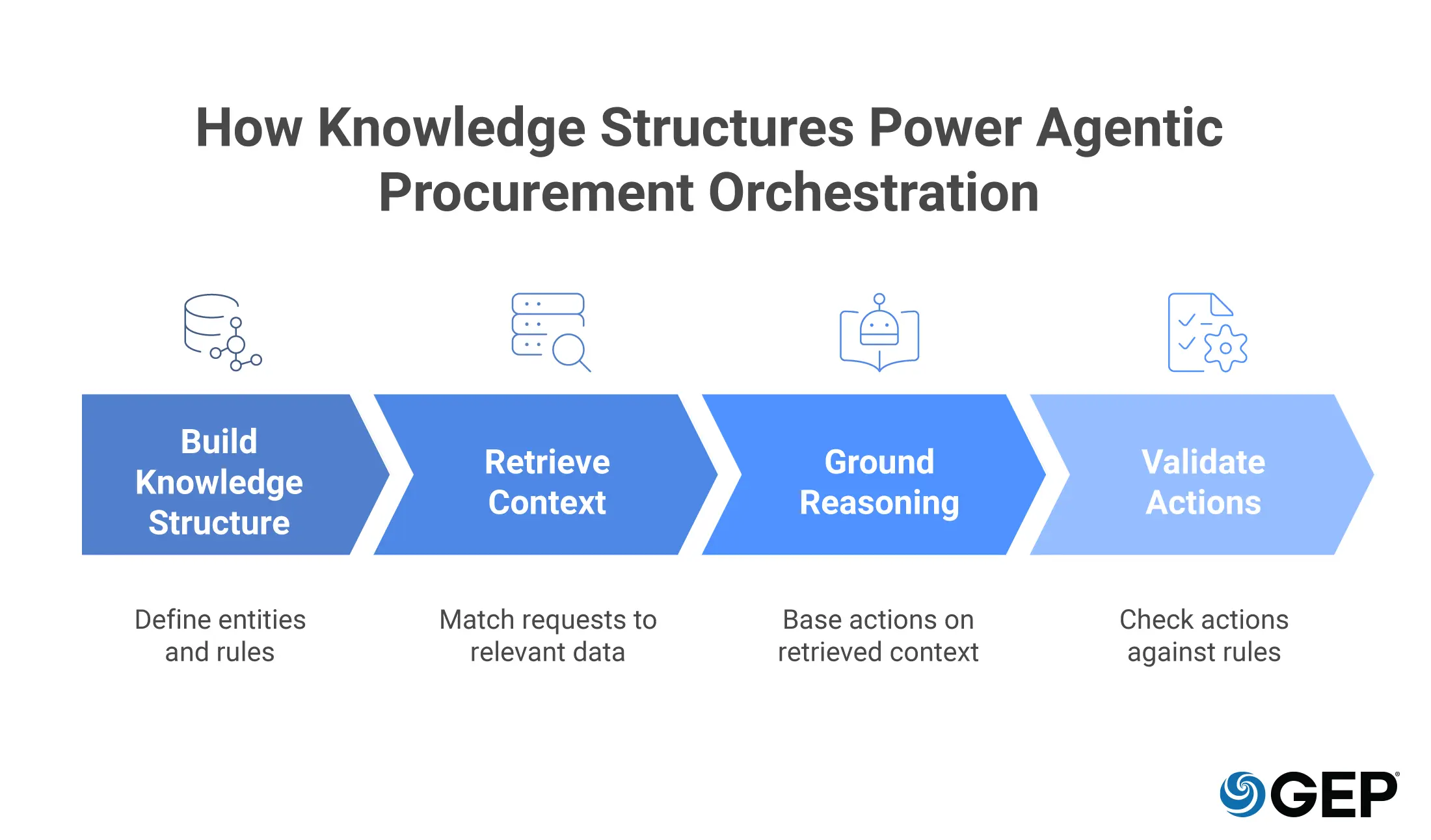
First, map procurement entities, relationships, and business rules: supplier hierarchies, category taxonomies, contract-to-category links, organizational structures, and the business rules that govern them.
A supplier may be part of a parent company. A contract may carry multiple amendments. A category may have preferred suppliers, negotiated terms, and specific risk rules. These relationships are defined, not inferred.
Second, when a request arrives, the platform resolves it to the right entities, even when the user does not know the correct terminology. It then retrieves connected context rather than a single record, like prior sourcing events, related contracts, supplier information, category strategies, benchmarks, and current business rules.
Third, the platform grounds its reasoning in the retrieved context before it recommends or acts, rather than generating from language alone.
Fourth, it validates the proposed action against the procurement structure and business rules. And critically, it can explain why that recommendation was made. This is the distinction between a platform that moves work and a platform that governs decisions.
Can Your Procurement Platform Think in Context?
Ground procurement decisions with connected knowledge and domain expertise
Building the Knowledge Foundation Before You Scale AI
Agentic AI will get better at interpreting requests and moving work across the source-to-pay process. But the platforms that improve decisions, not just route tasks, will be the ones grounded in connected procurement knowledge.
To reach this point, procurement leaders need three things in place:
- Connected data across the systems where suppliers, contracts, transactions, and policies live
- Defined relationships and taxonomies that capture how those records relate
- Governed business rules that are continuously maintained
This is the knowledge architecture that leaders must build toward. Without it, AI has nothing to ground against, and its output defaults to plausible rather than correct.
Our latest whitepaper, Why Domain Expertise Is an Essential Capability for Agentic Procurement Orchestration, examines how connected knowledge and domain expertise drive better decisions through agentic orchestration. Access it to see what procurement intelligence looks like in practice.




FAQ
A database stores records, and a warehouse aggregates them for reporting, but both treat entities as rows for querying. An enterprise knowledge structure stores the relationships between entities as first-class data: a supplier's link to its contracts, a contract's coverage across categories, a category's governing rules. The difference is queryable connections versus stored facts. A warehouse can tell you a contract exists; a knowledge structure lets a platform traverse what that contract touches and reason across it.
RAG retrieves passages that resemble the query, which works for finding text but not for reasoning over relationships. It can surface a contract that mentions a supplier; it cannot reliably tell you that the supplier rolls up to a parent company you've sanctioned elsewhere, or that the contract's category carries a rule the request violates. Those answers require defined connections, not semantic similarity. In practice, the two are complementary: a knowledge structure supplies the relationships and governance, and retrieval helps locate unstructured detail within them.
Start with the entities that carry the most decision weight and the most cross-system links, usually suppliers and contracts, since nearly every procurement decision traces back to them. Map their core relationships first: supplier-to-contract, contract-to-category, supplier hierarchies and parent-company links. Add transactional and policy data once those connections hold. Trying to model everything at once tends to stall; a working spine across a few high-value domains delivers usable grounding sooner.
Those systems are authoritative within their own boundaries, but each one knows only its own records. The ERP holds transactions, the repository holds contracts, and neither maps how a sourcing event relates to a contract that relates to a category strategy. Grounding fails at exactly those crossings, which is where most procurement judgment actually happens. A knowledge structure does not replace those systems; it connects them so the agent can reason across the boundaries they each stop at.
This is a strength of the approach, not a cost. Because the structure makes relationships explicit, the platform can show which entities, contracts and rules it pulled and why a recommendation followed from them, rather than producing an answer with no traceable basis. That matters for the parts of procurement that demand predictable, auditable execution, such as approvals and three-way matching. The structure also lets the platform enforce fixed workflows where compliance requires it, while reasoning more flexibly where judgment is needed.